Rugs
Entryway Rug Ideas Made Easy [+ Style Tips]
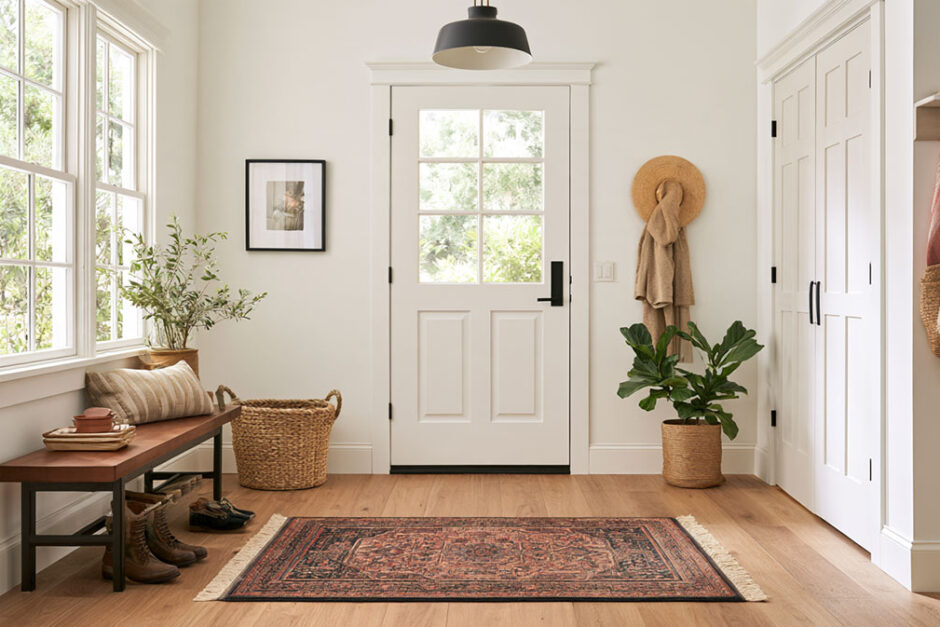
I’ve replaced more entry rugs because of the front door than because of how they looked. The door scraped the pile every morning, or the rug crept forward until it bunched against the threshold. Color never came into it.
So the door gets checked first. Vintage-wash runners, a doormat layered over a flatweave, round rugs for square foyers and bound jute all work at an entry, as long as they’re sized right and the fiber can take wet shoes.
No other rug in the house gets walked on this much. It sits on the main path, usually over hardwood, tile or luxury vinyl, and it gets grit, rain and snow most of the year.
Inspiration photos almost never show the one measurement that matters. The rug has to sit outside the door’s full swing and stay thinner than the gap under the door, which means pile height and rug pad thickness count for as much as the pattern does.
Entryway Rug Ideas That Hold Up to Daily Traffic
Everything below hides grit reasonably well and cleans up without much fuss. Pick a low enough pile and it’ll clear a standard door too.
Vintage-Wash Runners
If your entry is busy, start here. A faded, overdyed or distressed runner already looks a bit worn, so a week of sneakers barely shows.
- Amber Lewis x Loloi built collections on this look, including Molly, Morgan and Georgie, with faded patterns meant to read as vintage
- Revival Rugs sells one-of-a-kind vintage Turkish runners, if you’d rather have the real thing than a printed copy
- The printed versions cost less and run thinner (good news for door clearance)
Go low pile. Thick vintage-look rugs hold sand down at the base of the fibers, and they catch the door.
A Doormat Layered Over a Flatweave
Most of the dirt in a house walks in on shoes. The International Sanitary Supply Association puts it at 70 to 80 percent of the dust and dirt inside buildings.
Commercial buildings deal with this by using zones. A coarse scraper mat takes the mud, and a softer surface after it dries and wipes the sole.
You can copy that at home in a few feet of floor. Put a coir doormat on top and a washable flatweave underneath it. LEED guidelines call for entry matting at least 10 feet long, and trade guidance often attributed to the Carpet and Rug Institute puts 10 to 15 feet of matting at capturing 85 to 95 percent of contaminants. Hardly any house has that much runway, so two layers is the version that actually fits.
Round Rugs for Square or Arched Entries
A round rug looks right in a square foyer, under an arched doorway or beneath a round pedestal table sitting in the middle of the entry.
Narrow halls are another story. The circle leaves empty corners on both sides and makes a tight corridor look even tighter.
It also takes the edge off a foyer that’s all hard lines, with stair rails and door frames and square tile everywhere. Keep the rug clearly smaller than the table above it or clearly bigger than its footprint. Almost the same size just looks off.
Two Rugs in a Long Entry
One rug rarely covers a long entry well. Two usually do.
Put something dark and tough at the door to take the dirt, then a nicer rug farther in where shoes are already dry. Domino’s editors showed a related idea in a light-filled entry, layering a cream Turkish rug with a simple woven rug that has hand-tied fringe, and advised that two entryway rugs beat one.
Have the two share something, a color or the pile height, or even just the border width. It’s the same principle as keeping a room visually unified. Shared details, different jobs.
Striped Runners That Correct Proportions
Stripes change how a hallway reads, as Homes and Gardens points out.
- Run them across the width and a long, skinny hall feels wider
- Lengthwise stripes pull your eye down to the far end
Direction matters more than color here, which is basic use of line in a room. Flatwoven cotton or wool stripes stay thin enough for most doors.
Jute With a Bound Border
Jute gives you a lot of texture for not much money. Plain jute frays at the edges near a door, though, and that gets ugly fast.
A bound border fixes it. That’s cotton or linen tape (sometimes leather) stitched around the edge, and it makes the rug look finished. West Elm’s Bordered Jute Rug, an olive rug with a contrasting beige border, is one example of a jute rug with a defined edge.
Keep jute away from doors that let in rain. The materials section below explains why.
What Size Should an Entryway Rug Be?
Revival Rugs’ entryway size guide goes by layout rather than one standard number. Small entries take a 2×3 or 3×5, hallways take a runner 2 to 3 feet wide and 6 to 10 feet long, and open foyers take a 5×7 up to a 6×9.
| Entry layout | Typical size | Shape | Watch for |
|---|---|---|---|
| Small or apartment entry | 2×3 or 3×5 | Rectangle | Door swing |
| Narrow hallway | 2-3 ft wide, 6-10 ft long | Runner | Wall gap on both sides |
| Square foyer | 5 to 6 ft across | Round | Table footprint |
| Large foyer or double doors | 5×8 or 6×9 | Rectangle | Centering on the doors |
How Much Floor Should Show
Sources disagree on the border. Revival Rugs suggests 6 to 18 inches of exposed floor around the rug, while Atlanta Designer Rugs’ 2026 guide puts it at 4 to 6 inches from the walls.
Honestly, both are right for different rooms. A tight hall can’t give up 18 inches per side, and a big foyer with only 4 inches showing starts to look like wall-to-wall carpet.
Keep the border even all the way around, and let it grow as the entry gets bigger. That’s about as much of a rule as I’d follow.
Orientation and Furniture
In a wide, shallow foyer, run the long side of the rug parallel to the door. In a deep, narrow one, run it toward the house.
With a console table or a bench in the entry, the rug should either sit fully in front of the piece or slide under its front legs. Stopping a few inches short of the furniture looks like a mistake, because it is one.
Most sizing problems are really scale and proportion problems. Think of a 2×3 floating in a 10-foot foyer, or a 6×9 jammed into a hall. Run your entry measurements through a rug size calculator before you shop and you’ll probably skip a return.
How to Place an Entryway Rug So the Door Clears It
Measure the door before the floor. The rug needs to stay out of the door’s full swing and lower than the gap under it.
- Measure the gap under the door. Close the door and measure from the floor to the bottom edge. The rug and pad together have to be thinner than that.
- Open the door all the way. Mark where its edge travels on the floor with painter’s tape.
- Add a buffer. Keep the rug edge at least 2 inches beyond the fully open arc, per Atlanta Designer Rugs (2026).
- Tape out the rug. Mark the rug’s full outline on the floor and walk through it a few times with shoes and bags.
- Center on the traffic path. Wayfair’s size guide calls the foot traffic pattern from the front door the most important placement factor.
Pile height catches a lot of people. The Chris Loves Julia x Loloi Scottie wool rug, for example, has a 0.9-inch pile. Lovely in a living room. Too tall for plenty of front doors.
If the door scrapes the rug even once, size down or move it back. The pile won’t flatten out the way you’re hoping.
What Is the Best Material for an Entryway Rug?
For most indoor entries I’d go with wool. In a wet climate, or with a dog that loves mud, polypropylene makes more sense. Sisal looks great and handles moisture worse than anything else on the list.
| Material | Durability | Moisture | Cleaning | Best for |
|---|---|---|---|---|
| Wool | High, springs back | Repels spills at first | Vacuum, blot spills | Most indoor entries |
| Polypropylene | High | Water resistant | Hose off or scrub | Rain, snow, pets |
| Nylon | Very high | Good | Spot clean | Heavy traffic |
| Jute | Medium, sheds | Poor | Vacuum, blot spills, don’t soak | Dry, covered entries |
| Sisal | High | Poor, stains | Vacuum, keep water to a minimum | Low-moisture entries |
| Cotton flatweave | Low to medium | Absorbs | Often machine-washable | Layering, small rugs |
Wool
Wool fibers carry lanolin, a natural wax that makes spills bead up long enough to blot them, according to Loloi’s own fiber guide.
It has downsides, and Loloi admits them. Wool fades faster than synthetics in direct sun, and a new wool rug sheds for a while.
Jute and Sisal
They look alike in photos. At a wet door they behave very differently.
Jute is soft and cheap. It sheds, and it flattens out along the main walking path.
Sisal is tougher and stiffer, which sounds like the better deal until it gets wet. Rug cleaner Bane-Clene warns that it browns and water-stains badly if it gets soaked, and it should never be exposed to rain.
Snow melting off boots counts as soaked. For a covered entry where shoes come in dry, either one is fine, and the texture natural fibers add is hard to fake with synthetics.
Synthetics: Polypropylene, Nylon, Polyester
Polypropylene is the indoor outdoor fiber. Water doesn’t bother it, which is why brands like Dash and Albert use it for rugs you can hose down.
It’s cheap, colorfast and easy to scrub. The flip side is a flatter feel underfoot, and some of them look plasticky. Under heavy traffic it also crushes over time.
Nylon is the most durable of the three and shows up a lot in performance rugs. Polyester feels soft but mats down faster in a main walkway.
Patterns and Colors That Hide Dirt
Solid cream shows every footprint. Solid black or navy shows every bit of lint, sand and pet hair. Mid-tone, multicolor patterns hide dirt best, and it isn’t close.
The real trick is matching the rug to what actually comes through your door. Gray road salt disappears into a different color than golden retriever fur does.
- Traditional Persian and Turkish Oushak layouts with lots of small motifs
- Heathered or abrashed (uneven dye) grounds
- Distressed and vintage-wash finishes
- Small-scale geometrics in two or three mid tones
Busy doesn’t have to mean loud. A pattern can be quiet in color and still break up the surface enough that a muddy print vanishes. That’s the practical side of how pattern works in a room.
In a small entry, keep the motif small and the palette tight. A big medallion on a 2×3 gets cut off at the edges and ends up looking like a remnant.
Floor color matters too. A rug a few shades off the floor looks intentional, and the right rug color for dark wood floors is usually a warm mid tone, not a dark one that disappears into the boards.
Pull one color from the front door or the wall paint. That ties the rug to the entry without everything matching.
Are Washable and Indoor Outdoor Rugs Worth It?
With pets, kids or real weather, yes. Just check your washer first, because capacity requirements change by brand and rug size.
Dash and Albert’s care instructions say its washable rugs 5×8 and smaller go in a 4.2 cubic foot or larger washer, while 6×9 and 8×10 should be spot cleaned or sent to an extra-large commercial machine.
Ruggable does it differently with a two-piece system. Only the top cover goes in the washer, and Ruggable’s support page states the rug pad underneath is spot-clean only.
Entry sizes are easy on the machine anyway. Ruggable lists its flatwoven 2×3, 3×5 and 2.5-foot runners at a 2.2 cubic foot minimum washer size, which most home washers meet.
Washable rugs
The big win is a full reset after a muddy week instead of endless spot cleaning. Polyester versions usually skip the shedding phase, too.
They’re thin and flat, though, so they feel less substantial underfoot. The rug plus its pad also adds height under the door. And line drying a runner takes space and most of a day, which nobody mentions in the ads.
Indoor outdoor rugs
You can hose these off outside and leave them in the sun. Polypropylene handles melting snow without staining.
Inside the house they feel stiffer and a bit slick. Cheaper ones look like plastic up close.
For a back door or mudroom, I’d pick indoor outdoor every time. For the front entry that guests see, a washable rug with a printed vintage look is the better compromise.
How to Keep an Entryway Rug From Sliding
Use a thin rug pad cut slightly smaller than the rug, in a material your floor can tolerate.
Small entry rugs slide more than big living room rugs. They’re light, and people step on them at an angle every time the door opens. So the pad isn’t optional here.
Picking the Pad
Felt and rubber pads grip well and add cushion, but they also add height, so check one against the gap under your door before buying.
A thin rubber or PVC grid sits lowest and gives you the least cushion. It’s the usual choice for a flatweave at a front door.
If the floor is luxury vinyl plank, look for EVA or pads labeled vinyl-safe. Some rubber backings and dyes discolor LVP.
Trim the pad so its edges stay hidden under the rug. An exposed pad edge is a trip hazard on its own.
Rubber Backing and Vinyl Floors
Rubber backing and dyes can discolor vinyl floors. Tarkett’s 2023 luxury vinyl consumer protection plan specifically excludes damage from rubber backing or dyes used in floor mats, rugs and carpets. Its care guide points to undyed natural rubber pads and non-staining latex-backed entry mats instead.
That applies to rubber-backed doormats too, not only pads. With LVP or sheet vinyl in the entry, read the flooring maker’s care guide before putting anything rubber on it.
Hardwood finishes can react to some cheap PVC pads over time as well. On finished wood, a felt-backed or labeled floor-safe pad is the safer default.
Curled Edges
Curling corners are the most common trip hazard at an entry.
- Reverse-roll the rug for a day
- Use rug corner grippers on flatweaves
If the backing has started to crack, stop fighting it and replace the rug.
When an Entryway Rug Idea Does Not Work
Some popular choices fail at the front door almost every time. Living room logic doesn’t hold up against wet shoes and a door swinging over the rug all day.
| Choice | Why it fails at the door | Use instead |
|---|---|---|
| Shaggy Moroccan Beni Ourain | Door drag, traps sand deep in the pile | Low-pile wool or a flatweave |
| Sisal in a wet climate | Water spots and browning from boots | Polypropylene or wool |
| Solid cream or white | Shows every footprint within days | Mid-tone pattern |
| Long fringe | Catches the door, vacuums and paws | Bound or serged edges |
The Wrong Size for the Room
A rug that’s too big ends up inside the door arc. It gets shoved, folded over and scuffed every time someone comes in.
Go too small and you get a doormat-sized rug floating in a large foyer like it fell there, with most of the walking path still bare.
Wet Boots Parked on the Rug
No rug survives being used as a boot tray. Snow melting for hours soaks through to the pad and the floor underneath.
Give boots a hard spot of their own, like a tray or a bench with a shelf below. There are plenty of shoe storage ideas that fit beside an entry rug without crowding it.
A Rug Doing a Doormat’s Job
A decorative rug isn’t a scraper. Without a mat outside or right at the threshold, grit grinds into the fibers and wears a path through them.
Coarse mat first, nice rug second. Always.
Entryway Rug FAQ
Do you need a rug in the entryway at all?
No, but bare floors at the door wear fastest. Grit on shoe soles scratches hardwood and dulls vinyl finishes right where people stop to take their shoes off.
A rug also cuts the echo in a hard-surfaced foyer and gives wet shoes somewhere to land.
Should the doormat go inside or outside the front door?
Both, ideally. A coarse coir or rubber mat outside scrapes off mud before it reaches the threshold.
Inside, a softer rug catches what’s left and dries the soles. With room for only one, put it outside on a covered porch and inside on an open stoop.
How much does a good entryway rug cost?
Size and fiber drive most of the price. A small polyester washable rug or a printed flatweave sits at the low end.
Hand-knotted wool and true vintage runners cost several times more. Set aside money for a rug pad too. A cheap rug that slides is worse than no rug.
How often should you clean or rotate an entryway rug?
Vacuum weekly, more often in wet or snowy months. Grit does the damage, so getting it out matters more than shampooing.
Rotate the rug every few months so the walking path doesn’t wear a visible lane down one side.
Does the entryway rug need to match the rug in the next room?
No. Sharing one thing is enough, whether that’s a color, the pile height or the general style.
In an open floor plan where you see both at once, let one rug carry the pattern and keep the other quieter.
Can you put a rug on top of carpet in an entryway?
Yes. A low-pile or flatweave rug over wall-to-wall carpet protects the spot that collects the most dirt.
Use a carpet-to-rug pad, not a hard-floor pad. Otherwise the rug creeps across the carpet and bunches up.
What kind of entryway rug works best with dogs?
Look for a low, tight weave in a mid-tone pattern. Loops and long pile snag claws, and solid colors show fur fast.
Machine-washable polyester or polypropylene handles muddy paws best. Skip sisal, which stains when wet, and skip fringe, because dogs chew it.
Which Entryway Rug to Buy First
Buy the outdoor scraper mat before anything else. After that, a thin rug pad that suits your floor, and then a low-pile, mid-tone washable or wool rug sized to clear the door. Style upgrades can wait until the rug has made it through one wet season.
The order protects the more expensive piece. A rug bought before the mat ends up absorbing the grit the mat should have caught.
If you’re leaning washable, check the washer first. Ruggable’s small runners fit a 2.2 cubic foot machine while Dash and Albert asks for 4.2 or more, so washer capacity can decide the brand before color does.
You do give something up either way. Washable rugs stay thin, and wool costs more to replace. Care specs here were checked in October 2026.
Once the entry is sorted, the same sizing logic carries into rug ideas for the living room.

- Entryway Rug Ideas Made Easy [+ Style Tips] - November 25, 2026
- Japandi Bathroom: Is It the Spa Style You Need? - November 22, 2026
- White Dove vs Alabaster [Complete Breakdown] - November 16, 2026