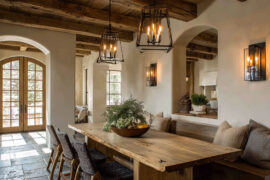
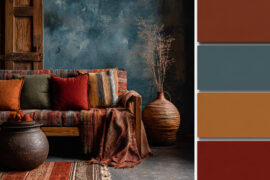
Raw wood. Polished brass. Linen that looks lived-in. Rustic chic decor is one of the few styles that gets better the more you layer it.
It sits between pure rustic and refined contemporary, borrowing natural materials from one and intentional polish from the other. Pinterest searches for rustic Vintage Americana spiked 145% in 2024 alone.
Getting it right requires more than buying reclaimed wood furniture. You need to understand the contrast principle, the right color palette, and where the style ends and farmhouse begins.
This guide covers everything: core elements, color, furniture, texture, lighting, wall treatments, room-by-room application, sourcing, and the 5 mistakes that quietly ruin most attempts at this style.
What Is Rustic Chic Decor?
Rustic chic decor is a style that pairs raw, natural materials with refined, polished finishes. Think a weathered reclaimed wood dining table set against linen upholstered chairs, or exposed stone walls softened by aged brass pendant lighting.
It is not purely rustic. It is not purely glam. The style sits exactly between them, and that tension is the whole point.
The rustic side brings texture, imperfection, and organic warmth. The chic side brings intention, restraint, and refinement. Neither element overwhelms the other.
Pinterest reported a 310% increase in searches for Western-influenced rustic bedding in 2024, and Vintage Americana searches spiked by 145% (Goodhomes Magazine, 2024). Rustic chic is clearly not a niche taste.
Between May 2024 and April 2025, around 521,500 global searches were made for vintage interiors, a 13.59% increase from the previous year (Level Frames, 2025). The appetite for natural, layered, story-driven spaces keeps growing.
The style has roots in French country design and American barn conversion aesthetics, both of which balance utilitarian origins with a layer of polish. It overlaps with wabi-sabi in its acceptance of imperfection, though rustic chic is considerably more curated.
One useful distinction: rustic chic differs from farmhouse interior design in that farmhouse prioritizes function and practicality. Rustic chic prioritizes layered refinement. The two share materials but not the same visual goal.
What Are the Core Elements of Rustic Chic Decor?

Rustic chic decor has 5 non-negotiable building blocks. Remove any one of them and the space tips either too rough or too precious.
- Raw natural materials: reclaimed wood, stone, linen, jute, raw iron
- The contrast principle: every distressed surface needs a refined counterpart
- A neutral base palette with warm undertones, never cool-toned or stark
- Layered lighting across at least 3 sources: ambient, accent, and natural
- A deliberate mix of organic shapes and structured silhouettes
Interior design professionals report that 62% of high-end residential projects in 2023 incorporated reclaimed wood elements specifically to create distinctive design statements (Market Data Forecast, 2024).
The role of texture in this style cannot be overstated. Layering rough, soft, and reflective surfaces in the same space is what gives rustic chic its depth. A stone fireplace, a linen sofa, and a brushed brass mirror in the same room work because each surface reads differently under light.
Natural Materials That Define the Style
Reclaimed wood is the anchor material. It brings grain variation, history, and warmth that newly milled timber cannot replicate.
Stone (travertine, slate, raw granite) works as a grounding element on floors, fireplace surrounds, and accent walls.
Iron and aged brass serve as the metal layer. Raw iron reads rougher and more industrial. Aged brass reads warmer and more refined. Both fit within the style. Polished chrome does not.
Linen, jute, and cotton make up the textile layer. These natural fiber textiles handle the softness that raw materials cannot provide.
The Contrast Principle in Rustic Chic
The contrast principle is the rule that separates rustic chic from pure rustic decor. Every rough element needs a polished counterpart in the same room.
A reclaimed wood coffee table works with a clean-lined linen sofa. Exposed brick works with a refined upholstered chair. A distressed wood floor works with a sleek, matte-finish pendant light. Without the polish, the space reads as a cabin. Without the rough, it reads as generic contemporary.
This is the same tension that contrast in interior design creates across all styles, but rustic chic applies it specifically through material texture rather than color opposition.
What Color Palette Works for Rustic Chic Interiors?
Rustic chic relies on warm neutrals as the base, with earthy tones as the accent layer. Cool grays and stark whites both break the visual warmth the style depends on.
| Color Role | 2026 Specific Hues | What to Avoid |
|---|---|---|
| Base Neutrals | Warm Mahogany, Mushroom, Sand, Oatmeal | Cool grays, stark clinical whites |
| Accent Colors | Olive green, Moss, Terracotta, Burnt Sienna | Neon shades, highly saturated brights |
| Grounding Tone | Charcoal Smoke, Deep Umber, Warm Ink | High-gloss black, navy with blue undertones |
| Metallic Layer | Antique Copper, Muted Bronze, Champagne Gold | Polished chrome, bright silver |
Peak Petersen, interior design principal at Hoedemaker Pfeiffer, confirmed that warm neutrals will reign through 2024 and beyond, specifically naming Benjamin Moore “Fossil” and Farrow & Ball “Card Room Green” as standout choices for modern rustic spaces (Homes & Gardens, 2023).
Farrow & Ball “Elephant’s Breath” is a reliable base wall color. Benjamin Moore “White Dove” handles trim and ceiling work without pulling too bright. Both sit in warm undertone territory.
The rustic color palette skews earthier and darker than farmhouse palettes. Where farmhouse uses light, airy whites, rustic chic leans into aged, layered tones. The difference is visible the moment you put them side by side.
Accent colors should stay muted. Dusty rose, muted sage, and slate blue all keep their saturation low. They add personality without competing with the warmth of the base.
How Do You Choose Rustic Chic Furniture?

The global wooden furniture market was valued at USD 461.84 billion in 2024, expected to reach USD 719.61 billion by 2032 at a 5.70% CAGR (Data Bridge Market Research, 2024). The shift toward reclaimed and sustainably sourced pieces is a primary driver of that growth.
Rustic chic furniture selection comes down to 3 decisions: anchor pieces, upholstery, and hardware.
Anchor Furniture Pieces
Reclaimed wood dining tables and coffee tables are the anchor pieces. They carry the most visual weight and set the material tone for the room.
For sofas and armchairs, upholstered pieces in linen, muted velvet, or washed cotton bring the refined layer. Clean silhouettes work better than overly ornate carved frames.
- Avoid high-gloss lacquer on any surface
- Avoid chrome or polished nickel hardware and legs
- Avoid furniture with excessive ornamentation or baroque carving
- Avoid pieces that read as purely contemporary with no warmth in the material
Mixing vintage finds from platforms like Chairish or estate sales with new pieces works well, but the finish tones must align. Three different wood tones in one room without a unifying warmth reads as chaotic, not curated.
Upholstery and Fabric Choices
Slubby linen and washed cotton are the safest choices for upholstery. They show texture without looking precious.
Muted velvet works in small doses, mostly on accent chairs. Used on a large sectional sofa, velvet tips the space toward glam and away from rustic. That shift is usually too far.
Leather in a warm, aged finish works as a secondary seating option. Worn leather upholstery adds character the way reclaimed wood does: imperfection is the feature, not the flaw.
What Textures and Fabrics Belong in Rustic Chic Decor?

The layering rule for rustic chic: minimum 3 textures per room, covering rough, soft, and reflective surfaces. A space with only one texture type, regardless of how good the material is, reads as flat.
Restoration Hardware and McGee & Co. both build their rustic chic collections around this principle. Their room setups consistently show reclaimed wood (rough), linen or sheepskin (soft), and aged brass or matte iron (reflective) in the same frame.
- Rough layer: jute rugs, sisal, reclaimed wood, exposed brick, raw stone
- Soft layer: slubby linen, chunky knit throws, sheepskin, washed cotton bedding
- Reflective layer: aged brass fixtures, iron hardware, matte ceramic vessels
Jute and sisal rugs anchor the flooring layer. They work under most furniture configurations and add the natural fiber texture that polished hardwood floors alone cannot provide.
Sheer curtains mixed with heavier woven throws is a combination that works well in living rooms and bedrooms. The sheer layer lets in light. The woven layer adds weight. Together they create the layered textile effect the style depends on.
The wabi-sabi philosophy that informs parts of rustic chic treats imperfect textures as assets. Chunky knits with visible loops, linen with natural slubs, and ceramic with uneven glazing all read as intentional in this context.
Which Lighting Fixtures Fit Rustic Chic Spaces?

Lighting is the fastest way to either complete or break a rustic chic space. The wrong fixture undermines every correct material choice in the room.
Wrought iron and aged brass are the two metal finishes that work. Polished chrome, brushed nickel, and geometric minimalist fixtures all pull the space toward contemporary and away from warm rustic.
| Fixture Type | Best Placement | 2026 Trending Finish | Key Material Detail |
|---|---|---|---|
| Oversized Dome Pendant | Single statement over kitchen island or dining | Aged Brass or Terracotta Powder-coat | Hammered metal or irregular “artisanal” lip |
| Sculptural Wall Sconce | Hallways, flanking mirrors, or reading nooks | Blackened Bronze or Forged Iron | Gooseneck curves or slim straight-arm lines |
| Organic Branch Chandelier | Living room or grand entryway | Antique Bronze with gold peeking through | Smoked amber glass globes or seeded glass |
| Textured Table Lamp | Sideboards, consoles, or nightstands | Muted Pewter or Matte Graphite accents | Pleated linen shades or fluted ceramic bases |
Edison bulbs remain reliable for this style. They emit warm-toned light (around 2200K) that reinforces the amber warmth of reclaimed wood and aged brass finishes. LED replacements with equivalent warmth work just as well on a practical level.
Layering is non-negotiable. A single overhead fixture in a rustic chic room looks unfinished. Floor lamps, table lamps, and overhead pendants working together create the depth and warmth the style requires. For more on how to use light in interior design at a structural level, the principles of ambient, task, and accent layers all apply here.
Ambient lighting sets the base warmth. Accent lighting highlights architectural features like exposed brick or a stone fireplace surround. Pendant lighting marks functional zones like dining tables and kitchen islands.
How Do You Decorate Walls in a Rustic Chic Interior?

Rustic chic walls work through texture first, art second. A smooth painted wall with art hung on it reads as a generic backdrop. A textured wall with art hung on it reads as a deliberate design decision.
Wall Treatments
Shiplap, exposed brick, and whitewashed wood plank panels are the 3 primary wall treatments for this style. Each adds a different texture level.
Shiplap is the most versatile. It works painted in warm whites or left with a natural wood stain. The horizontal lines add subtle rhythm to a room without demanding too much visual attention. For a closer look at how the broader rustic design vocabulary handles wall treatments, shiplap consistently appears as a defining feature.
Exposed brick is the strongest texture option. It works best as a single accent wall, particularly behind a fireplace or in an entryway. Used on all 4 walls, it overwhelms everything else in the room.
Whitewashed wood paneling sits between the two. It softens the rawness of natural wood while keeping the grain visible. Good for bedrooms and dining rooms where shiplap might read as too sharp.
Art, Mirrors, and Textile Wall Pieces
Gallery walls in rustic chic spaces use vintage frames in mixed metals and natural wood finishes. The frames matter more than the art inside them.
Oversized mirrors in distressed or iron frames serve dual purpose: they add the reflective surface layer the style needs and they open up smaller rooms visually. A single large mirror works better than several small ones for this effect.
Macrame wall hangings and woven textile pieces add the soft texture layer to walls that hard materials cannot. They work particularly well in bedrooms and above sofas where the scale allows for a larger piece.
One rule: do not fill every wall. Rustic chic relies on negative space to let the textured surfaces read clearly. A wall left bare next to a heavily textured wall makes both surfaces more visible.
What Are the Best Rustic Chic Decor Accents and Accessories?

Accessories make or break a rustic chic space. The right ones add the final layer of warmth and intentionality. Too many, and the space tips from curated to cluttered.
Interior designer Kathy Kuo puts it bluntly: “Less is more” with the rustic chic approach, especially in spaces that already have high material density like kitchens and dining areas (Homes and Gardens, 2023).
The edit rule: 3 objects per surface maximum. A tray, a ceramic vessel, and a candle. A stack of books, a dried botanical stem, and a wooden bowl. Three items read as a vignette. Four items read as clutter.
- Matte stoneware and ceramic vessels in earthy glazes (sage, clay, warm cream)
- Dried botanicals: pampas grass, eucalyptus bundles, dried lavender stems
- Pillar and taper candles in natural beeswax or unbleached cotton wick versions
- Woven trays and raw wooden bowls as surface organizers
- Linen or cotton throw pillows in muted tones, maximum 4 per sofa
Dried pampas grass became one of the defining rustic chic accent pieces after trending on Pinterest and Instagram from 2022 onward. It still reads well in 2025 because it sits at the intersection of organic texture and low-maintenance styling.
McGee and Co. built an entire accessory philosophy around this kind of curation. Their styled room shots consistently show grouped objects at different heights, matte finishes mixed with soft natural textures, and botanicals used as the organic accent rather than fresh flowers.
For rustic table centerpieces, the same rule applies. A low wooden bowl filled with dried citrus slices, a pillar candle, and a sprig of eucalyptus reads more finished than a tall floral arrangement that hides the natural wood grain of the table beneath it.
How Do You Apply Rustic Chic Decor to Specific Rooms?

The style’s core principles translate to every room, but the application shifts based on how each room is used and what materials make functional sense in that context.
Living Room

Houzz has over 30,700 rustic living room images in its database (Houzz, 2025), making it one of the most searched residential room styles on the platform. The demand is real and consistent.
Anchor pieces for a rustic chic living room:
- Reclaimed wood coffee table or live-edge slab as the focal point
- Linen or washed cotton sofa in warm neutral (greige, cream, warm oat)
- Layered jute rug over hardwood or stone floors
A stone or brick fireplace surround is the single most effective feature for this room. It provides the rough texture anchor that lets everything else in the space read as polished by comparison. For ideas on handling a stacked stone fireplace or rustic fireplace treatments more broadly, both give practical starting points for this approach.
The focal point in a rustic chic living room should be one strong architectural feature, not several competing accent walls.
Bedroom

The rustic chic bedroom is the room where the soft textile layer does the most work. Raw materials recede here. Comfort and warmth lead.
Upholstered headboard in linen or muted velvet is the anchor. Reclaimed wood nightstands with natural grain variation flank the bed. Linen bedding in warm white or soft taupe layers over a chunky knit throw at the foot.
Limewashed walls work particularly well in bedrooms. They add texture without visual weight, keeping the room feeling soft rather than rugged. Rustic bedroom decor done well does not look like a cabin. It looks like a hotel room that has more personality than a hotel room.
One common mistake: adding too many wood tones. A reclaimed wood headboard, a walnut nightstand, and a honey oak dresser in one room create visual conflict. Pick one dominant wood tone and stick to it.
Kitchen and Bathroom
These two rooms share a functional constraint: the materials need to handle water, heat, and daily use. The rustic chic approach has to work within those limits.
Kitchen priorities:
- Open wood shelving with ceramic dishware displayed
- Aged brass faucets and cabinet hardware
- Rustic kitchen island in reclaimed or stained wood with stone or butcher block countertop
Bathroom priorities:
- Wooden vanity in a natural or whitewashed finish
- Stone vessel sink or stone-effect ceramic
- Woven baskets for storage instead of plastic bins
Interior designer Nicole Cullum notes that the modern rustic kitchen specifically goes wrong when one element is overdone and out of balance (Homes and Gardens, 2023). The same principle applies in bathrooms. A full shiplap wall works. Shiplap walls plus a barn door plus a wooden vanity plus exposed beam ceiling is too much raw texture for a small room.
What Is the Difference Between Rustic Chic and Farmhouse Style?
These two styles share so much material overlap that most people use the terms interchangeably. They should not. The differences are real and they affect how a finished room actually looks.
| Feature | Rustic Chic (Modern Elevated) | Modern Farmhouse (Heritage) |
|---|---|---|
| Primary Goal | Refined layering & sculptural beauty | Cozy functionality & communal warmth |
| 2026 Color Palette | Warm Mahogany, Mushroom, Sand, Taupe | Oatmeal, Soft Bone, Slate Blue, Moss Green |
| Furniture Profile | Curved edges, upholstered, sculptural forms | Simple, utilitarian, boxy, sturdy frames |
| Wall Treatment | Lime wash or plaster; minimal shiplap | Wide-plank shiplap or Board-and-Batten |
| Textile Weight | Heavier textures: Linen, Light Velvet, Sheepskin | Lighter textures: Cotton, Muslin, Woven Plaid |
Interior designer Jennifer Davis describes farmhouse and rustic as sharing “elements rooted in simplicity, warmth, and a connection to the natural environment, yet they have distinctive characteristics that set them apart” (Homes and Gardens, 2024).
Key visual test: a farmhouse space could plausibly exist in an actual working farmhouse. A rustic chic space could not. The polish, the aged brass, the linen upholstery, the curated botanicals. They reference the farmhouse but never commit to it.
Where they genuinely overlap: reclaimed wood, warm neutral palettes, and natural materials. Those shared elements are why the confusion happens. But the intention behind them is different in each style. Farmhouse interior design uses those materials for comfort and function. Rustic chic uses them for visual contrast and layered refinement.
Joanna Gaines of Magnolia made shiplap the defining symbol of the farmhouse style. Rustic chic borrows the material vocabulary but applies it with the restraint and refinement that the broader rustic design philosophy never required.
Where Do You Source Rustic Chic Furniture and Decor?

The global second-hand homeware market was valued at USD 29.9 billion in 2024 and is projected to reach USD 50.9 billion by 2034 (GM Insights, 2025). Vintage sourcing for rustic chic pieces is not a niche behavior. It is the mainstream approach for this style.
Platforms like Chairish and Kaiyo saw a 33% sales increase between 2019 and 2022, with 54% of buyers citing environmental reasons as a primary motivation (Fairfield Market Research, 2025). Both motivations align perfectly with rustic chic’s emphasis on reclaimed materials and handcrafted pieces.
High-End Sourcing
Three retailers consistently anchor the high-end rustic chic market.
Restoration Hardware (RH) is the benchmark for large-scale rustic chic investment pieces: reclaimed wood dining tables, linen upholstered sofas, aged brass hardware at commercial scale. Their 97,000-square-foot Newport Beach gallery, opened December 2024, is built around this exact aesthetic positioning.
McGee & Co. handles the softer, more layered end. Their collections lean into natural linen, muted ceramics, and dried botanicals more than RH does.
Pottery Barn sits between the two. More accessible price point, solid reclaimed wood options, decent aged brass fixture selection.
Mid-Range and Vintage Sourcing
World Market and Wayfair’s curated collections cover the mid-range with reasonable accuracy. The key is selective buying: choose the anchor pieces from these sources and mix with vintage finds rather than furnishing an entire room from one retailer.
For vintage sourcing specifically:
- Chairish for curated vintage furniture with strong visual filtering
- 1stDibs for higher-end antique pieces and rare finds
- Habitat for Humanity ReStores for reclaimed wood pieces at low cost
- Estate sales and local salvage yards for raw reclaimed wood sourcing
One inspection rule before buying vintage: check structural integrity first, finish compatibility second. A beautiful reclaimed wood table with compromised joinery is not a deal. A slightly scratched piece with solid bones is.
For rustic shelving and smaller accent pieces, salvage yards and Craigslist sourcing for raw reclaimed wood planks is genuinely the most cost-effective route. The EPA notes that using reclaimed wood reduces construction waste by up to 25% (Market Data Forecast, 2024). The sustainable sourcing angle aligns naturally with what the style already demands aesthetically.
What Common Mistakes Undermine Rustic Chic Decor?
Most rustic chic rooms fail for one of 5 reasons. None of them require expensive fixes. All of them require noticing the problem first.
Overloading Rough Textures
Raw materials without polished counterparts produce a cabin, not a chic space.
A reclaimed wood wall, a jute rug, a stone fireplace, barn doors, and a raw iron chandelier in one room is too much texture density at the rough end of the spectrum. The eye has nothing refined to rest on. Every rough surface needs a soft or polished counterpart in the same visual field.
The AND Academy notes that a common mistake in rustic interiors is relying solely on overhead lighting, “which can make a room feel cold and uninviting” (AND Academy, 2025). Cold and uninviting is the opposite of what rustic chic targets. Multiple layered light sources soften the effect of dense raw materials.
Mixing Too Many Wood Tones
Three different wood tones in one room without a unifying warmth reads as chaotic.
The two-tone maximum: one dominant wood (reclaimed pine, white oak, walnut) and one secondary that shares the same warm or cool undertone. A honey oak coffee table with a dark walnut dining table and a weathered gray driftwood shelf is 3 competing tones. Pick 2 and commit.
Wrong Scale and Proportions
Scale and proportion mistakes are the most common structural error in rustic chic spaces. Oversized reclaimed wood furniture in a small room makes the room feel like a storage unit. Delicate accent pieces in a large open-plan space disappear entirely.
A reclaimed wood dining table should seat the room’s actual occupants comfortably. A feature wall treatment like shiplap should cover one wall, not wrap around three. Proportions define whether the room reads as rustic chic or rustic cabin.
Too Many Accent Colors
Rustic chic works on a 2-color maximum for accents beyond the neutral base. Dusty sage and terracotta together: good. Dusty sage, terracotta, slate blue, and dusty rose: the palette is doing too much and the warm neutrals lose their grounding effect.
Color in interior design always needs hierarchy. In rustic chic, the warm neutrals own the hierarchy. Accent colors exist to support them, not compete with them.
Ignoring Lighting Warmth
This is the fastest way to flatten the entire style. Cool-toned LED bulbs under 3000K make reclaimed wood look gray, aged brass look greenish, and linen look washed out.
The fix: bulbs at 2200K to 2700K throughout the space. Dimmer switches on overhead fixtures. At least 3 independent light sources per room so the overhead is never the primary source. A room lit purely from overhead with cool-toned bulbs looks nothing like the rustic chic reference images that made you want the style in the first place.
For a full picture of how emphasis in interior design works through lighting, the principle is the same: direct attention where you want it, and warm light draws attention to texture better than any other technique in the rustic chic toolkit.
FAQ on Rustic Chic Decor
What is rustic chic decor?
Rustic chic decor pairs raw, natural materials with refined finishes. Reclaimed wood, linen, stone, and aged brass work together in one space. Every rough element has a polished counterpart. The result sits between a cabin and a contemporary interior.
How is rustic chic different from farmhouse style?
Farmhouse prioritizes function and comfort. Rustic chic prioritizes layered refinement. Farmhouse uses light whites and utilitarian furniture. Rustic chic uses warm neutrals, curved upholstered pieces, and curated accessories. The intention behind the materials is different in each style.
What colors work best in a rustic chic interior?
Warm whites, greige, taupe, and soft clay form the base. Accent colors stay muted: dusty sage, terracotta, slate blue. Farrow & Ball “Elephant’s Breath” and Benjamin Moore “White Dove” are reliable starting points. Avoid cool grays and stark whites.
What furniture defines the rustic chic style?
Reclaimed wood dining tables and coffee tables anchor the space. Upholstered seating in natural linen or washed cotton adds the refined layer. Aged brass or raw iron hardware and legs tie both elements together. Avoid high-gloss lacquer and polished chrome.
How do you layer textures in a rustic chic room?
Use a minimum of 3 textures per room: rough, soft, and reflective. Jute rugs, chunky knit throws, and aged brass fixtures cover all three. Without this layering, the space reads flat regardless of the materials used.
What lighting works in a rustic chic space?
Wrought iron and aged brass are the right metal finishes. Edison bulb pendants, linen-shade fixtures, and candle-style chandeliers all fit. Use bulbs between 2200K and 2700K. Layer at least 3 independent light sources per room so overhead lighting is never the primary source.
Can rustic chic work in a small room?
Yes, but scale matters. Choose one anchor piece in reclaimed wood rather than several competing ones. Limit wall treatments to a single feature wall. A jute rug, linen curtains, and one aged brass pendant can establish the style without overwhelming a compact space.
Where do you buy rustic chic furniture and decor?
Restoration Hardware, McGee & Co., and Pottery Barn cover the high end. World Market and Wayfair handle mid-range. For vintage finds, Chairish and 1stDibs are the strongest options. Habitat for Humanity ReStores and local salvage yards work well for raw reclaimed wood sourcing.
What are the most common rustic chic decorating mistakes?
Overloading rough textures without polished counterparts is the most frequent error. Mixing more than two wood tones creates visual chaos. Too many accent colors beyond the 2-color maximum breaks the warm neutral base. Cool-toned lighting flattens the entire style instantly.
Is rustic chic decor still on trend in 2025?
Yes. Pinterest reported a 310% spike in Western rustic searches in 2024, and vintage interior searches grew 13.59% year-over-year through April 2025. The style’s use of natural materials and sustainable sourcing keeps it relevant well beyond typical trend cycles.
Conclusion
This conclusion is for an article presenting rustic chic decor as a style built on one core principle: contrast between weathered wood finishes and polished, refined elements.
Get the contrast right and everything else follows. Warm earth tones, layered natural fiber textiles, aged brass lighting, and curated vintage accessories all serve that same tension.
The mistakes are predictable. Too many rough textures. Competing wood tones. Cool-toned bulbs that drain warmth from every surface.
Avoid those, and the style delivers what it promises: a cozy home aesthetic that feels collected rather than decorated.
Whether you source from Restoration Hardware or a local salvage yard, the approach stays the same. Fewer pieces. Better materials. Intentional layering at every scale.

- Paint Colors That Go with Gray Floors - August 20, 2026
- What Color Bedding Goes with Dark Wood Furniture - August 18, 2026
- What Color Walls Go with Oak Floors - August 16, 2026