Not every home needs twinkling chrome or matching sets from a big-box store to feel festive.
Rustic holiday decor works with what nature already provides: birch logs, dried botanicals, pineconeHow Does Rustic Holiday Decor Differs, warm candlelight, and unfinished wood.
It is one of the few decorating approaches that gets better when materials are imperfect.
This guide covers everything from defining the style and choosing the right natural materials, to regional variations, DIY projects, where to buy, small-space solutions, and the storage mistakes that shorten the life of handmade pieces.
By the end, you will know exactly how to build a cozy, cabin-style holiday scheme that holds together from the front door to the mantel.
What Is Rustic Holiday Decor?

Rustic holiday decor is a decorating approach that uses natural, raw, and handmade materials to create warm, low-key seasonal spaces. It prioritizes wood grain, organic textures, dried botanicals, and muted earth tones over polished, manufactured finishes or high-gloss ornaments.
The global Christmas decoration market was valued at USD 6 billion in 2024 and is projected to reach USD 8.06 billion by 2033 (Global Growth Insights). Over 57% of that growth is expected to come from rising demand for sustainable and personalized decorations, which aligns directly with what makes rustic holiday styling appealing to begin with.
How Does Rustic Holiday Decor Differ from Farmhouse and Scandinavian Styles?

People mix these up constantly. They share some DNA, but the differences matter when you’re actually decorating.
| Style | 2026 Core Materials | 2026 Color Palette | Signature “Soulful” Feel |
|---|---|---|---|
| Modern Rustic | Raw wood, hammered bronze, velvet, dried berries | Burgundy red, moss green, dark tobacco brown | Grounded & Moody: Feels like a historic mountain lodge at dusk. |
| Modern Farmhouse | Matte iron, linen, hand-woven cotton, cream pottery | Creamy whites, sage green, “Mocha Mousse” brown | Warm & Curated: Softer than previous years; focused on “lived-in” comfort. |
| Scandinavian (Hygge) | Pale oak, recycled paper, beeswax, wool knits | Winter white, sand, soft lichen gray, silver | Sparse & Luminous: Quiet minimalism that prioritizes light and space. |
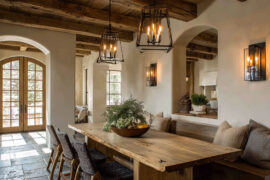
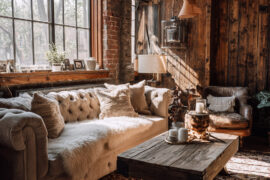
Rustic is the roughest of the three. Think exposed knots in the wood, pinecones with their scales intact, candle wax pooled onto a wooden surface. It fits naturally into cabin interiors, older homes with exposed beams, or any open-plan living space where wood and stone are already present.
The style draws from rural American and Nordic winter traditions. It shows up in rustic interior design broadly, but at the holidays it becomes more specific: darker greens, heavier textures, and a focus on handmade or foraged materials rather than store-bought sets.
Where Does Rustic Holiday Decor Fit Best?
Best-fit spaces:
- Log cabins and mountain homes with natural wood floors or exposed ceiling beams
- Traditional homes with stone fireplaces or brick walls
- Open-plan living areas where reclaimed wood furniture already anchors the space
- Any room that already has warm-toned wood, leather, or linen as a base
It does not work in spaces dominated by cool grays, glossy surfaces, or chrome fixtures. The contrast reads as a clash, not a complement.
What Materials Define the Rustic Holiday Aesthetic?
6 materials carry almost all the visual weight in rustic holiday decor: reclaimed wood, natural fiber textiles, dried botanicals, matte metals, beeswax candles, and unfinished clay or terracotta.
In 2024, 53% of homeowners reported plans to use natural materials like wood and stone in their decor (Market.us). Eco-friendly home decor products saw a 25% sales rise in 2023. The rustic holiday aesthetic sits squarely in this shift toward raw, tactile materials.
Natural Wood Varieties and Their Uses

Birch is the workhorse of rustic holiday decor. Its white bark and visible horizontal markings photograph well and work in almost every application: log stacks beside a fireplace, sliced rounds as ornament bases, bundled twigs in a vase.
Reclaimed wood brings age and grain variation that new lumber cannot replicate. Boards with saw marks, nail holes, or weathered gray patina add the kind of character that a rustic holiday scheme depends on. For more on how to work with this material, the guide on what reclaimed wood is covers sourcing and preparation.
Driftwood and cedar round out the wood palette. Driftwood makes strong sculptural pieces. Cedar branches and boughs bring both texture and scent, which matters more than most people account for when setting a seasonal atmosphere.
Dried Botanicals: Which Hold Up Through the Season
Not all dried botanicals survive a 6-week holiday display. Choosing the right ones avoids mid-December crumbling.
High durability: pinecones, dried orange slices, cotton stems, wheat bundles, eucalyptus (dried, not fresh)
Moderate durability: dried rosemary, lavender, seed pods, teasel
Short-lived (use sparingly): fresh berry stems, fresh magnolia leaves, fresh eucalyptus
Dried orange slices last the entire season and add a warm citrus scent for the first two to three weeks. They pair well with cinnamon sticks in garlands or bowl arrangements. Pinecones from the yard outperform store-bought versions in both scale and authenticity.
Textiles, Metals, and Candles
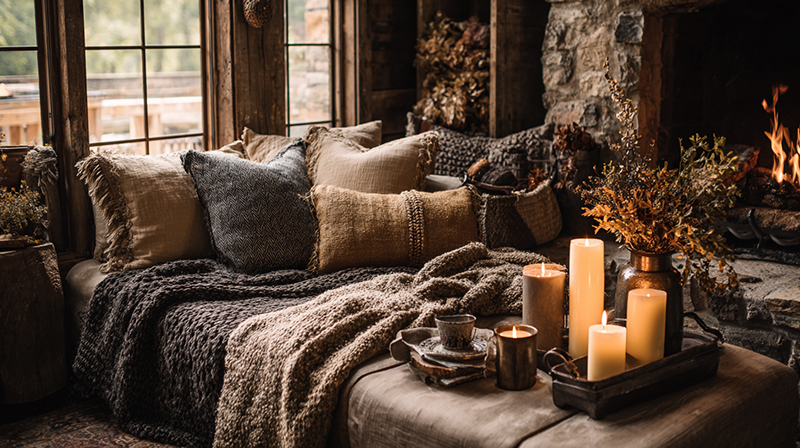
Textiles: burlap, jute, chunky knit wool, and linen. These provide the soft contrast that keeps raw wood and dried material from feeling cold.
Metals: matte black iron, brushed copper, aged bronze. These three work. Chrome and silver break the palette immediately. Hearth and Hand with Magnolia (Target) built its entire holiday line around this metal approach, pairing warm-toned metals with natural materials to keep the rustic feeling without going too rough or primitive.
Candles: beeswax pillar candles are the standard. They burn cleaner than paraffin, have a natural honey tone that complements wood and linen, and carry a mild scent without competing with dried botanicals. Avoid glitter-coated or brightly dyed candles. They read as wrong immediately.
What Are the Core Rustic Holiday Color Palettes?
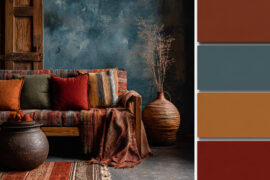
Rustic holiday decor runs on 4 color families: warm neutrals as the base, deep forest tones as the primary seasonal color, earth reds and burgundy as accent colors, and copper or antique brass as the metallic layer.
PwC’s 2024 Voice of the Consumer Survey found that 80% of consumers are willing to pay more for sustainably sourced goods. The same research identified a clear consumer lean toward natural, earthy tones in home products. The rustic palette reflects this preference directly.
The Four Color Families
Warm neutrals (base layer): cream, camel, tan, warm white. These anchor everything. They appear in textiles, unfinished wood, and dried botanicals naturally, which means you don’t have to force them.
Deep forest tones (seasonal color): hunter green, moss, olive, dark spruce. This is where the Christmas reference lives. Using these in garlands, wreaths, and tree foliage grounds the scheme without making it feel generic.
Earth reds and burgundy (accent): not bright Christmas red. The difference is subtle but significant. Burgundy and deep earth red read as intentional. Bright red reads as costume. Berry stems, red-checked linen, and dried rose hips carry this color without overpowering.
Metallic accents: copper, antique gold, aged brass. One metallic per room is enough. Mixing copper and gold in the same space risks looking unresolved.
What Colors Break the Rustic Look
Cool grays, icy blues, neon-toned ornaments, and any high-gloss finish pull the palette out of the rustic range immediately.
Bright white is also tricky. It works in Scandinavian and farmhouse holiday styling, but in a rustic scheme it reads as too clean. Warm white or cream are the correct substitutes. The difference in undertone, yellow versus blue, is the deciding factor.
How Is Rustic Holiday Decor Used Indoors?
Indoor rustic holiday decor organizes around 5 primary application zones: the mantel, the dining table, the entryway and staircase, the Christmas tree, and shelves or bookcases.
In the US, nearly 78% of households actively decorate for the holidays, with 54% purchasing new items annually (Global Growth Insights, 2024). The categories where rustic decor performs best are the ones that involve handmade or natural materials, which align with the 34% of consumers who favor personalized ornaments.
Rustic Christmas Tree Decorating Approach
The rustic Christmas tree looks best when it follows a few specific choices, not a general vibe.
- Ornaments: wood slice rounds, twine-wrapped ball ornaments, dried orange slices, hand-thrown clay beads, birch bark rolls
- Ribbon: buffalo check in red or black, wide burlap ribbon, plaid linen in muted tones
- Lighting: warm white (2700K-3000K) only. No multicolor, no cool white
- Tree skirt: chunky knit wool, buffalo check wool, or a simple piece of jute burlap
The goal is restraint. A rustic tree with fewer, heavier ornaments reads as intentional. A dense tree with a mix of glossy and matte finishes loses the aesthetic.
Mantel Styling for a Rustic Holiday Look

The mantel is the easiest place to establish the rustic holiday tone for an entire room.
Classic layered approach: Start with a cedar or pine garland as the base. Add pillar candles in varied heights using matte black iron holders. Stack 3-5 birch logs at one end. Tuck dried orange slices, pinecones, and small cotton stems into the garland. Finish with vintage-style stockings in linen or plaid wool.
McGee and Co. uses a similar approach in its holiday collections: natural greenery first, then candles and wood, with minimal metal as a finishing layer. The result looks styled without looking arranged.
For more ideas on building this zone, the overview of mantel decor approaches covers both rustic and adjacent styles with specific placement guidance.
Table Centerpiece Ideas Using Natural Materials
A rustic holiday centerpiece works best when it uses odd-numbered groupings and varying heights.
Centerpiece formula: one tall element (tall taper candles or birch branches in a vessel), one mid-height element (a wooden bowl with pinecones and dried citrus), one low element (scattered greenery or a flat arrangement of cotton stems).
Wooden chargers, linen table runners, and terracotta candle holders reinforce the material language without adding cost. The rustic table centerpiece guide covers specific material combinations for different table sizes.
How Is Rustic Holiday Decor Applied Outdoors?
Outdoor rustic holiday decor focuses on 4 exterior zones: the front door, the porch and steps, window boxes, and the yard or garden perimeter.
The Christmas lights and decorations market is forecast to grow by USD 5.24 billion between 2023 and 2028, at a 5.96% CAGR (Technavio). Outdoor displays are identified as one of the primary growth drivers in this category.
Front Door and Porch Styling
Front door: cedar, magnolia, or pine wreaths in large formats (24-30 inches for most doors). Avoid thin, sparse wreaths. Volume and density matter for outdoor display. Pair with a plaid or burlap bow, never a metallic or glitter-coated ribbon.
Lanterns flanking the door are a reliable rustic exterior choice. Matte black or aged bronze finishes. Battery-operated candles inside keep the look without the fire risk. Galvanized buckets planted with evergreen cuttings add height variation without requiring permanent installation.
Porch and steps: Stacked firewood beside the door is both functional and decorative. It reads as genuine rather than staged. Metal deer silhouettes in matte black or aged finish work well in larger porch spaces. Galvanized washtubs filled with pine boughs and birch branches make strong corner accents.
Window Boxes and Garden Perimeter
Window boxes: evergreen cuttings (cedar, spruce, or pine) mixed with red berry stems and pinecones. No plastic elements. Seal the ends of cut greenery with floral preservative to extend life by 2-3 weeks in cold climates.
Yard perimeter: wooden holiday signs with simple lettering in black or dark red paint. Solar-powered Edison string lights strung between trees or along fences. Edison bulbs with their warm amber filament glow (1800K-2200K) fit the rustic outdoor palette better than standard warm white LEDs.
Material rule for outdoors: sealed or naturally weather-resistant materials only. Untreated reclaimed wood warps and splits in freeze-thaw cycles. Powder-coated metal holds up; bare iron rusts visibly within one season.
What Lighting Works for Rustic Holiday Decor?
Rustic holiday lighting runs on warm color temperatures and non-electric candle sources. The right lighting choices are what separate a rustic holiday room from a generic festive one.
The global decorative lighting market was valued at USD 41.60 billion in 2024 and is expected to grow at a 2.9% CAGR through 2030 (SwiftBeacon). Within that market, warm-toned and Edison-style fixtures are the fastest-growing residential segment.
Color Temperature and Bulb Format
Warm white at 2700K-3000K is the correct range. This produces a yellow-amber tone that complements wood, linen, and dried botanicals. Anything cooler than 3000K starts reading as blue-white, which conflicts directly with the rustic palette.
Edison bulb string lights are the primary rustic lighting format for both indoor and outdoor use. The visible filament at 1800K-2200K produces the warmest available output and references early 20th-century workshop and barn lighting, which fits the aesthetic’s historical roots.
For more on how bulb format and placement affect a room’s atmosphere, the breakdown of ambient lighting covers the principles behind layered light planning.
Candle-Based Lighting

Candles do more work in a rustic holiday scheme than in most other styles.
Best formats:
- Pillar candles in 3-4 inch diameter on wooden or iron holders
- Taper candles in matte black iron candlesticks at varying heights
- Votives inside galvanized holders or mason jars
- Battery-operated candles for wreaths, garlands, and window displays
Beeswax burns at a lower temperature than paraffin, drips less, and produces a natural honey-colored light. That warm color output is part of why it works so well in a rustic setting.
What to Avoid
Cool white LEDs, blinking or chasing light sequences, neon or multicolor bulbs, and visible extension cords all break the rustic lighting atmosphere.
High-output recessed lighting also works against this style. It flattens the texture of wood, dried botanicals, and woven textiles. The rustic holiday look depends on shadow and warm pools of light, not even illumination across a room. Recessed lighting can be dimmed and supplemented with candles and string lights to work within a rustic scheme, but it cannot carry the aesthetic on its own.
What Are the Best DIY Rustic Holiday Decor Projects?
DIY is not optional in rustic holiday decor. It is part of the point. 7 projects cover the full range of skill levels and material types: dried orange garlands, wood slice ornaments, pinecone fire starters, burlap table runners, mason jar candle holders, birch log centerpieces, and twig star ornaments.
NielsenIQ’s 2023 study found that 78% of US consumers say a sustainable lifestyle is important to them. DIY holiday decor from natural or foraged materials is the most direct expression of that value in a seasonal context.
DIY Dried Orange Garland: Process and Materials
Dried orange slices are one of the most forgiving beginner projects and one of the most effective finishing touches in a rustic holiday scheme.
Materials needed: navel oranges (thin rind, lower moisture), sharp mandoline or knife, cooling rack, oven or dehydrator, twine or jute cord, large needle
Process:
- Slice oranges to 1/4 inch thickness, consistent cuts dry more evenly
- Pat dry with paper towels before drying
- Oven method: 200F on a cooling rack set over a baking sheet, 4-6 hours, flipping every 90 minutes
- Dehydrator method: 135F for 8-12 hours, no flipping needed
- Cool completely before stringing (24 hours minimum)
- Thread onto jute twine using a large embroidery needle, alternating with cinnamon sticks or dried cranberries
Shelf life: 4-6 weeks at room temperature if dried thoroughly. Partial drying causes mold within 2 weeks.
Wood Slice Ornaments: Cutting, Sealing, and Hanging
Wood slice ornaments are the signature piece of a rustic Christmas tree.
Best wood types: birch (clean white color, visible grain), cedar (natural scent, warm tone), maple (dense grain, takes stamping well)
Cut branches to 1/4-3/8 inch thickness using a miter saw or have a lumber yard make cuts. Sand both faces to 220 grit. Seal with two coats of matte or satin polyurethane to prevent cracking as the wood dries.
Add hanging holes using a 1/8 inch drill bit before sealing. Thread with jute twine or thin copper wire. Leave natural or stamp with seasonal motifs using a rubber stamp and black craft ink.
The DIY rustic home decor resource covers additional project ideas using similar material combinations for year-round use beyond the holiday season.
Five More Projects Worth Building

Pinecone fire starters: Dip foraged pinecones in melted beeswax, tie with jute twine, use as fireplace starters or bowl filler that doubles as functional decor.
Burlap table runner: Cut burlap to table width plus 2 inches on each side. Pull threads along each long edge to create a 1-inch fringe. No sewing required. Add a strip of buffalo check ribbon down the center for contrast.
Mason jar candle holders: Fill half-pint mason jars with a 1-inch layer of sand or salt to stabilize a taper candle. Wrap the jar exterior with jute twine secured with a hot glue gun. Tuck a sprig of dried rosemary or eucalyptus under the twine wrap.
Birch log centerpiece: Drill 3 holes in the top of a 12-inch birch log using a 1-1/4 inch spade bit, spaced 3 inches apart. Insert pillar candles. Arrange dried greenery, pinecones, and cranberries around the base.
Twig star ornaments: Cut 5 equal-length twigs (3-4 inches each). Form a star shape and bind each intersection with natural jute twine. Seal with a thin coat of matte Mod Podge. Hang with a loop of copper wire.
Where to Buy Rustic Holiday Decor
The Christmas Eve boxes category alone saw over 1 million searches on Etsy in 2023, and searches for handmade or vintage furniture on the platform happen every 15 seconds (Etsy Trend Report, 2023). Those numbers reflect exactly where rustic holiday shoppers are spending their time.
Online channels now capture 63% of total Christmas decoration sales in the US (Global Growth Insights, 2024). But for rustic decor specifically, the distinction between platforms matters more than in any other style category.
Best Platforms and Retailers by Category
| Source Category | 2026 Strategic Use | The “Authenticity” Filter |
|---|---|---|
| Etsy & Independent Makers | Bespoke Hardware: Hand-forged hooks, latches, and custom furniture. | Look for “Bench-made” or “Hand-planed” in descriptions. Avoid “rustic look” resins. |
| McGee & Co. / High-End Curated | Foundation Layers: Oversized stoneware, heirloom rugs, and unlacquered brass. | Focus on Weight: If a “stone” vase is surprisingly light, it’s likely a composite. |
| Hearth & Hand / High-Street | Seasonal Soft Goods: Woven napkins, heavy knit throws, and simple stoneware. | Stick to Textiles: Fabric is harder to “fake” than wood or metal textures. |
| Antique Malls / Local Foraging | The “Soul” Piece: Original dough bowls, aged crates, and birch logs. | The “Smell & Touch” Test: Real aged wood has a distinct scent and temperature. |
Etsy: What Actually Works
Search terms that return accurate rustic results: “reclaimed wood ornaments,” “dried orange garland,” “wood slice Christmas,” “hand-stamped birch ornaments,” “natural fiber holiday garland.”
Avoid searching just “rustic Christmas.” That query pulls heavily decorated, glitter-finished pieces that use the word but miss the aesthetic.
Check seller photos for scale references and read material descriptions word by word. “Rustic-inspired” and “rustic-look” frequently mean printed or faux finishes on plastic bases.
Local and Salvage Sources
Farm stands near Christmas tree farms sell fresh cedar boughs, pine branches, and birch logs at far better prices than retail. The scale is also more appropriate for decorating than pre-cut bundles sold in stores.
Salvage yards are underused for rustic holiday decor. Reclaimed wood boards, old window frames, and worn metal pieces all function as display surfaces or structural elements. A single weathered plank makes a better mantel base than most purpose-made shelf pieces sold as rustic decor.
How Does Rustic Holiday Decor Differ Across Regional Styles?
Rustic holiday decor has 4 distinct regional variations: American cabin/mountain, Scandinavian (hygge-influenced), French country, and Southern. Each shares the core commitment to natural materials but diverges sharply in palette, pattern, and ornament type.
American Cabin vs. Scandinavian Rustic
American cabin/mountain rustic:
- Heaviest use of plaid, buffalo check, and antler motifs
- Dark wood tones dominate: walnut, weathered oak, dark pine
- Animal imagery: deer, moose, bear silhouettes in iron or carved wood
- Color range extends to deep burgundy, forest green, dark navy
Scandinavian rustic (hygge-influenced):
- Candle-dominant lighting, minimal ornament use
- More white space, less layering than American cabin style
- Red and white as accent colors, not dark greens or earth reds
- Paper ornaments, wooden Dala horse figurines, simple wool textiles
The hygge approach to interior design and Scandinavian interior design both emphasize warmth through restraint, which carries directly into the holiday version of the style.
French Country Rustic
French country rustic is softer than American cabin and warmer than Scandinavian.
Key markers: toile patterns on textiles, softer color palette (dusty rose, sage, cream, muted gold), more ornate ironwork in candle holders and wall sconces, dried lavender alongside pine and eucalyptus.
It sits closer to farmhouse interior design than the other rustic regional variants, but distinguishes itself with more pattern mixing and a warmer, more decorated feel.
Southern Rustic
Southern rustic holiday decor leans into magnolia, cotton stems, and warm neutrals. Less plaid. More texture.
Signature materials: magnolia leaf wreaths and garlands (fresh or preserved), cotton bolls on branches, cypress or cedar rather than pine, galvanized metal as the primary metallic.
Joanna Gaines and the Magnolia brand popularized this version of rustic holiday styling nationally. The Hearth and Hand line at Target reflects it directly, with cotton stems, magnolia wreaths, and galvanized buckets as core seasonal SKUs.
Blending Regional Influences
Mixing regional rustic styles is workable. Mixing more than 2 at once usually is not.
American cabin and Southern rustic layer well because both use dark wood and natural greenery as anchors. Scandinavian and French country blend because both favor restraint and softer palettes. The pairings that clash: American cabin plaid alongside toile, or Scandinavian white-dominant styling alongside deep Southern earth tones.
What Rustic Holiday Decor Works for Small Spaces?
Home decor spending remained stable in 2024 even as large-scale renovation budgets fell (Houzz & Home Study, 2024). The specific growth area was smaller spaces, which maps directly onto apartment and studio holiday decorating.
Rustic decor scales down better than most styles. It relies on texture and material contrast rather than volume. A single birch log, one well-chosen garland, and three pillar candles read as complete in a small room. The same room with 40 ornaments and three competing patterns does not.
Vertical Strategies for Tight Spaces
Vertical elements use wall and ceiling height rather than floor or surface area.
Best options:
- Tall birch branches (5-6 feet) in a wide-mouth ceramic or galvanized vase: replaces a tree entirely in studios
- Wall-mounted cedar or pine wreaths in place of tabletop arrangements
- Hanging dried botanical bundles from curtain rods or ceiling hooks
- Vertical macrame with dried greenery tucked in: combines texture and height
The 3-Item Vignette Rule
Small-space rustic holiday styling works best with groupings of 3 items per surface. Odd numbers read as intentional. Even numbers read as incomplete or overly symmetrical.
Formula: one tall item, one mid-height item, one low item. Vary material within the three. A birch twig bundle (tall), a pillar candle on a wood slice (mid), and a cluster of pinecones (low) is a complete vignette on a side table or windowsill.
For ideas on building out these arrangements, the guide on rustic shelving ideas covers how to stage small surfaces with natural materials year-round.
Scent as a Decor Layer
Scent functions as a decor element in small spaces where visual layering has limits.
Beeswax candles, dried herb bundles (rosemary, thyme, sage), and simmer pots with cinnamon sticks, clove, and dried orange peel create the seasonal atmosphere of a fully decorated cabin in a 400-square-foot apartment. The olfactory signal is stronger than most visual cues for triggering a cozy winter association.
This is one area where rustic holiday decor has a clear advantage over more visual-heavy styles like traditional or maximalist Christmas decorating. The materials do sensory work that goes beyond what you can see.
How to Store Rustic Holiday Decor Without Damage
Rustic holiday materials are among the most storage-sensitive of any decor category. The 4 most fragile types are dried botanicals, wood pieces, natural fiber textiles, and metal accents. Each requires different conditions.
U.S. consumers spend an average of $1,598 on home decor annually (Opendoor, 2024). Protecting that investment through correct storage extends the usable life of handmade and natural pieces by 3-5 seasons.
Dried Botanicals and Wood
Dried botanicals need breathable containers, not sealed plastic bins. Airtight storage traps residual moisture and causes mold even in pieces that appear fully dry. Use cardboard boxes lined with tissue paper, or open-weave baskets.
Add silica gel packets (2-3 per box) to absorb ambient moisture. Replace them each season. Avoid storing in garages or basements with freeze-thaw cycles. Consistent, dry, room-temperature conditions are the only requirement.
Wood pieces (slices, logs, carved ornaments) crack when stored in environments with large temperature swings. Treat bare wood surfaces with a thin coat of mineral oil before packing. Wrap individual pieces in acid-free tissue to prevent surface scratching during stacking.
Textiles and Metal Accents
Burlap and linen: roll rather than fold to prevent permanent crease lines. Store flat in a breathable cotton bag or pillowcase, not sealed plastic. Cedar blocks (not mothballs) protect natural fiber textiles from insect damage without leaving a chemical odor.
Copper and brass accents: tarnish during storage even in dry conditions. Wrap each piece in anti-tarnish strips or silver cloth before packing. The strips are inexpensive and cut the annual polishing work significantly.
Galvanized metal: wipe dry before storage. Surface rust begins within one season if stored with any moisture present. A light coat of paste wax applied before packing creates a barrier that holds through 2-3 storage cycles.
Labeling System
Label storage containers by zone, not by item type. A box labeled “mantel” contains everything for that surface: garland, candles, birch logs, and stockings. Unpacking by zone cuts setup time by roughly half compared to hunting through boxes labeled “ornaments” or “greenery.”
Photograph each finished zone at the end of the season before dismantling. Store the photo with that zone’s box. Next year’s setup takes minutes instead of reconstruction from memory.
What Are Common Mistakes in Rustic Holiday Decorating?
Most rustic holiday decorating failures come down to 6 specific mistakes: conflicting wood tones, over-decorating, wrong surface finishes, incorrect scale, mislabeled product purchases, and flat texture.
Eco-friendly home decor products saw a 25% sales rise in 2023 (Market.us), which means more consumers are buying in this space, and more getting it wrong as a result.
Wood Tone Conflicts and Over-Decoration
Mixing too many wood tones without a unifying neutral is the most common mistake.
Three different wood tones in one room (golden pine, gray driftwood, dark walnut) with no shared neutral element reads as chaotic rather than layered. Fix: choose one dominant tone and treat the others as accents. Or unify through a consistent warm neutral in textiles and candles that bridges the wood tones.
Over-decorating kills the rustic aesthetic. The style depends on intentional negative space. A crowded mantel with 20 items looks like a craft store display. The same mantel with 7-8 thoughtfully placed pieces looks styled. When in doubt, remove one more item.
Finish, Scale, and Product Labeling
Wrong finish: lacquered pinecones, glitter-coated branches, and high-gloss artificial berries are the fastest way to break a rustic scheme. They are sold in the same aisle as natural materials at most craft stores. Read the label. If it says “glitter,” “shimmer,” or “frosted,” it does not belong in a rustic holiday arrangement.
Incorrect scale: small accent pieces in large rooms lose the grounding effect that makes rustic decor work. A 6-inch wreath on a 10-foot wall reads as an afterthought. A 24-inch wreath on the same wall reads as intentional. Scale up more than you think you need to.
Farmhouse vs. rustic confusion: many retailers label products as “rustic” when they are actually farmhouse in material and finish. The difference at point of purchase: rustic pieces have visible grain, raw edges, and matte finishes. Farmhouse pieces tend toward cleaner lines, white-painted surfaces, and structured forms. Buying farmhouse products expecting a rustic result produces a style clash that is difficult to fix without starting over.
Texture Layering
All-smooth surfaces flatten the rustic look entirely. The aesthetic depends on texture contrast: rough wood against soft linen, coarse burlap against smooth beeswax, knobbly pinecone against a flat wooden surface.
If every surface in the arrangement has the same tactile quality, add one rough element. A single piece of raw-edge bark, a small bundle of wheat, or a handful of loose pinecones is enough to reintroduce the contrast the style requires.
For a broader look at how texture functions as a design element across styles and seasons, the overview of texture in interior design covers the underlying principles that apply directly to rustic holiday styling decisions.
FAQ on Rustic Holiday Decor
What is rustic holiday decor?
Rustic holiday decor uses natural, raw materials like reclaimed wood, dried botanicals, burlap, and beeswax candles to create warm, handmade seasonal spaces. It prioritizes texture and organic imperfection over polished, manufactured finishes.
What materials are used in rustic holiday decor?
The core materials are birch logs, pinecones, jute twine, linen, dried eucalyptus, cotton stems, matte black iron, and unfinished clay. Dried orange slices and cedar boughs are among the most common seasonal additions.
What colors work for a rustic holiday color palette?
Warm neutrals, deep forest greens, earth reds, and burgundy form the base. Copper and antique brass work as metallic accents. Cool grays, bright reds, and icy blues break the palette and should be avoided.
How is rustic holiday decor different from farmhouse Christmas decor?
Rustic decor uses rawer, more unfinished materials with darker, earthier tones. Farmhouse holiday decor leans toward white-heavy palettes, structured forms, and cleaner finishes. Both use natural materials, but rustic is rougher and less polished overall.
What lighting is best for rustic holiday decor?
Warm white lights at 2700K-3000K and Edison bulb string lights are the standard. Beeswax pillar candles and iron candlestick holders add layered candlelight. Cool white LEDs and blinking sequences break the aesthetic immediately.
Can rustic holiday decor work in a small apartment?
Yes. Tall birch branches in a ceramic vase replace a tree entirely. Wall-mounted wreaths and 3-item vignettes on shelves keep surfaces from feeling crowded. Scent through beeswax candles and dried herb bundles adds atmosphere without taking up space.
What are easy DIY rustic holiday decor projects?
Dried orange garlands, wood slice ornaments, and birch log candle centerpieces are the most beginner-friendly. Pinecone fire starters and burlap table runners require no special tools. Most projects use materials foraged locally or sourced from a craft store.
Where is the best place to buy rustic holiday decor?
Etsy is the strongest source for handmade, one-of-a-kind pieces. McGee and Co. and Hearth and Hand with Magnolia offer curated natural collections. Local Christmas tree farms and salvage yards provide the most authentic raw materials at better prices.
How do you store rustic holiday decor without damaging it?
Store dried botanicals in breathable cardboard boxes with silica gel packets. Wrap copper and brass pieces in anti-tarnish strips. Roll burlap and linen rather than folding. Label containers by room zone, not item type, to simplify next year’s setup.
What are the most common mistakes in rustic holiday decorating?
Using glossy or glitter-coated finishes, over-decorating, and mixing too many wood tones without a unifying neutral are the top errors. Buying products labeled “rustic” that are actually farmhouse in style is also a frequent and fixable problem.
Conclusion
This conclusion is for an article presenting rustic holiday decor as a style built on intentional choices, not impulse purchases.
Pinecones, dried orange garlands, reclaimed wood, and warm candlelight do more decorating work than any mass-produced ornament set.
The regional variations, from American cabin plaid to hygge-influenced Scandinavian restraint, show how flexible the core aesthetic really is.
Small spaces, tight budgets, and DIY projects all fit naturally within this approach.
Get the color palette right, choose materials with real texture, avoid glossy finishes, and the rest follows.
Cozy cabin Christmas styling is not a trend. It has been the same idea for generations: bring natural materials inside, light a candle, and leave some space for the room to breathe.

- Paint Colors That Go with Oak Floors - August 22, 2026
- Paint Colors That Go with Gray Floors - August 20, 2026
- What Color Bedding Goes with Dark Wood Furniture - August 18, 2026