Home Decor
Maximizing Space: Chic Walk-In Closet Ideas

A closet 4 to 5 feet wide holds a single storage wall. Go to about 7 feet and you can hang clothes on both sides, and an island only makes sense somewhere around 10 to 12 feet.
Technically, any space you can step into with rods, shelves and drawers along one or more walls counts as a walk-in closet.
Most plans skip the aisle width, and that’s where they go wrong. The U.S. Department of Justice’s 2010 ADA Standards for Accessible Design call for 30 x 48 inches of clear floor space, which means the common 24 inch aisle doesn’t pass.
Private closets don’t have to follow the standard. It still shows roughly where a loaded aisle stops working for a wheelchair.
How big does a walk-in closet need to be?

Plan on 5 x 5 feet (25 square feet) at minimum, with 4 x 4 feet (16 square feet) as the absolute floor, according to HomeGuide.
After that the sources stop agreeing, both on the footprint and on how wide the aisle between hanging runs should be.
HomeGuide treats 4 x 4 ft as the absolute minimum and 5 x 5 ft as the practical one. Lazzoni agrees that 5 x 5 is where a walk-in becomes possible at all. Block Renovation starts its bathroom floor plans at 4 x 6 ft.
Aisle width has a few common answers. HomeGuide gives 24 inches as the minimum and 30 to 36 inches as comfortable, while Dimensions.com and Lazzoni both say 36 inches.
Lazzoni calls 36 inches the width where a closet feels comfortable rather than merely passable. I’d treat 24 inches as the limit for a pass-through closet and design to 36.
The 2010 ADA Standards for Accessible Design (U.S. Department of Justice, 2010) require a clear floor space of 30 x 48 inches for a wheelchair, so a 24 inch aisle fails that test.
The Standards cover public and commercial buildings, so a private closet isn’t bound by them. Still a handy benchmark if you’re planning to age in place.
Length matters less than width. Extra width mostly adds floor to walk on, while extra length adds wall, and wall is what holds clothes (Lazzoni).
Walk-in closet layouts and the width each one needs
A 4 to 5 foot room fits a single wall. Around 7 feet you can hang on both sides or wrap the storage into a U, and an island starts to fit at roughly 10 feet.
| Layout | Minimum width | Suits | Source |
|---|---|---|---|
| Single wall | 4 to 5 ft | Narrow rooms, one person | HomeGuide, Dimensions.com |
| Double sided (galley) | 6.5 to 7 ft | Two full hanging runs | Livingetc, Dimensions.com |
| L-shaped | 5 ft wide, 5 to 6 ft deep | Corner rooms, using the end wall | Dimensions.com, HomeGuide |
| U-shaped | 7 ft wide, 10 ft deep | Large wardrobes | HomeGuide, Dimensions.com |
| Island | About 10 ft | Rooms with floor to spare | Lazzoni, HomeGuide |
Width here means the span from the storage wall to the opposite wall. Length is flexible, and every layout gains wall space as it gets longer.
Door swing and wall lengths come first, before any hardware is bought. That is basic space planning, and it settles the layout early.
One failure case comes up often. A U-shape needs 10 feet of depth (HomeGuide), so it falls apart in a room 6 feet long, where an L-shape is the better pick.
His and hers walk-in closets

Dimensions.com sizes a split single-sided closet at 5 feet per person, made up of 2 feet of storage and a 3 foot aisle.
Together the pair needs at least 10 feet 4 inches of width, and a door at the far end can connect it to the master bathroom.
The split version means 10 ft 4 in of width, a closet each and no shared aisle. A double-sided layout gets by on 6.5 to 7 ft with one aisle between you, though Lazzoni puts a closet built for two people dressing at once at 8 ft.
Small and narrow walk-in closet ideas

Keep the floor clear and build up. One storage wall with shelving that runs near the ceiling, plus a door that doesn’t swing into the aisle, beats a crowded two-wall plan in a tight room.
Bob Vila’s narrow-closet picks follow the same logic, and Homes and Gardens notes that a single run of open wardrobes fits on a small footprint.
Narrow closets under 5 ft wide
Below 5 feet there’s room for one storage wall and a tight aisle.
At 4 ft wide with 24 inch hangers, you’re left with a 24 inch aisle (HomeGuide). Drop to 20 inch hangers, which Dimensions.com allows as the lowest hanger depth, and the aisle grows to 28 inches.
Skip the swing door. It takes floor space, so a pocket door or a curtain keeps the aisle clear, and Block Renovation’s plans use a pocket door for exactly this reason.
Double hang adds capacity, but the 80 and 40 inch rods (Angi) sit 40 inches apart, which caps each tier at roughly that garment length.
Dresses and coats need a separate long-hang bay with the rod at 66 inches.
Alcoves, under-stair space and spare-room conversions
Real Homes suggests splitting a bedroom with a wardrobe or a floor-to-ceiling storage unit to zone off a closet area, and it lists an alcove as another spot to squeeze one in.
A freestanding divider does the same job with a lighter look, and there are plenty of room divider ideas built from IKEA pieces.
Under a staircase, the sloped ceiling sets the limit. Hang clothes only where headroom clears a 66 inch rod height (Bob Vila), and put shelves or drawers at the low end.
For modular pieces that work around the slope, look at IKEA storage ideas for the space under stairs.
A spare room already has walls and a door. Measure the shortest wall first. Past 7 feet a double-sided layout fits, and past 10 feet there’s floor left for an island.
How high should closet rods and shelves go?
Mount a single rod 66 inches above the floor, or a double-hang pair at 80 and 40 inches, according to Angi.
- A single rod sits at 66 in (Angi, Bob Vila).
- Double rods go at 80 in and 40 in (Angi), or 81.75 in and 40.5 in (Bob Vila).
- Angi puts the top shelf in a walk-in at 80 in.
- Hangers need 24 in of depth to be comfortable and 20 in at minimum (Dimensions.com).
- Shoe shelves run 12 in deep, with 6 to 7 in between tiers (HomeGuide).
Check where each source measures from before drilling. Bob Vila measures to the bottom of the rod, TaskRabbit to its center, and Hunker lists a lower single-rod range of 64 to 65 inches.
The tallest regular user sets the final number. Angi’s guidance ends on the same point, that the height of the person who uses the closet most outweighs any standard.
Accessible heights carry their own disagreement. The 2010 ADA Standards (U.S. Department of Justice, 2010) limit unobstructed reach to 15 to 48 inches above the floor, while Massachusetts’ accessibility code (521 CMR) allows a side reach up to 54 inches.
Angi’s accessible-closet row uses 54 inches. If the closet has to meet the federal standard, stay at 48.
Storage ideas for shoes, folded clothes and accessories
Start by sorting what you own, first by category and then by garment length. Components come after that, meaning long hang, short hang, folded shelves, drawers, shoe storage and accessories.
Real Homes opens with the same step, which is to assess what you own before choosing any storage.
Shoes
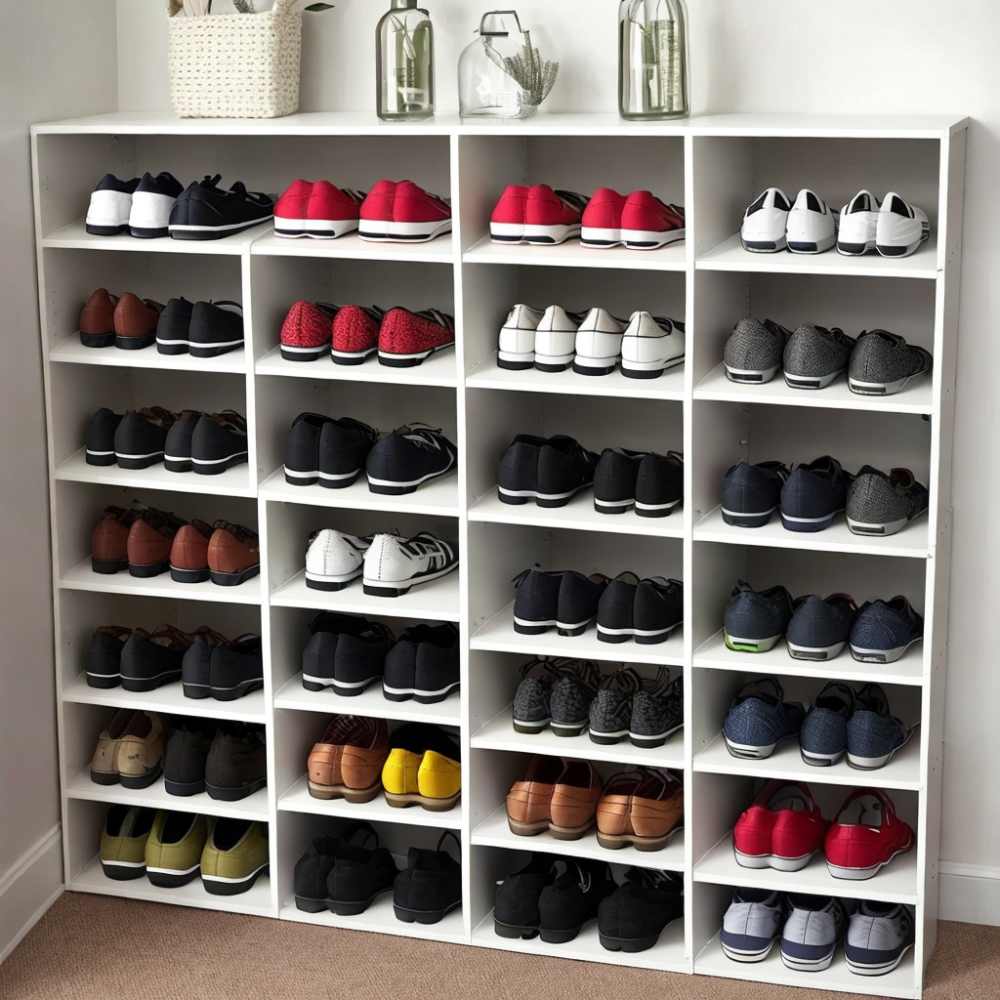
Shoe shelves run 12 inches deep with 6 to 7 inches between tiers, according to HomeGuide. Boots and larger shoes go on inclined racks, which save depth.
Bob Vila’s pick for shoe lovers is stadium shelving, where every pair stays visible.
Once a collection outgrows a single rack, a wider range of shoe storage ideas (walls, cubbies, drawers) is worth comparing.
Folded clothes and drawers
Drawers for folded clothes need at least 18 inches of depth, and 24 inches when you want multiple rows (Dimensions.com).
Open shelves keep everything visible, which is why Apartment Therapy’s featured designer favors them for shoes.
Drawers hide the contents, so I’d keep shelves for the sweaters and jeans you wear every week and put everything else in drawers.
Accessories, laundry and seasonal items
- Jewelry and small accessories do well in shallow drawers with dividers, or on open display when the pieces double as decor (Bob Vila).
- Bob Vila also builds the hamper into the cabinetry.
- Seasonal items get rotated with the seasons (Real Homes).
- A ladder gives reach to the top shelves in a small walk-in (Livingetc).
How to light a walk-in closet
Start with a ceiling fixture for base light and add LED strips at the rods and shelves for task light. A sensor that switches everything on when the door opens finishes it off.
Closet World’s lighting guide describes the same layering, with overhead ambient light combined with task lighting at different heights and LED strips behind the rods. IKEA’s PAX design guide lists sensor lights that run automatically as the door opens and closes.
The overhead fixture carries the ambient lighting, so size it first and let the strips handle detail.
An LED light requirement calculator turns the floor area into a brightness target for that fixture.
NEC section 410.16(C) sets how far fixtures must sit from storage.
- 12 in from the nearest storage space for surface-mounted incandescent or LED with a completely enclosed light source
- 6 in for recessed fixtures and surface-mounted fluorescent
- 0 in for surface-mounted LED or fluorescent fixtures identified for use inside the storage space
The code (NEC 410.2) defines the storage space as the volume reaching 24 inches out from the back and side walls, up to 6 feet or the highest hanging rod, and 12 inches or the width of any shelf, whichever is greater, above that. Wording differs between editions, so confirm the adopted one with the local inspector before buying strips.
Color temperature is where sources split. PAC Lights and Closet World both recommend 3000K to 4000K, while LEDCO recommends 4000K and warns against 2700K.
Buy a fixture with adjustable color temperature and test both. Alcon Lighting’s 14205 closet rod light, for example, comes in 2700K to 5000K options with a CRI of 90 or higher.
Is an island, vanity or seating worth the floor space?
An island pays off only when the room holds 36 inches of clearance on every side, which means about 10 x 10 feet with storage on one wall and close to 12 feet of width with storage on both, according to Lazzoni.
Lazzoni’s 10 foot island width works only with a single storage wall. A second wall of 24 inch hanging adds the other two feet. HomeGuide’s 10 x 10 foot island minimum assumes just 24 inches of clearance around the island.
Islands and peninsulas
For a two-wall closet the math runs like this. 24 inches of hanging, 36 inches of clearance, a 24 inch island, another 36 inches of clearance and 24 inches of hanging on the far wall. That adds up to 144 inches, or 12 feet.
An island should be at least 4 ft long to be worth building (Lazzoni). A slim one, 18 in deep with a single row of drawers, leaves more width for the aisles. A peninsula needs clearance on three sides instead of four, so it fits narrower rooms.
Vanity nooks
Closet World describes a well-lit corner vanity for hair and makeup, which leaves the bathroom for showering.
Light it at CRI 95 or higher, the level Creative Closets recommends for makeup and jewelry areas.
Bob Vila’s alternative to a built-in is a freestanding dressing table, which breaks up a long run of cabinetry.
Seating, rugs and a desk
Crown Asia suggests a bench under a window, and Closet World leaves room for a large tufted ottoman. Island seating is a different matter, since stools need extra pull-out clearance on top of the 36 inches (Lazzoni).
Apartment Therapy calls a rug both luxurious and practical in a walk-in. A rug size calculator keeps it inside the aisle and clear of the drawer fronts.
A small work corner fits too, as long as the room has floor to spare (Apartment Therapy).
Wire, laminate and wood finishes compared
Wire is the cheapest and holds the least. Wood costs the most and holds the most, with laminate somewhere in the middle.
| Finish | Typical cost | Catch |
|---|---|---|
| Wire | $100 to $300, prefab, self-installed | Lower load limit, plain look |
| Laminate | $300 to $1,000, kit | Pricier than wire, near the wood range |
| Wood | Up to $5,000 for a large, high-end custom installation | Holds more weight, and a custom system takes at least 8 hours of labor |
Prices come from HomeAdvisor’s cost guide, and the wire versus wood load comparison from Home Addition Plus. Weight ratings vary by brand and gauge, so read the per-shelf rating before buying.
IKEA’s PAX frames are the common modular starting point, and these IKEA walk-in closet ideas show how they scale to a full room.
PAX frames come in 50, 75 or 100 cm widths, 35 or 58 cm depths and 201 or 236 cm heights (IKEA).
The 58 cm frame is about 22.8 inches deep, which falls inside Dimensions.com’s 20 to 24 inch hanger range. The 35 cm frame (about 13.8 inches) is too shallow for hanging, so it suits shelves and folded stacks.
IKEA’s product listing describes the frames as particle- and fibreboard with a honeycomb filling made from 100% recycled paper.
How much does a walk-in closet cost to build?
A professional closet organizer averages $1,543, according to HomeAdvisor (2025), but the range around that average is wide.
HomeAdvisor’s custom closet systems run from $150 for a basic wire or plastic unit up to $5,000 for a large, high-end wood installation. Closet and Beyond prices walk-in systems from $3,500 to $10,000 or more, depending on design, finishes and features.
The gap comes down to scope and seller. HomeAdvisor’s range starts at wire inserts, while a custom closet vendor prices full cabinetry walk-ins.
HomeAdvisor ties cost mostly to prefab versus custom and to the material, with extras such as lighting and drawers pushing it up.
DIY wins on a simple rectangular closet that takes standard rods and shelves, since a prefab kit keeps upfront costs down (HomeAdvisor). Custom wins when the closet has an unusual shape or every inch has to work, because prefab kits are not customizable (HomeAdvisor).
When the closet is part of a larger remodel, run it through a home renovation cost calculator alongside the other rooms.
When walk-in closet ideas do not work
The standard advice stops working in a few situations.
A small wardrobe is the first. HomeAdvisor notes that organizing a full walk-in costs more than a simple reach-in with just a rod and a shelf, so a small wardrobe may not justify a walk-in.
Low ceilings are the next problem. IKEA’s product page for the 201 cm frame gives 202 cm as the minimum ceiling height for upright assembly and 205 cm with sliding doors. That matches the PAX design guide, which says to allow 1 cm extra for hinged doors or 4 cm for sliding doors.
Plan for the larger number if you want sliding doors, which is 205 cm for a 201 cm frame.
Heavy loads on lightweight shelving also fail. Wire shelving is designed to support less weight than wood (Home Addition Plus), so folded denim stacks and shoe boxes belong on laminate or wood.
Walk-in closet ideas FAQ
What is the difference between a walk-in closet and a reach-in closet?
Mostly size and access. A reach-in gets used from outside, with a single rod, shelves and a standard 24 inch depth. A walk-in is large enough to step into, with storage along one or more walls (Dimensions.com).
Is a walk-in wardrobe the same as a walk-in closet?
Yes. Walk-in wardrobe is the British term for the same space.
UK fitted-furniture maker FCI London describes it in four styles: single-sided, double-sided, island and wrap-around.
Does a walk-in closet add value to a home?
Builders treat it as a standard feature, but no independent source in this research gives a resale return. NAHB’s survey, reported by NAR in 2024, ranks a primary-bedroom walk-in closet fifth among the features builders most plan to include.
The “up to 60%” recoup claim comes from a closet vendor, Closet and Beyond, whose own pages also say 56%, so treat it as a sales figure.
Should a walk-in closet have doors or a curtain?
Neither is required. A pocket door or a curtain keeps the aisle clear, while a swing door takes floor space (Block Renovation).
If you hang a door, Livingetc’s expert gives 36 inches as the minimum opening.
Should a walk-in closet have a window?
No. Walk-in closets are often windowless, according to Homes and Gardens, and a window gives up a wall that could hold rods.
If the room already has one, Crown Asia suggests a bench under it.
What color should a walk-in closet be painted?
Light and dark both work. Bob Vila’s picks include a crisp white closet, and Livingetc shows a dark small walk-in.
Test a few palettes with a room color scheme generator, then light the space at CRI 90 or higher, the level LEDCO recommends for a walk-in dressing room.
Can a walk-in closet be added during a bathroom renovation?
Yes. Block Renovation publishes five bathroom floor plans with walk-in closets, and the door swings into the closet so the bathroom’s clearance zones stay open.
The closet is the cheap part. Plumbing runs away from the existing stack add the cost.
Where to Spend First on a Walk-in Closet
Spend first on whatever is hardest to change later. Walls, aisle width and door position cost the most to move, while shelves, finishes and decor swap out cheaply.
That puts layout, aisle width and door type at the top. Rod, shelf and drawer positions come next, with lighting right after. Finish upgrades, the island, the vanity and seating can wait.
Lighting follows the shelf layout because fixture positions depend on where storage sits.
Wood belongs where the load is heaviest, in drawers and shoe shelves, which means accepting wire or laminate elsewhere.
As of October 2026, that order holds for the sources reviewed. A newer NEC edition adopted locally can change the lighting rules, so confirm the edition before wiring.

- Kitchen Color Schemes by Cabinet Color: What Pairs Well - October 19, 2026
- Curtain Colors for Every Wall Color: Safe vs Bold Picks - October 18, 2026
- Interior Design Styles: Find Your Primary and Secondary - October 14, 2026