Color Combinations
What Color Walls Go with Brown Furniture
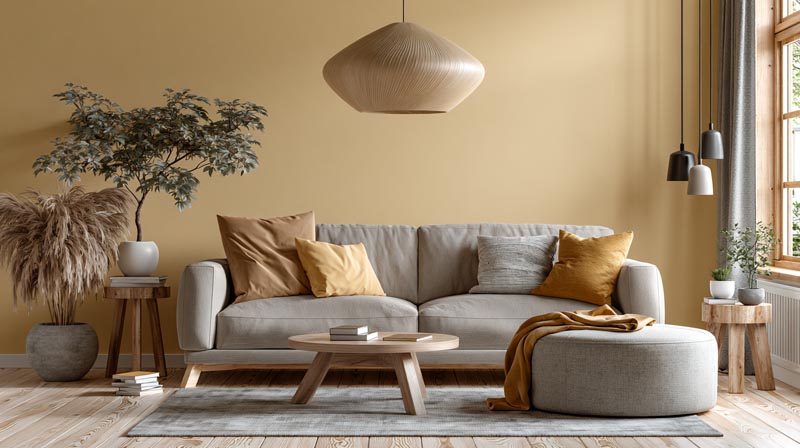
Brown furniture is back, and it is not going anywhere.
Choosing what color walls go with brown furniture is trickier than it looks. The wrong wall paint drains warmth from the wood, flattens the room, and makes a perfectly good sofa or dining table look dated.
The right pairing does the opposite. It makes the furniture feel intentional, the room feel resolved, and the whole space easier to live in.
This guide covers wall color pairings for every brown tone, from dark espresso to honey oak to cool driftwood, across room types and lighting conditions. By the end, you will know exactly which paint colors work, which ones to avoid, and why.
Wood, floors and other fixed surfaces are one part of our guide to putting a color palette together, which also covers walls, textiles and rooms.
What Determines Which Wall Colors Work With Brown Furniture
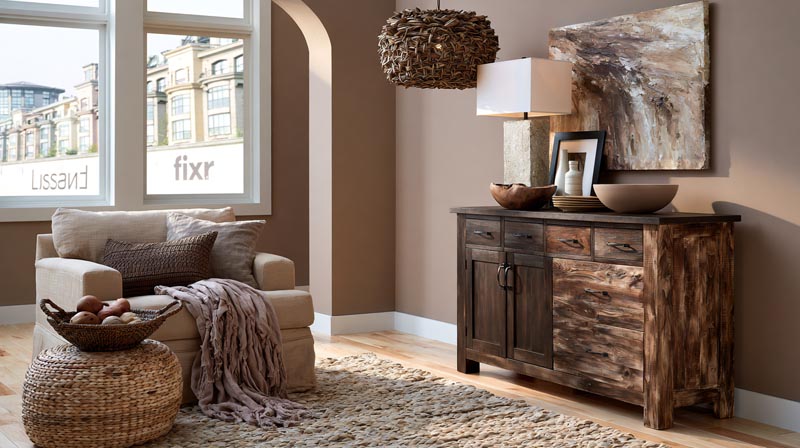
Brown furniture covers a wide tonal range. Espresso, walnut, honey oak, mahogany, and driftwood all fall under “brown,” but each pulls in a different direction on the color wheel. Choosing wall paint without identifying where your specific piece sits on that spectrum is the most common reason color pairings fall flat.
The 3 core variables that determine the right wall color are undertone, value (light vs. dark), and saturation of the furniture itself.
According to a 2025 Fixr survey of 67 interior design experts, 34% of professionals named rustic browns, grays, and taupes as homeowners’ top color choices. Brown furniture has moved from dated to deliberate.
How to Read Undertones in Brown Furniture
Every brown piece has a dominant undertone. Most read warm, but the specific warmth varies significantly.
- Red-orange undertone: mahogany, cherry, and dark walnut. These pull toward terracotta, rust, and deep greens.
- Yellow-amber undertone: honey oak, golden teak, and pine. These work with warm whites, sage, and soft olive.
- Gray-brown undertone: driftwood, ash, and weathered finishes. These sit closer to cool neutrals and pair well with blue-grays or muted lavender.
- Neutral brown: medium walnut, mid-tone espresso. These are the most flexible and accept both warm and cool wall palettes.
A quick test: hold a sheet of white paper next to the furniture. If the furniture looks orange by comparison, it reads warm. If it looks slightly purple or gray, it leans cool.
Why Furniture Value Changes the Wall Color Equation
Dark brown furniture (espresso, chocolate) carries a lot of visual weight. Light walls create contrast and give the room breathing room. Very light walls with an LRV above 70 work especially well here.
Light brown and honey-toned furniture sits in the mid-range visually. It can handle both lighter and slightly deeper wall colors without the room feeling unbalanced.
According to Benjamin Moore’s paint specification data, LRV (Light Reflectance Value) runs from 0 (pure black) to 100 (pure white). Most warm whites fall between LRV 75 and 85. That range is the sweet spot for pairing with dark brown furniture.
Warm vs. Cool Brown: The Split That Matters Most
Warm browns pull toward analogous palettes. Earthy, nature-inspired colors in the same warm family feel cohesive. Contrast comes from value (light walls vs. dark furniture), not from competing color temperatures.
Cool browns open up contrast options. Gray-brown and driftwood pieces can accept cooler wall tones without visual tension, because both are pulling toward the neutral end of the spectrum.
This is the split that professionals use to start every color recommendation. Room size and natural light matter after this step, not before it.
| Brown Type | Undertone | Best Wall Direction |
|---|---|---|
| Espresso | Dark neutral to red | Warm white, greige, deep contrast |
| Honey / Oak | Yellow-amber | Warm white, sage, muted olive |
| Mahogany | Red-orange | Warm neutrals, forest green |
| Driftwood / Ash | Gray-brown | Blue-gray, greige, cool white |
| Mid walnut | Neutral | Wide range of warm or cool colors |
—
What Wall Colors Go With Dark Brown Furniture
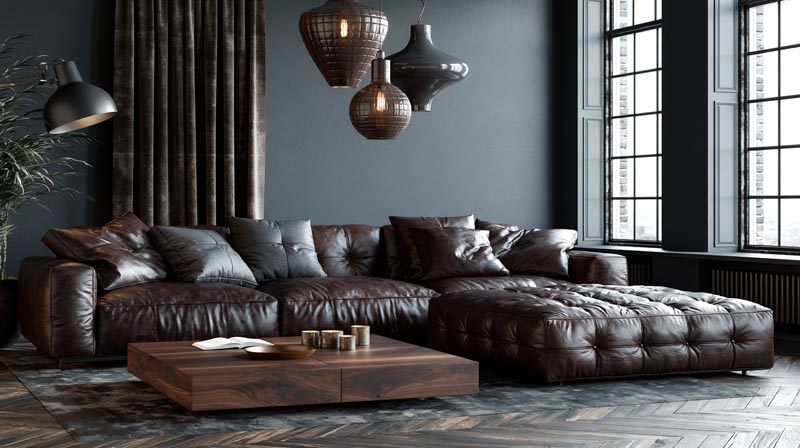
Dark brown furniture, think espresso beds, chocolate leather sofas, and deep walnut dining tables, creates strong visual weight in any room. The wall color either relieves that weight or adds to it. Most rooms benefit from walls that contrast upward in lightness.
The 1stDibs 2026 Interior Design Trends Survey found that chocolate brown was named the top designer color for 2026 by 33% of respondents, nearly double the 17% who chose it in 2022. Dark brown furniture is no longer a compromise. It is a deliberate choice.
Off-White and Warm White Walls
This is the most reliable pairing for dark brown furniture. Off-whites with yellow or pink undertones soften the contrast while keeping the room bright.
- Benjamin Moore Chantilly Lace (OC-17): LRV 92.2. Clean, crisp contrast. Works best in rooms with strong natural light.
- Sherwin-Williams Alabaster (SW 7008): LRV 82. Warm, creamy. Takes the edge off dark espresso without going yellow.
- Benjamin Moore White Dove (OC-17): LRV 85.4. Slightly warmer than Chantilly Lace. Friendlier in lower-light spaces.
True cool white walls (LRV 90+) work against dark brown. The cool undertones flatten the richness of dark wood and push the room toward a clinical look.
Greige and Warm Neutral Walls
Greige walls reduce contrast while keeping the room tonally cohesive. This is the right move in spaces where you want the furniture to anchor the room without stark visual opposition.
Sherwin-Williams Accessible Beige (SW 7036) is the most widely used greige with dark brown furniture. It reads warm without turning yellow, and it does not compete with any brown undertone.
Sherwin-Williams Agreeable Gray (SW 7029) sits slightly cooler. It works when the dark brown furniture has a gray-brown lean rather than a red or amber lean.
Deep Contrast Walls: Navy and Forest Green
Deep wall colors with dark brown furniture create a high-drama, enveloping room. This works in larger spaces with strong light sources. Done well, it is among the most sophisticated results in residential color work.
Navy works because it occupies the opposite end of the warm-cool spectrum from brown, creating clear contrast without brightness. Forest green works because brown and green share a natural, earthy pairing that feels resolved rather than forced.
Both approaches require controlled lighting. Recessed lighting or deliberate accent lighting prevents these rooms from reading dark and heavy.
What to Avoid With Dark Brown Furniture
Cool gray walls are the most common mistake. Grays with strong blue undertones, like many popular mid-tone grays from the 2010s, make dark brown look muddy and drain the warmth from the wood.
Sherwin-Williams Repose Gray (SW 7015) is often cited as safe. But in rooms with dark brown furniture, its cool purple undertone fights the warmth. Test it with a large swatch before committing.
| Wall Color | Paint Reference | Effect With Dark Brown |
|---|---|---|
| Warm white | Alabaster SW 7008 | High contrast, bright, clean |
| Greige | Accessible Beige SW 7036 | Tonal, cohesive, grounded |
| Forest green | Farrow & Ball Mizzle | Dramatic, earthy, sophisticated |
| Navy | Benjamin Moore Hale Navy | Bold contrast, high-end feel |
| Cool gray | Repose Gray SW 7015 | Avoid: flattens warmth, can look muddy |
—
What Wall Colors Go With Light Brown and Honey-Toned Furniture
Light brown and honey-toned furniture, oak, maple, golden teak, pine, carries a strong yellow-amber undertone. Wall colors need to either complement that warmth or introduce enough contrast to keep the room from looking monochromatic.
A 2024 market report noted that 53% of homeowners plan to use natural materials like wood and stone in their decor (News.Market.Us). Honey and oak furniture is at the center of this shift.
Warm Whites and Cream Walls
The safest, most universally successful pairing. Warm whites with a yellow or pink lean echo the amber undertone in honey oak without competing with it.
Benjamin Moore Pale Oak (OC-20) is named partly for this reason. LRV 68.8. It reads as a warm, slightly peachy off-white that ties directly to golden wood tones. Used widely in Scandinavian-influenced spaces that feature light wood furniture throughout.
Sage Green and Muted Olive Walls
Sage green is the most discussed wall color pairing for light brown furniture in 2024 and 2025 design coverage. It works because green and brown share a natural, outdoor reference that feels resolved rather than designed.
- Muted olive amplifies the earthy warmth of honey tones.
- Sage with gray undertones keeps the room cooler and prevents yellow saturation.
- Dusty sage, not bright or saturated green, is the right target.
This pairing is particularly effective in biophilic interior design schemes where natural wood and plant life are both present.
Dusty Blue-Gray Walls
A dusty blue-gray introduces contrast without introducing tension. It sits far enough from the yellow-amber undertone of honey wood to create clear visual separation.
Key rule: the blue-gray must be muted, not saturated. Bright or cool blues will fight the warmth. Chalky, low-saturation blues, closer to denim or slate, work better.
This is one of the pairings that reads differently room by room. Test a 12×12 inch sample against the furniture at different times of day before committing.
—
What Wall Colors Go With Medium Brown Furniture
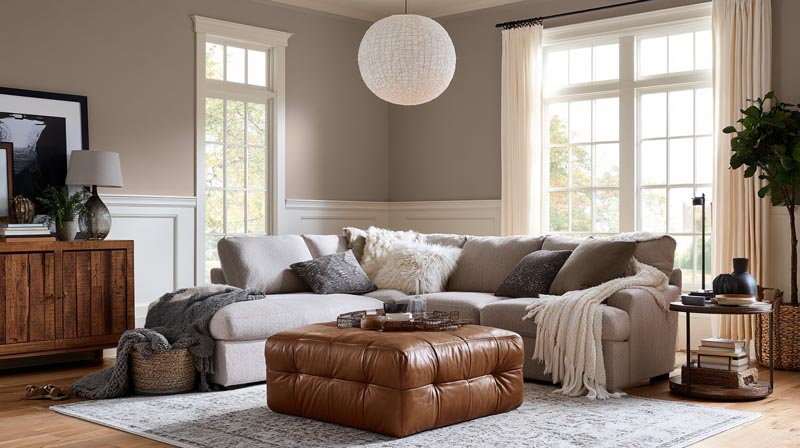
Medium brown is the most common furniture tone in American homes and also the most flexible. It accepts a broader range of wall colors than either light or dark brown because its visual weight sits in the middle of both ends.
Sherwin-Williams Agreeable Gray is consistently the top-selling paint color in the United States. Much of its success comes directly from how well it works alongside medium brown wood tones.
Warm Whites and Taupes
A tone-on-tone approach uses wall colors in the same warm neutral family as the furniture. The room reads cohesive and calm rather than high-contrast.
Best options:
- Benjamin Moore Pale Oak (OC-20): warm, slightly peachy off-white
- Sherwin-Williams Accessible Beige (SW 7036): warm greige, almost no gray
- Benjamin Moore Navajo White (OC-95): creamy, golden neutral
The risk with tone-on-tone is that rooms without strong natural light can read flat. Introduce contrast through textiles and flooring if the room lacks windows.
Muted Greens
Sage and eucalyptus work with medium brown for the same reason they work with light brown. The natural pairing is resolved. But with medium brown, slightly deeper greens, muted olive, dusty hunter green, also hold well because the furniture has more visual weight to balance them.
This is a strong pairing for rustic interior design and farmhouse interior design schemes, where natural wood and organic tones already define the room’s direction.
Soft Blue-Grays
Blue-gray adds contrast without introducing competition. It sits far enough from brown’s warmth to create visual separation, close enough to neutral to avoid making the room feel directional.
Benjamin Moore Gray Owl (OC-52) is a widely recommended option for medium brown furniture. It reads as a soft, almost-white gray with no strong undertone bias, which makes it flexible across varying wood tones in the same room.
—
What Wall Colors Go With Cool-Toned Brown Furniture
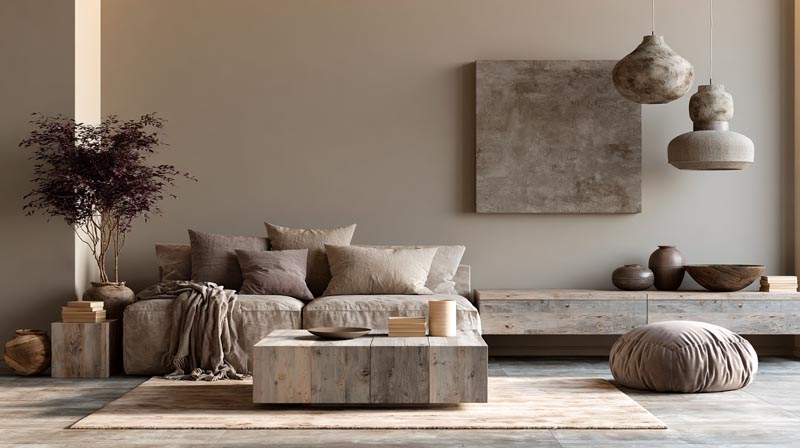
Cool-toned brown furniture, driftwood, ash, weathered gray-brown finishes, and certain painted or washed wood pieces, behaves differently from warm brown. It leans gray rather than amber, which changes the entire pairing logic.
This category is becoming more common in 2024 and 2025 as Scandinavian interior design and organic modern styles continue to drive demand for muted, washed wood tones.
Blue-Gray and Muted Cool Neutrals
Best match for cool-toned brown. The gray lean in the furniture and the gray lean in the wall color create cohesion rather than conflict.
- Sherwin-Williams Repose Gray (SW 7015): works here because the furniture’s undertone matches its purple-gray lean
- Benjamin Moore Gray Owl (OC-52): softer, more neutral, less directional
- Benjamin Moore Pale Oak (OC-20): bridges between warm and cool, works when the brown furniture sits in the middle of the warm-cool spectrum
What Does Not Work With Cool Brown
Warm wall colors fight cool-toned brown furniture. The visual result is a room where nothing settles.
Terracotta pulls hard toward orange and red warmth. Against driftwood or ash furniture, it reads as a mistake rather than a contrast. Mustard or golden yellow walls create the same problem at a higher saturation level.
The test is simple: if your furniture has any gray visible in it, keep the walls in the cool-neutral to cool-color range. Warm colors are for warm-undertoned furniture only.
—
What Role Does Wall Color Saturation Play With Brown Furniture
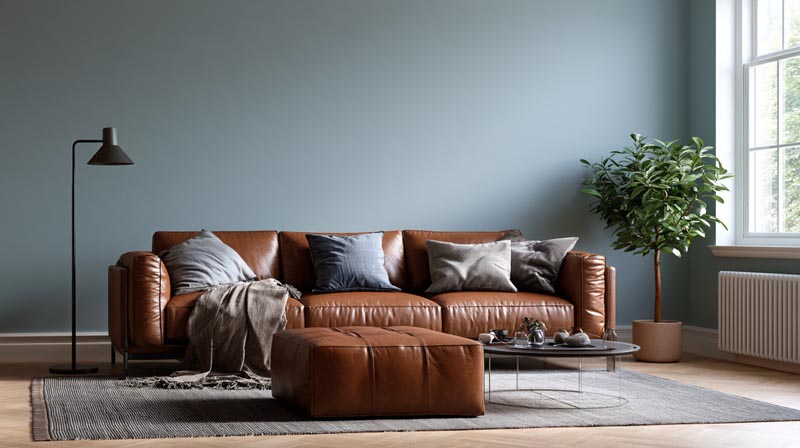
Saturation is how much pure color a paint contains, separate from how light or dark it is. A deep navy and a pale powder blue are different in value, but also in saturation. Both variables affect how brown furniture reads in the room.
According to the European Journal of Theoretical and Applied Sciences, color choices in interiors affect both the aesthetic of a room and the emotional experience of the people in it. Saturation is one of the primary drivers of that emotional response.
High-Saturation Walls: When They Work and When They Don’t
High-saturation walls make brown furniture recede. Deep navy, saturated forest green, and rich burgundy draw the eye to the walls. The furniture becomes a grounding element rather than the visual anchor.
This works in 2 specific conditions:
- Large rooms with strong natural light (south-facing, tall ceilings)
- Intentional design schemes where the wall color is meant to be the feature
In small or dark rooms, high-saturation walls alongside brown furniture create heaviness. The room loses depth and feels compressed.
Low-Saturation Walls: The Safe, Flexible Approach
Muted, low-saturation walls let brown furniture carry the room’s visual weight. This is the pairing logic behind the widespread use of warm whites, greiges, and dusty sage greens with brown furniture.
Matte and eggshell finishes reinforce this effect by absorbing rather than reflecting light. Satin and semi-gloss finishes add reflectivity, which can lighten the feel of a wall color by 5 to 10 LRV points in perception.
This distinction matters in north-facing rooms with limited natural light. A matte greige can read considerably darker there than it does in a paint store sample. Understanding light in interior design and how it interacts with paint saturation is the step most people skip before buying.
| Saturation Level | Effect on Brown Furniture | Best Room Type |
|---|---|---|
| High (navy, deep green) | Furniture recedes, walls become the focal point | Large, well-lit rooms |
| Medium (dusty sage, muted blue) | Balanced visual weight | Mid-size rooms with varied lighting |
| Low (greige, warm white) | Furniture anchors the room | Small rooms with limited natural light |
—
What Paint Colors to Avoid With Brown Furniture
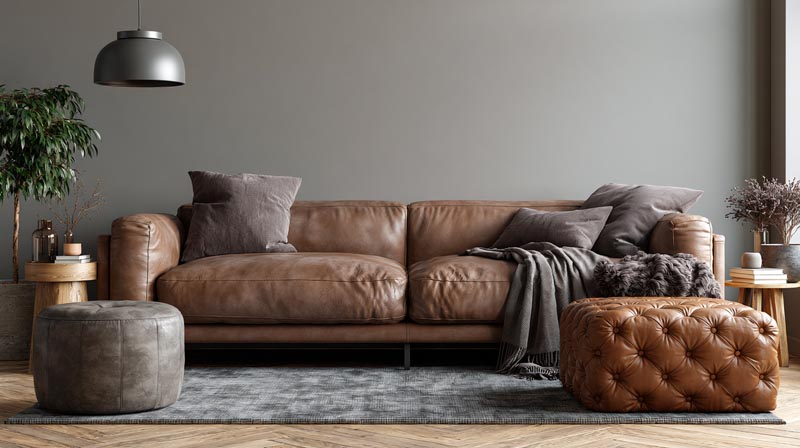
Knowing what does not work is as useful as knowing what does. Several wall color categories consistently fail with brown furniture across all tones and room types. Understanding why they fail makes it easier to avoid similar mistakes in adjacent color families.
A 2024 Fixr survey found that 85% of top design experts recommend warm neutrals to create an inviting feel. The inverse is true: cool, high-contrast, or competing-warmth colors are the most common reasons a room with brown furniture feels off.
Cool Grays With Blue Undertones
The most common mistake. Many of the most popular gray paints from 2010 to 2020 carry a strong blue or purple undertone. Against warm brown furniture, these grays drain the wood’s richness and push it toward a dull, muddy read.
Specifically: Sherwin-Williams Repose Gray (SW 7015) against warm brown, Benjamin Moore Gray Huskie, and most mid-tone blue-grays marketed as “universal neutrals.” These work with cool-toned brown only.
Bright or Saturated Yellows
Honey and oak furniture already carries yellow-amber. A bright yellow wall does not contrast that undertone. Instead, it amplifies it until the room feels oversaturated and close.
Muted, dusty yellows (closer to ochre or straw) can work in specific cases, but anything described as “bright,” “sunny,” or “lemon” is a reliable miss.
Orange-Adjacent Walls With Red-Brown Furniture
Mahogany and cherry furniture carries a red-orange undertone. Terracotta, burnt orange, or rust walls add more of the same undertone rather than providing contrast. The result is a room with no visual relief point, all warmth and no balance.
Contrast rule: when the furniture reads orange-warm, the walls need either to go lighter (warm white, cream) or to shift into a different color family entirely (green, navy). Understanding contrast in interior design prevents this mistake before paint hits the wall.
Bright White in Low-Light Rooms
Bright white walls (LRV 88+) alongside brown furniture in rooms with limited natural light create a jarring result. The furniture looks darker and heavier than it is. The white reads stark rather than clean.
Off-white and warm white (LRV 75 to 85) solve this without sacrificing brightness. The visual result is warmer, more resolved, and more flattering to the wood tones throughout.
How Room Lighting Changes Which Wall Colors Work With Brown Furniture
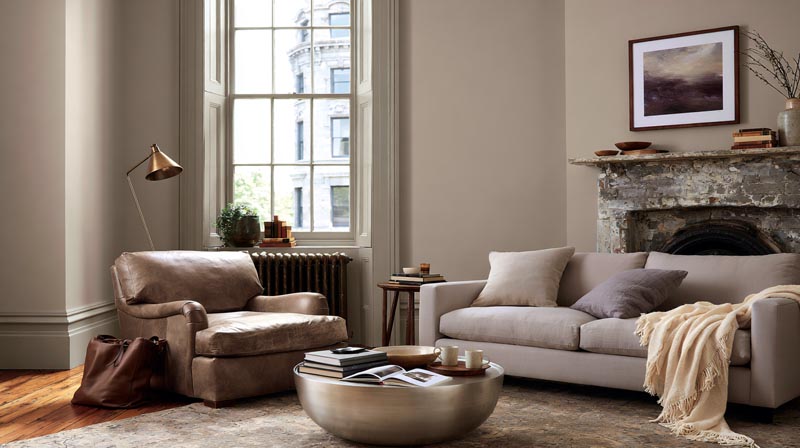
The same wall color looks different in every room. A warm greige that reads perfectly in a south-facing living room can turn flat and dull in a north-facing bedroom. Brown furniture amplifies this problem because its undertones shift depending on how much yellow or blue is in the ambient light.
Farrow and Ball’s color guidance confirms that halogen and incandescent bulbs push yellow warmth into a room, while cool white LED bulbs add a blue cast that affects how warm neutrals and wood tones read against each other.
North-Facing Rooms With Brown Furniture
North-facing rooms receive cool, indirect light throughout the day. Every paint color reads cooler and slightly grayer than it would under direct sun. Warm brown furniture often looks dull in this light if the wall color has any blue or gray undertone at all.
Benjamin Moore’s color guidance recommends yellow-based whites for north-facing rooms specifically because they counteract the blue cast of indirect northern light.
Practical options:
- Benjamin Moore Navajo White (OC-95): warm cream that gains from the cool light rather than fighting it
- Sherwin-Williams Accessible Beige (SW 7036): reads as a resolved warm neutral even in limited daylight
- Avoid cool-leaning grays entirely in north-facing rooms with warm brown furniture
South-Facing Rooms With Brown Furniture
South-facing rooms receive the most natural light. Warm light dominates from late morning through mid-afternoon, which intensifies any warm undertone already present in brown furniture.
The result: south-facing rooms can handle deeper, more saturated wall colors alongside brown furniture without the room feeling closed-in.
Navy, forest green, and deep greige all work here because the strong light prevents them from reading dark. This is also where cool wall colors, including soft blue-grays, perform best alongside warm brown wood tones.
Artificial Lighting and Brown Furniture Rooms
Warm-toned bulbs (2700K to 3000K) amplify yellow and amber undertones in both the wall paint and the wood. This benefits warm brown furniture rooms by making the overall scheme read richer and more intentional.
Cool daylight bulbs (5000K+) neutralize warmth. Used in a room with honey oak furniture and warm white walls, they can make the whole scheme look washed out and gray. They suit cool-toned brown furniture rooms better.
The practical test: paint a 12×12 inch sample on the wall and view it under your actual lighting at three times of day, morning, afternoon, and evening with lights on. Relying on a paint chip under store fluorescents leads to the most common repaint regrets (Benjamin Moore color consultation guidance, 2024).
| Room Condition | Effect on Brown Furniture | Wall Color Approach |
|---|---|---|
| North-facing, indirect light | Wood looks cooler and flatter | Warm whites, yellow-based creams |
| South-facing, strong natural light | Warmth intensifies | Wider range of colors, including deeper shades |
| Warm bulbs (2700K) | Amber undertones are amplified | Cool-neutral walls provide balance |
| Cool bulbs (5000K+) | Warmth is neutralized | Warm wall colors help restore balance |
—
What Accent Colors Complete a Room With Brown Furniture and Colored Walls
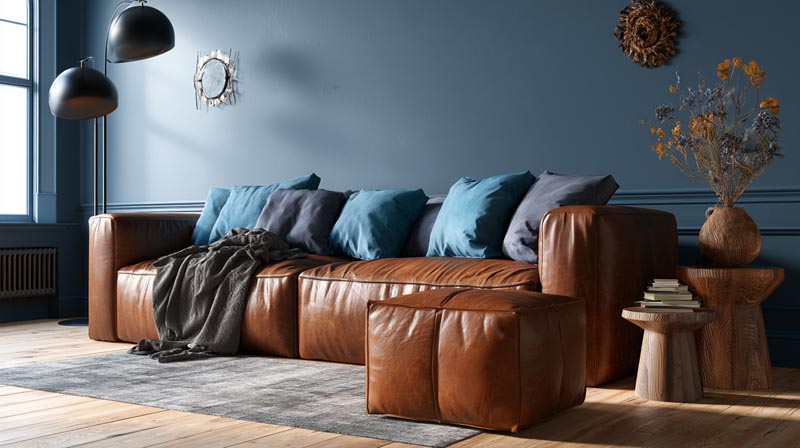
Wall color and furniture are 2 of the 3 layers in a complete room palette. The accent layer, the remaining 10% in the 60-30-10 color rule, is where the room stops looking like a staged display and starts feeling resolved.
Interior designer Artem Kropovinsky notes that brown’s position on the color wheel makes it directly complementary to blue-based hues, which is why teal, dusty blue, and navy accents consistently read well against brown furniture regardless of wall color.
Accent Colors for Warm White Walls and Brown Furniture
Warm white is the most common wall color with brown furniture. The accent layer carries the visual interest.
Best accent combinations:
- Burnt orange and rust: deepens the earthy warmth without adding a second competing neutral
- Teal and brass: teal introduces cool contrast, brass ties back to the amber in the wood
- Olive green: adds organic depth, especially effective with honey and walnut tones
These combinations appear frequently in earthy color palette interior design schemes and in warm-toned mid-century modern interior design rooms where brown wood furniture is already foundational.
Accent Colors for Sage Green Walls and Brown Furniture
Sage green plus brown is an already warm, natural pairing. The accent color needs to either deepen the scheme or introduce a single point of contrast.
Muted gold works because it echoes the amber in brown wood and elevates the sage from casual to polished. Linen and cream textiles keep the room from feeling saturated. A single deeper green accent, forest or bottle green in a throw or cushion, adds depth without breaking the palette.
Bright accent colors fight this pairing. Red, electric blue, and saturated orange all introduce visual noise that the natural earthiness of sage and brown cannot absorb.
Accent Colors for Navy Walls and Dark Brown Furniture
This is a high-contrast, high-drama pairing. Accents must be light or metallic to prevent the room from reading entirely dark.
Brass and gold are the most effective accents here. They introduce warmth without adding more cool tones, and they bridge the navy wall and the dark brown furniture visually. Cream and off-white textiles provide relief. Natural linen and jute keep the scheme grounded rather than formal.
Veranda magazine confirmed in 2024 that rich, deep hues combined with brass and natural materials are among the strongest residential color directions in current design practice.
—
How Brown Furniture Works in Specific Room Types
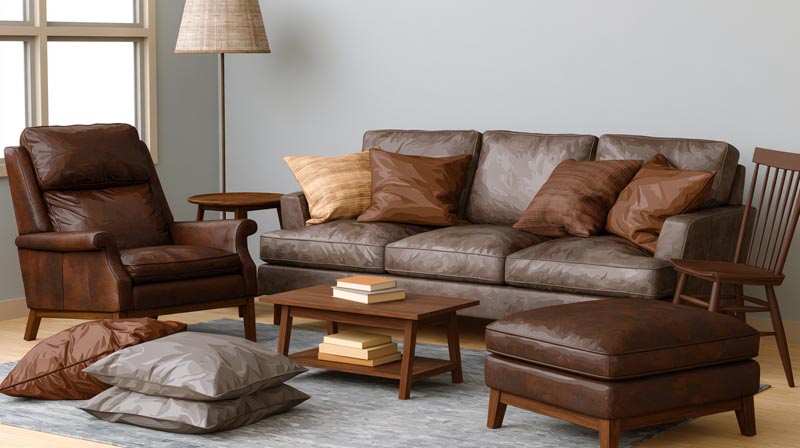
Wall color logic shifts depending on the room’s function. A bedroom asks for calm. A dining room benefits from warmth that encourages lingering. A home office needs visual clarity. Brown furniture serves all three contexts, but the wall color that works in each is different.
A 2024 Opendoor report found that U.S. consumers spend an average of $5,635 on home renovation projects, with kitchen and living room updates consistently ranking as top priorities. Brown furniture decisions most directly affect those rooms.
Living Rooms: Brown Sofas and Entertainment Units
Brown leather and upholstered sofas are the most common starting point for living room color decisions. NYC interior designer Dana Feagles recommends soft, moody blues, specifically Benjamin Moore Normandy, for medium to dark brown wood furniture in more traditional living room schemes.
Wall color by sofa tone:
- Dark espresso or chocolate sofa: warm white, greige, or deep navy
- Cognac or tan leather: sage green, warm cream, or dusty blue
- Mid-tone brown sectional: nearly any warm neutral, from greige to soft taupe
For open floor plan ideas where the living room connects to a dining area, keeping one consistent wall color across both zones prevents the brown furniture from reading differently in each space due to lighting shifts.
Bedrooms: Brown Bed Frames and Dressers
Calming colors are the primary target for bedrooms. According to RMCAD’s 2025 analysis of interior color trends, sage green, cream, and pale blue are the leading bedroom palette choices for 2025, all of which pair naturally with brown wood furniture.
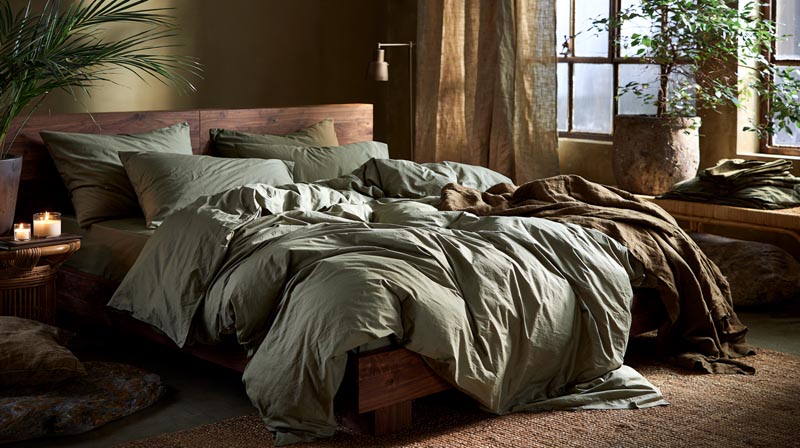
Dark espresso bed frames on pale blue or soft sage walls create visual separation between the furniture and the wall. This prevents the room from feeling heavy despite the dark wood.
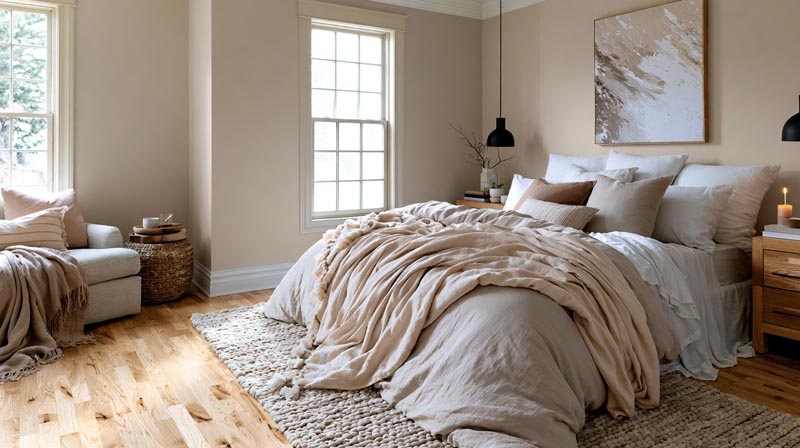
Warm taupe walls with mid-brown furniture create a tone-on-tone bedroom. Calm, resolved, and practical. The tradeoff is that the room lacks a focal point unless the bedding or lighting introduces contrast.
Dining Rooms: Brown Tables and Chairs
Dining rooms benefit from warmth that makes people want to stay at the table. Dark brown dining tables with warm white or cream walls create the clearest visual relationship between the table surface and the wall behind it.
Forest green dining room walls with a dark walnut table have become one of the most photographed combinations in residential design across 2023 and 2024. The pairing references the look of a Victorian or traditional English dining room without requiring period-specific decor.
Deep wall colors in dining rooms require deliberate lighting. Pendant lighting positioned over the table prevents the room from reading as a dark box when the walls are navy or green.
Brown Furniture in Small Dining Rooms
Light walls are not mandatory. A small dining room with dark brown furniture and a deep sage or soft charcoal wall can feel intimate and intentional rather than compressed, provided the ceiling is light and the lighting is warm.
The error is dark walls plus dark furniture plus no contrast element. Adding a white ceiling, light window treatments, or a pale-toned rug breaks the compression.
Home Offices: Brown Desks and Storage Units
Brown desks, whether walnut, oak, or espresso finish, are among the most popular home office furniture choices because they read as professional without the coldness of black or white.
Sage green walls are the most commonly recommended pairing for home office brown furniture, cited by design experts as balancing focus and calm (RMCAD, 2025). The earthy combination avoids both the clinical edge of gray-white offices and the heaviness of dark-on-dark schemes.
Warm gray walls, specifically Benjamin Moore Gray Owl (OC-52), work well with mid-tone brown desks for a more neutral, understated office that reads professional without any obvious color direction. This suits contemporary interior design home offices where the furniture is meant to blend rather than stand out.
Brown Furniture in Open-Plan Spaces
Brown furniture anchors open-plan rooms when the walls use a soft, receding color. Deep brown sofas and dining tables in a single large space benefit from a consistent wall color across all zones. Switching wall colors between zones when brown furniture spans them creates visual fragmentation rather than definition.
A single warm white or greige across the full open plan, with zone definition coming from rugs, lighting, and textiles, is the most resolved approach. This is standard practice in the contemporary farmhouse interior design and modern organic interior design spaces where brown wood furniture and warm neutrals define the overall scheme.
FAQ on What Color Walls Go With Brown Furniture
What is the best wall color for brown furniture?
Warm white is the most reliable choice. Off-whites with yellow or pink undertones, like Sherwin-Williams Alabaster (SW 7008) or Benjamin Moore White Dove, create clean contrast without draining the warmth from the wood.
Do gray walls go with brown furniture?
Warm grays work. Cool grays do not. A greige like Sherwin-Williams Accessible Beige complements brown furniture well. Grays with blue or purple undertones, like Repose Gray next to warm brown, flatten the wood and make it look muddy.
What color walls go with dark brown furniture?
Warm white, greige, deep navy, or forest green. Dark espresso and chocolate furniture needs either light walls for contrast or deep, saturated walls for a dramatic, intentional look. Avoid mid-tone cool grays entirely.
Do blue walls go with brown furniture?
Yes. Blue and brown sit opposite each other on the color wheel, making them a natural complementary pairing. Dusty, muted blues work best. Soft navy or slate blue alongside dark walnut or mahogany is one of the strongest combinations available.
What wall color goes with honey oak or light brown furniture?
Warm whites, sage green, and muted olive all complement honey and amber-toned wood. Benjamin Moore Pale Oak (OC-20) is a particularly well-matched choice. Avoid cool or bright colors that fight the yellow-amber undertone in the wood.
Does green work as a wall color with brown furniture?
Sage green and muted olive are among the most consistently successful pairings for brown furniture. Green and brown share a natural, earthy reference that feels resolved. Stick to low-saturation, dusty greens rather than bright or lime-toned shades.
What wall color makes a small room with brown furniture look bigger?
Light walls with a high LRV, above 70, create the most visual space. Warm whites and soft creams reflect light and prevent dark brown furniture from compressing the room. Avoid matching dark walls to dark furniture in small spaces without strong lighting.
Can you use dark wall colors with brown furniture?
Yes, in rooms with strong natural light or deliberate layered lighting. Deep navy, forest green, and rich charcoal all work alongside dark brown furniture in south-facing or well-lit rooms. The key is adding light-toned accents, cream textiles, brass, or pale rugs, to prevent the room from feeling heavy.
What accent colors work with brown furniture and neutral walls?
Burnt orange, rust, teal, olive green, and muted gold all pair well. Teal and brass together with dark brown on warm white walls is one of the most versatile combinations. The accent layer is where the room moves from functional to finished.
Does white go with brown furniture?
Off-white and warm white, yes. Pure bright white with warm brown furniture in low-light rooms creates a jarring contrast. Choose whites with an LRV between 75 and 85 and a yellow or pink undertone for a result that feels warm rather than clinical.
Conclusion
This conclusion is for an article presenting wall color pairings for brown furniture across every tone, room type, and lighting condition.
The core rule holds throughout: identify the undertone first, then match or contrast from there.
Warm white and greige cover most situations. Sage green, dusty blue-gray, and forest green handle the rest.
Paint color undertones matter more than the color name on the tin. A warm brown sofa and a cool-toned gray wall will always fight, regardless of how “neutral” the swatch looked in the store.
Test large samples under your actual lighting. Use the 60-30-10 rule to layer accent colors over the wall and furniture base.
Get those two steps right, and the room takes care of itself.

- Kitchen Color Schemes by Cabinet Color: What Pairs Well - October 19, 2026
- Curtain Colors for Every Wall Color: Safe vs Bold Picks - October 18, 2026
- Interior Design Styles: Find Your Primary and Secondary - October 14, 2026