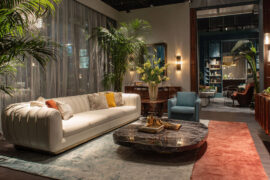
The sofa is the one piece of furniture that defines every other decision in a living room.
Get it right and the whole room works. Get it wrong and no amount of styling fixes it.
Contemporary sofa designs cover a wide range of silhouettes, materials, and price points, from Scandinavian tight-back sofas with tapered walnut legs to low-profile Italian sectional configurations built for open-plan spaces. The global sofa market was valued at USD 30.21 billion in 2024, reflecting just how central this furniture category is to how people live and design their homes.
This guide covers everything from sofa types and upholstery fabric options to placement rules, brand tiers, and how to spot quality construction before you buy.
What Is a Contemporary Sofa Design?
A contemporary sofa design is a piece of seating furniture that reflects what is current right now, not a fixed historical period. It borrows from multiple movements, including Scandinavian design, Italian minimalism, and mid-century crossover, without being defined by any single one.
This is the most common point of confusion: people use “contemporary” and “modern” as if they mean the same thing. They don’t.
- Modern design refers to a specific movement rooted in the 1920s through 1970s, characterized by Bauhaus influence, raw materials, and functional form.
- Contemporary design shifts with time. A sofa that was contemporary in 2015 may not read that way in 2025.
- Visual markers in 2025 include: clean lines, low-profile silhouettes, muted or neutral palettes, and mixed materials like boucle paired with matte black metal legs.
The global contemporary sofa market was valued at approximately USD 30.21 billion in 2024, projected to reach USD 44.38 billion by 2033 at a CAGR of 3.56% (Business Research Insights, 2024).
Understanding what contemporary interior design actually means helps clarify why the sofa sits at the center of a room’s visual identity. It is the largest piece of furniture in most living spaces, and its silhouette sets the design register for everything around it.
What Are the Main Types of Contemporary Sofa Designs?

Contemporary sofas fall into distinct categories based on configuration, cushion structure, and scale. Each type serves a different spatial need and aesthetic priority.
| Type | Key Feature | Best For |
|---|---|---|
| Modular / Sectional | Individual “modules” that can be rearranged or expanded over time. | Open floor plans, frequent entertainers, and growing households. |
| Curved / Organic | Soft, sweeping silhouettes without sharp angles; often backless or low-profile. | Statement living rooms and creating a conversational “flow.” |
| Deep-Seat / Cloud | Oversized depth (often 40″+) and feather-filled “sink-in” cushions. | Casual media rooms and maximum relaxation. |
| Japandi / Slatted | Low-profile wood frames (Oak/Acacia) with linen or boucle upholstery. | Minimalist interiors and fans of natural, sustainable textures. |
| Apartment / Loveseat | Compact footprint (under 80″) with slim arms to maximize seating area. | Small urban apartments, home offices, or bedroom nooks. |
| Convertible / Sofa-cum-Bed | Hidden pull-out mechanisms or “click-clack” flat-folding backs. | Studio living and multi-functional guest spaces. |
Modular sofas dominate the product segment, holding 28.3% of the modular furniture market in 2024 (Market.us, 2024). Their growth is tied directly to smaller urban living spaces.
Sectional vs. Modular: What Is the Difference?

Sectional sofas are sold as a fixed set of pieces, typically 2 to 4 connected units with a defined configuration. You choose from a limited number of preset layouts.
Modular sofas are sold as individual components you build from. You can add, remove, or rearrange units over time. Brands like Burrow and HAY Mags are built entirely on this premise.
The distinction matters for buyers who move often or live in spaces where the layout changes. For a fixed family home, a sectional may be the better investment for price per quality.
Which Sofa Profiles Are Considered Contemporary?
Not every sofa silhouette reads as contemporary. The Camelback profile, with its arched back, belongs firmly in traditional territory. The Bridgewater, with its rolled arms and loose cushions, sits in the transitional zone.
Profiles that register as contemporary in 2025: tight-back Lawson, bench-seat tight-back, and armless configurations. These work because line in interior design is what carries the style signal, and clean, unbroken horizontal lines are the defining characteristic of contemporary seating.
What Materials Are Used in Contemporary Sofa Designs?
The upholstery fabric market was valued at USD 44.5 billion in 2023 and is projected to reach USD 89 billion by 2031 at a CAGR of 6.36% (Verified Market Research, 2023). This growth is driven largely by demand for performance and sustainable fabrics in residential furniture.
Upholstery Options

Performance fabrics (Crypton, Sunbrella-based weaves) lead residential sofa sales right now. They resist stains, repel moisture, and hold up in households with pets and children without sacrificing texture.
In 2023, fabric sofas held 35% of the total sofa market and were the fastest-growing segment, ahead of leather (Verified Market Reports, 2023). Boucle and performance velvet are the two textures most associated with the contemporary aesthetic this decade.
- Boucle: Looped wool or wool-blend weave. Warm visual texture, reads contemporary-organic.
- Performance velvet: Polyester-based, crushable, rich color depth. Works in both casual and formal contemporary rooms.
- Linen blend: Natural look, breathable, best for cooler color palettes.
- Leather and vegan leather: Still relevant at higher price points, especially in Italian contemporary design.
Frame and Leg Materials
The frame you cannot see is the one that matters most for longevity. Kiln-dried hardwood resists warping and shrinkage. Engineered wood and particleboard are common in mass-market pieces under $1,200 and they perform accordingly.
Leg finishes tell the style story immediately. Contemporary interior design tends toward 4 finish types:
- Matte black metal (industrial-contemporary crossover)
- Natural or smoked walnut (Scandinavian-influenced contemporary)
- Brushed brass (warmer contemporary, pairs with boucle)
- Chrome (leaning modern rather than contemporary, use carefully)
Texture is not just about upholstery. The interplay between a smooth fabric and a rough-hewn walnut leg is what creates visual depth. For more on how material contrast works spatially, texture in interior design covers the underlying principles.
What Colors Define Contemporary Sofas Right Now?
Contemporary sofa color in 2024 and 2025 is almost entirely built around warm neutrals and earthy accents. The cold grey palette that dominated the previous decade has largely been replaced.
Dominant Neutrals in 2025
Warm white, greige, camel, cognac, and charcoal are the 5 core neutrals that appear across brand lines from IKEA to Poliform. These read as contemporary because they are quiet enough not to compete with the sofa’s form.
Monochromatic upholstery dominates contemporary sofa styling because it puts the silhouette first. A busy pattern interrupts the clean line the design is built on.
Accent Colors Gaining Ground
Terracotta, sage green, and dusty blue are present across the mid-range and high-end markets. These are not primary accent colors, they sit in the muted register of the earthy palette.
Key point: color naming by brand varies dramatically. West Elm’s “Sand” is a warm greige. Poliform’s “Ivory” skews warm white. Comparing by actual color family, not label, matters when pairing with wall color and flooring.
Color decisions on a sofa ripple through the entire room. Color in interior design and its relationship to natural light, wall finish, and flooring material is worth understanding before committing to a specific upholstery shade.
Which Contemporary Sofa Designs Work for Small Spaces?

The average size of newly constructed U.S. homes fell to a median of 2,179 square feet in 2023, the smallest in 13 years (National Association of Home Builders, June 2024). This shift has real consequences for sofa selection in urban and suburban apartments alike.
Key Dimensions for Small-Space Sofas
Seat depth under 35 inches. This single measurement does more for a tight room than anything else. Deep-seat sofas (36+ inches) eat floor space and visually compress the room.
Overall length under 84 inches keeps options open for traffic flow on both sides.
- CB2 Lapis two-seater: 71 inches wide, 30-inch seat depth
- Article Sven two-seater: 74 inches, 33-inch seat depth
- IKEA Uppland: 82 inches, modular-friendly at its price point
What to Avoid in Small Rooms
Platform bases close the room off visually. Raised legs, even at 4 to 6 inches, allow light to pass underneath the sofa and read as more open.
Rolled arms and skirts add visual bulk at the sides and bottom. In a small contemporary living room, these details add perceived mass without adding actual seating area. They also anchor the piece stylistically in a traditional direction, which creates a mismatch with the rest of a clean, contemporary scheme.
For ideas on how to set up a small contemporary living room around a scaled sofa, small contemporary living room ideas covers layout and proportion in practical terms.
What Are the Most Recognized Contemporary Sofa Designs by Style Movement?
Contemporary sofas draw from 4 main design movements without belonging entirely to any of them. The movement determines the silhouette, material palette, and leg treatment.
| Movement | Key Markers | Example |
|---|---|---|
| Scandinavian | Tapered legs, tight back, light upholstery, natural wood frames. | HAY Mags, Muuto Connect |
| Italian Minimalism | Low profile, monolithic form, deep seating, premium materials (leather/wool). | B&B Italia Tufty-Time, Flexform Groundpiece |
| Mid-Century Crossover | Walnut or acorn-finish legs, button-free cushions, structured track arms. | Joybird Briar, West Elm Andes |
| Japanese Minimalism | Floor-level platforms, clean geometry, zero ornamentation, neutral linen. | Muji low-profile series, Karimoku Case Study |
Scandinavian Contemporary Sofas
Scandinavian-influenced contemporary sofas rely on 3 features: tapered or dowel legs in light or smoked wood, tight backs with no loose cushions, and upholstery in natural fiber tones like oatmeal, cream, or warm grey.
HAY, a Danish brand, and Muuto, also Danish, are the two most-cited specification-grade references for this aesthetic. Both offer modular versions of their flagship sofas, making them practical for residential projects where future reconfiguration is likely.
Italian Contemporary Sofa Designs
Italian minimalism produces the most widely referenced high-end contemporary sofas. Poliform, B&B Italia, Flexform, and Minotti are the 4 brands designers mention most when specifying sofas in residential projects above $500,000 budgets.
The defining quality is proportion. Italian contemporary sofas tend to sit very low to the floor (seat heights of 14 to 16 inches), have deep cushion stacks, and use COM (Customer’s Own Material) upholstery as standard. The B&B Italia Tufty-Time, designed by Patricia Urquiola, remains one of the most commercially recognized examples of contemporary Italian sofa design globally.
Mid-Century Crossover in Contemporary Design
Mid-century crossover sofas keep walnut legs and structured cushion profiles but update the details: no tufting, no button backs, no contrast piping. The result reads contemporary rather than period-specific.
This category dominates mid-range retail. West Elm, Joybird, and Article all run their bestselling sofas in this zone. For buyers who want the visual warmth of mid-century modern interior design without committing to a period aesthetic, these sofas hit the right balance.
How Do Leg Style and Base Design Change a Contemporary Sofa’s Look?
Leg and base design is the fastest visual signal a sofa sends about its style register. Before anyone reads the cushion fabric or arm profile, the base anchors the piece in a specific aesthetic category.
The 4 Base Types and What They Signal
Tapered wood legs signal Scandinavian or mid-century contemporary. They add warmth and lightness simultaneously, which is why they appear on more contemporary sofas than any other base type.
Platform or plinth base is a monolithic solid structure with no visible legs. It signals high-end Italian minimalism. Poliform and Minotti use this construction frequently. The trade-off: it looks expensive and is harder to clean underneath.
Metal sled or square tube legs cross into industrial-contemporary territory. Matte black is the dominant finish. This works well in loft spaces and open-plan layouts where the sofa sits alongside exposed materials.
Hairpin legs are the lightest visual option. They create minimal visual contact with the floor, which reads as open and airy. They appear more in mid-century crossover sofas than in pure contemporary minimalist designs.
Leg Finish and Style Register
The same sofa silhouette reads differently depending on leg finish alone. This is something most buyers underestimate when ordering online without seeing the piece in person.
- Matte black metal: Sharper, more graphic. Pushes the piece toward a contemporary-industrial direction.
- Natural walnut: Warmer, more organic. Moves the piece toward Scandinavian or mid-century contemporary.
- Brushed brass: Warmer still, slightly formal. Works in contemporary spaces with warmer upholstery tones like camel or cognac.
- Smoked oak: Earthy, current in 2024-2025. Pairs naturally with boucle and linen blend fabrics.
The leg finish should be read alongside other metal finishes in the room. A brushed brass sofa leg next to chrome light fixtures creates a disjointed finish palette. Details in interior design covers how small decisions like this accumulate into a cohesive or incoherent space.
What Cushion and Back Configurations Are Common in Contemporary Sofas?
Cushion configuration is the most overlooked detail in contemporary sofa design. It directly affects how the sofa looks in 5 years, not just when it arrives.
Contemporary sofas favor tight-back or knife-edge cushion profiles over deep-set, pillow-back arrangements. The reason is simple: loose back cushions drift, bunch, and require constant restyling to maintain a clean line.
Seat Cushion Formats
Bench seat cushion: one continuous cushion across the full seat width. This is the most contemporary-reading format, preferred in Italian and Scandinavian designs.
Individual seat cushions: 2 or 3 separate cushions. More common in transitional and mid-century crossover sofas. Slightly warmer in feel but harder to keep aligned.
High-resilience foam with a density of 2.5 to 3.0 lb/ft3 is the material benchmark for seat cushion longevity, lasting approximately 12 years under normal use (FoamOnline). Anything below 1.8 lb/ft3 starts losing shape within 2 to 3 years.
Fill Types and What They Mean for Longevity
Foam-only cores are firmer and more structured. They read clean and maintain their silhouette well. Foam-wrapped-down is softer and more casual, associated with the cloud sofa aesthetic that dominated social media between 2022 and 2024.
- HR foam (high resilience): best lifespan, structured appearance, holds form after years of use
- Foam-wrapped down: immediate comfort, sinks over time, requires regular fluffing
- Dacron wrap over foam: mid-range option, softer than HR alone, used by most mid-market brands
What “Cloud Sofa” Actually Means Structurally

The cloud sofa is not a brand. It is a configuration type: oversized back cushions, 36+ inch seat depth, loose-filled cushions with high down content, and usually a platform or plinth base.
West Elm’s Harmony sofa and the Restoration Hardware Cloud sofa are the 2 most widely replicated references for this format. The trade-off is maintenance: the softer the fill, the more reshaping it needs weekly.
Which Contemporary Sofa Brands Are Most Referenced by Designers?
The luxury furniture market was valued at USD 29.13 billion in 2024 and is projected to reach USD 40.69 billion by 2030 at a CAGR of 5.73% (Markntel Advisors, 2024). In 2024, about 22% of major luxury furniture companies launched eco-friendly collections using recycled and sustainable materials (Business Research Insights, 2024).
| Tier | Brands | Price Range (Sofa) |
|---|---|---|
| Specification Grade | B&B Italia, Poliform, Flexform, Minotti, Cassina | $10,000+ |
| High-end Accessible | Maiden Home, Mitchell Gold + Bob Williams, Restoration Hardware (RH) | $4,000 – $10,000 |
| Mid-range Designer | Article, Burrow, Interior Define, Joybird, Floyd | $1,200 – $4,000 |
| Mass Market Contemporary | West Elm, CB2, IKEA (Kivik, Uppland), Castlery | $400 – $1,200 |
What Separates Specification Grade from Retail Grade
3 differences matter in practice: frame construction, cushion lifespan, and COM availability.
Specification-grade sofas use kiln-dried hardwood throughout, not just in the main rail. COM (Customer’s Own Material) upholstery is standard at B&B Italia and Poliform, allowing architects and designers to specify exact fabric grades. Retail-grade pieces offer preset fabric options only.
Frame warranty is the fastest quality signal to check: 5 years is baseline for mid-range, lifetime frame warranty is common at specification grade. Maiden Home, a U.S.-based brand in the high-end accessible tier, advertises kiln-dried hardwood frames and a lifetime structural warranty at $3,500 to $6,500 price points.
Designer Preference Patterns in Practice

Poliform dominates residential specification above the $500,000 project budget level. Its collaboration history with Jean-Marie Massaud and Carlo Colombo gives it a consistent design language across product categories.
For mid-range residential projects, Maiden Home and Interior Define are the 2 most-used U.S. brands. Both offer fully customizable upholstery, solid wood frames, and lead times of 8 to 12 weeks from COM specification.
How Is a Contemporary Sofa Placed in a Living Room?
According to a 2023 Houzz survey, 67% of homeowners prioritize maintaining window views when arranging living room furniture. Poor traffic flow is the number one functional complaint among homeowners, according to a 2023 study by the Interior Design Association.
Floating vs. Against the Wall
Floating the sofa, positioning it away from the wall with 12 to 36 inches of clearance behind it, is the standard approach in contemporary interior styling. A sofa pushed flush against a wall makes a room feel smaller and less intentional.
Interior designer Sara Chiarilli Davis of Artful Conceptions states that sofas should “almost always be floated,” noting that furniture up against a wall feels “under arrest” and disconnects the room visually.
Minimum room size to float a sofa: 12 x 15 feet, with 30 to 36 inches of clearance required for walkable traffic flow on all sides.
Rug and Coffee Table Proportions
2 rules apply consistently across contemporary living room layouts.
Front legs on rug: placing only the two front sofa legs on the area rug anchors the seating zone without over-committing the rug size. This works in rooms where an all-legs-on-rug approach would require a rug larger than the furniture arrangement warrants.
Sofa to coffee table distance: 14 to 18 inches is the functional standard. Less than 14 inches limits legroom. More than 18 inches breaks the visual relationship between the pieces. For more on how scale and proportion in interior design affect seating arrangements, those principles apply directly here.
Seating Arrangement Configurations
The 4 layouts used in contemporary living rooms:
- Single sofa + 2 accent chairs facing (most common in smaller rooms)
- 2 sofas facing each other, 6 to 8 feet apart
- L-shaped sectional + 1 accent chair (works in open-plan layouts)
- U-shaped configuration with sectional + bench or ottoman
Studio McGee’s design team consistently pairs 1 sofa with legs against 1 sofa with a solid or skirted base to vary visual weight. The rule: never use the same base type on every piece of seating in the same room. This creates the variation that makes a contemporary contemporary living room feel designed rather than assembled.
What Is the Price Range for Contemporary Sofas?
The average American household spends between $1,400 and $1,800 on a new full-size sofa in 2025 (Hernest, 2026). Sofas at the $300 to $1,000 range typically last 3 to 5 years under normal use. Mid-range options at $1,000 to $3,000 stay structurally sound for 7 to 10 years. Premium pieces above $2,000 with proper construction can last 15 years or more (Chita Living, 2025).
Price Tiers and What Each Buys
Entry ($400-$1,200): IKEA, Wayfair private label, Amazon Rivet. Sinuous spring or webbing foundations. Foam-only cushions at 1.5 to 1.8 lb/ft3 density. Limited frame details. Fine for 3 to 5 years in low-use rooms.
Mid-range ($1,200-$4,000): West Elm, Article, Crate and Barrel, Burrow. Kiln-dried hardwood in most cases. Foam-wrapped-down or high-resilience foam cushions. 5-year frame warranties are common. This is where contemporary design variety is widest.
High-end accessible ($4,000-$10,000): RH, Maiden Home, Mitchell Gold + Bob Williams. 8-way hand-tied spring construction available. COM upholstery on request. Longer lead times (8 to 14 weeks) but substantially better cushion lifespan.
Specification grade ($10,000+): Poliform, B&B Italia, Minotti, Flexform. Full COM capability. Lifetime frame warranties. Designed for residential projects where the sofa is expected to last the lifetime of the renovation.
What Drives Price Within Each Tier
Frame construction cost difference: kiln-dried solid hardwood versus plywood adds roughly $500 to the manufacturer cost (Insider’s Guide to Furniture). Spring construction difference: 8-way hand-tied coils cost a couple of hundred dollars more than sinuous wire at the manufacturer level, but both that and down-wrapped cushioning add up to a significant retail markup.
Fabric cost at the mill ranges from $2.50 to $25 per yard. An average sofa uses around 16 yards, so material cost at manufacturer level ranges from $40 to $400, regardless of what the retail price says. Fabric price does not equal fabric durability. Performance fabrics in the $5 to $8 per yard mill range can outperform decorative fabrics at $20 per yard for stain resistance and wear.
How Do You Identify a High-Quality Contemporary Sofa?
Most buyers cannot see the frame or spring system before purchasing. The quality signals that are visible and testable are worth knowing before you sit down in a showroom or unbox a delivery.
Frame and Foundation Tests
Press firmly into the corners of the sofa seat. Solid hardwood frames resist flex. Particleboard or softwood frames give slightly under pressure, particularly at the joints. This test takes 10 seconds and tells you more than the product description.
Spring systems ranked by durability:
- 8-way hand-tied coil: lasts 20+ years, most labor-intensive to produce
- Sinuous (no-sag) wire: lasts 10 to 20 years, standard in most mid-range sofas
- Webbing: shortest lifespan, found primarily in entry-level pieces
Cushion and Upholstery Checks
Lift a seat cushion and check the density of the foam core. Foam that compresses more than 2 inches under moderate hand pressure is likely below 1.8 lb/ft3 density. High-resilience foam at 2.5 to 3.0 lb/ft3 should feel firm but responsive.
Seam and stitching quality on a contemporary sofa should show:
- Pattern alignment across seams (not offset by more than 2mm)
- Double-stitched seams at stress points (arms, front seat edge)
- Consistent welt cord width along all edges
Leg Attachment and Warranty Terms
Legs bolted through the frame are more durable than glued blocks. Ask the brand or check the spec sheet. A 5-year frame warranty is the minimum benchmark for mid-range. Brands that offer less than this on frames above $2,000 are signaling something about the construction confidence.
The contemporary living room decor a sofa anchors only holds together long-term if the sofa itself holds together. Construction is the foundation. Everything else, the upholstery color, the leg finish, the cushion profile, is built on top of it.
FAQ on Contemporary Sofa Designs
What is the difference between a contemporary sofa and a modern sofa?
Modern refers to a fixed design period rooted in the 1920s to 1970s, defined by Bauhaus influence and raw materials. Contemporary means current right now. It shifts with time and borrows from multiple movements without being anchored to one.
What sofa styles are considered contemporary in 2025?
Tight-back Lawson profiles, bench-seat sectionals, low-profile platform sofas, and armless configurations all read as contemporary. Boucle and performance velvet upholstery, matte black or walnut legs, and clean horizontal lines are the key visual markers this year.
What is the best fabric for a contemporary sofa?
Performance fabric is the top choice for households with pets or children. Boucle suits lower-traffic spaces. Linen blends work well in Scandinavian-influenced rooms. Each fabric handles wear differently, so match the material to how the sofa will actually be used daily.
How deep should a contemporary sofa seat be?
For a clean, structured contemporary look, seat depth between 20 and 34 inches works best. Deep-seat sofas at 36 inches or more lean casual. Seat depth under 35 inches is the standard recommendation for most living rooms with balanced traffic flow.
What leg style suits a contemporary sofa?
Tapered wood legs in walnut or smoked oak read Scandinavian contemporary. Matte black metal legs push the piece toward industrial-contemporary. Platform or plinth bases signal Italian minimalism. The finish should match other metal or wood tones already present in the room.
How do you style a contemporary sofa in a small living room?
Choose a two-seater or apartment-scale sofa under 84 inches wide. Raised legs keep the floor visible and make the room feel larger. Avoid rolled arms, skirts, and oversized sectionals. A floating placement 12 inches from the wall reads more intentional than pushing it flush against it.
What colors are most popular for contemporary sofas?
Warm neutrals dominate: greige, camel, cognac, warm white, and charcoal. Accent shades like terracotta, sage green, and dusty blue appear at mid-range and high-end price points. Monochromatic upholstery is preferred because it keeps the focus on the sofa’s silhouette rather than its surface.
What is the average price of a quality contemporary sofa?
Most American households spend between $1,400 and $1,800 on a full-size sofa. Mid-range options from brands like Article or West Elm run $1,200 to $4,000. Specification-grade pieces from Poliform or B&B Italia start at $10,000 and offer COM upholstery and lifetime frame warranties.
How long should a contemporary sofa last?
Entry-level sofas under $1,000 typically last 3 to 5 years. Mid-range pieces with kiln-dried hardwood frames and high-resilience foam last 7 to 10 years. Premium sofas with 8-way hand-tied spring construction and foam density above 2.5 lb/ft3 can hold up for 15 years or more.
What is a modular contemporary sofa?
A modular sofa consists of individual sections that can be added, removed, or rearranged over time. Unlike fixed sectionals, modular configurations adapt to different room layouts. Modular sofas held 28.3% of the modular furniture market in 2024, driven by demand for flexible seating in smaller urban living spaces.
Conclusion
This conclusion is for an article presenting contemporary sofa designs as something far more considered than a furniture purchase.
The sofa profile, cushion fill, leg finish, and upholstery fabric all work together to anchor a room’s visual identity. Getting one element wrong pulls the whole composition off.
Whether you are choosing between a modular sectional sofa and a tight-back two-seater, or deciding between boucle and performance velvet, the decisions layer on top of each other.
Frame construction and foam density determine longevity. Leg finish and silhouette determine style register. Placement determines whether the room feels designed or just furnished.
Start with the construction. Build the sofa upholstery options and aesthetic outward from there.

- Paint Colors That Go with Oak Floors - August 22, 2026
- Paint Colors That Go with Gray Floors - August 20, 2026
- What Color Bedding Goes with Dark Wood Furniture - August 18, 2026