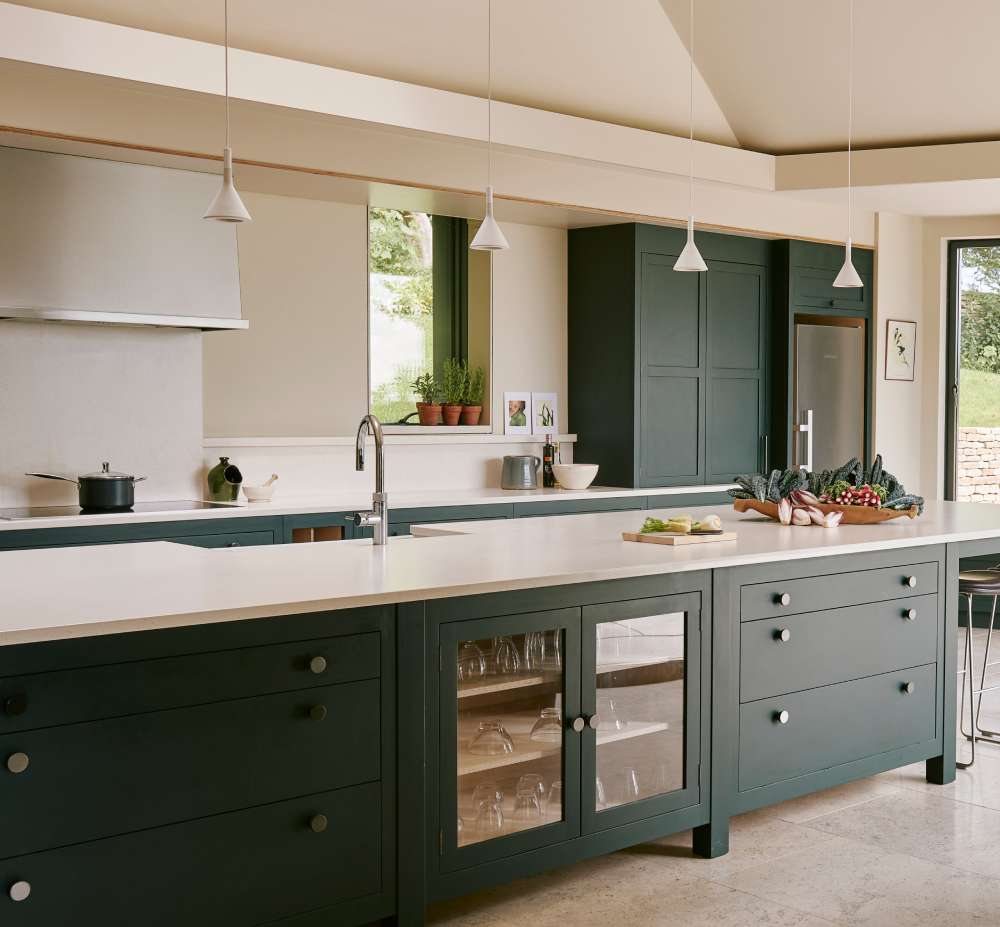
A large kitchen island is one of the hardest surfaces in a home to decorate well. Too much on it and the whole kitchen feels cluttered. Too little and a 7-foot slab of quartz just sits there, looking like it is waiting for something.

Knowing how to decorate a large kitchen island means understanding scale, surface zoning, and style proportion together, not just picking a centerpiece and hoping for the best.

This guide covers everything from pendant lighting and stool selection to color strategy, hardware finish, waterfall edges, and the decorating mistakes that are hardest to spot until the whole room is finished.

What Is a Large Kitchen Island and What Makes It Different to Decorate


Image source: Nick Smith Photography

A large kitchen island is any island that measures at least 4 feet by 2 feet, though most that qualify as “large” run 6 feet or longer in length.

That extra size changes everything about how you decorate it. Surface area, visual weight, and the island’s role as a kitchen focal point all behave differently once you cross that 6-foot threshold.

The global kitchen island market was valued at approximately USD 8.9 billion in 2024 and is expected to reach USD 14.7 billion by 2033 (Data Horizzon Research). That growth reflects how central the island has become to modern kitchen design.

The U.S. Census Bureau reports that over 85% of new homes built in 2023 incorporated open-concept kitchen designs, most featuring an island as the room’s centerpiece.

Why Standard Island Advice Fails at Larger Scale

Most decorating tips treat islands as simple prep surfaces with a centerpiece on top. That approach breaks down completely on a 6- or 8-foot island.

The problem is the dual function challenge. Large islands serve as work surfaces, dining areas, and visual anchors simultaneously. A single vase in the center of a 7-foot island looks lost and disconnected from the rest of the space.

Gideon Mendelson, founder of the Mendelson Group, has noted that oversized kitchen islands often fail functionally when the homeowner cannot even reach the countertop’s center, which minimizes the island’s usefulness before decoration even enters the picture.

The Three Problems Unique to Large Islands


Image source: Alvarez Homes

Visual weight: A large island introduces significant mass into a room. Decoration either balances that mass or amplifies it into something overwhelming.

Multi-zone demands: The surface cannot function as a single decorative canvas. It needs distinct zones, each with its own purpose and visual logic.

Scale dependency: Every decorating choice, pendant size, stool height, hardware pull length, reads relative to the island’s footprint. What works on a 4-foot island often looks miniature or wrong on a 6-foot one.

Island Size Typical Use Key Decorating Challenge
Under 4 ft Prep only Keeping it from looking cluttered
4–6 ft Prep + limited seating Balancing function and decor
6 ft+ Prep, dining, focal point Multi-zone scale and visual weight

What Proportions Should Guide Decorating a Large Kitchen Island?

Scale and proportion in interior design determine whether a large kitchen island reads as a confident design statement or a cluttered, visually heavy box sitting in the middle of the room.

Get the proportional relationships right and every other decorating decision becomes easier. Get them wrong and no amount of styling fixes it.

How to Zone a Large Island Surface

The rule of thirds gives the clearest framework for island surface zoning. Divide the surface into three equal sections: one active work zone, one transitional zone, and one decorative zone.

Active zone: Kept clear for food prep, typically nearest the cooktop or sink side.

Transitional zone: Holds items used daily but not constantly, a cutting board stack, a ceramic utensil holder, a small plant.

Decorative zone: Reserved for purely visual elements, a sculptural bowl, a candle grouping, a book stack.

Keeping 60-70% of the surface clear at any given time is the practical target. Less than that and the island reads as cluttered regardless of how carefully each object was chosen.

How Ceiling Height Changes Decorating Decisions


Image source: Rudloff Custom Builders

Ceiling height is the vertical axis of island decoration, and most people ignore it.

A kitchen with 9-foot ceilings and a 7-foot island has very different proportional needs than the same island under a 12-foot ceiling. The vertical decorating elements, primarily pendant lights, need to bridge that gap convincingly.

9-foot ceilings: Pendants at standard 30-36 inches above the countertop. Decor objects kept low-to-mid height.

12-foot ceilings: Pendant drop length increases. Taller decorative objects (60+ cm) can work without overpowering the surface.

The countertop material itself sets the decorating baseline. A dark leathered quartzite reads heavier than a light Calacatta marble, which means lighter-toned accessories feel more balanced on the former and bolder choices work better on the latter.

Which Pendant Lighting Styles Work Best Over a Large Kitchen Island?

Pendant lighting is the single most impactful vertical decorating decision for a large kitchen island. It connects the island visually to the ceiling plane and defines the island’s style identity more than any other element.

Industry guidelines are clear: pendants should hang 30 to 36 inches above the countertop surface for proper task lighting and visual proportion (Kouboo Design, 2024).

Linear vs. Clustered Pendant Arrangements

Three pendant configurations work reliably at the scale of a large island.

  • Linear pendants: Single fixtures that span most of the island’s length. Work best on flat-front contemporary islands where clean horizontal lines are the priority.
  • Clustered mini pendants: Groups of 3 to 5 smaller fixtures hung at varying heights. Add visual texture and work well over islands with more decorative cabinetry.
  • Oversized single pendants: One statement piece, typically 24 inches or wider. Reserved for islands above 8 feet or rooms with ceilings above 11 feet where the scale supports it.

The general guideline is 2 pendants for islands under 6 feet and 3 pendants for islands 6 feet or longer, with at least 30 inches between each fixture on center (Kouboo Design, 2024).

Matching Pendant Finish to Kitchen Hardware


Image source: PUDDLE Inc

Mismatched finishes are one of the most common decorating mistakes on large islands.

The pendant finish should match or directly complement the cabinet hardware finish on the island itself. These are the 3 finish directions that work across the widest range of kitchen styles:

Finish Kitchen Style Match Works With
Unlacquered brass Warm, transitional, traditional White, cream, navy cabinetry
Matte black Modern, industrial, contemporary White, gray, green cabinetry
Brushed nickel Transitional, Scandinavian Most cabinet colors

Brands worth considering for large-island pendant scale: Visual Comfort, Rejuvenation, and Hudson Valley Lighting all produce fixtures specifically proportioned for longer island runs.

How Do You Use Seating to Decorate a Large Kitchen Island?

Stool selection is one of the most direct ways to add color, material contrast, and visual identity to a large kitchen island. Most people treat seating as a functional afterthought. It is actually one of the strongest decorating levers available.

Large islands typically seat between 4 and 6 people, which means the stools collectively occupy a significant portion of the island’s visible surface area from across the room.

Choosing Stool Height for Your Island

Get the math wrong here and the stools either look like they are floating above the countertop or cramped beneath it.

Counter-height islands (35-36 inches): Require stools 24-26 inches in seat height.

Bar-height islands (40-42 inches): Require stools 28-30 inches in seat height.

Leave at least 6 inches of clearance between stools when spacing them along the island. For a 6-foot island seating 3 people, that works out to roughly 24 inches of space per stool, which is comfortable without feeling crowded.

Using Stool Upholstery as a Color Strategy


Image source: Michael Nash Design, Build & Homes

This is where real decorating decisions happen. The stool seat is one of the few genuinely flexible color elements in a kitchen, which is otherwise locked into painted cabinetry, fixed countertops, and permanent hardware.

3 upholstery approaches that work on large islands:

  • Match the island color: Creates a cohesive, furniture-like look. Works best on two-tone kitchens where the island is already differentiated from perimeter cabinets.
  • Contrast the island color: The bolder choice. Navy island with cognac leather stools, for example, adds warmth that a cool-toned stone countertop cannot provide.
  • Neutral baseline: Linen, boucle, or natural leather in a warm neutral. The safest option and works across seasonal decor changes on the island surface.

Backless stools keep the visual weight low and let the island itself remain the dominant element. High-back stools add vertical presence but can compete with pendant lighting if the ceiling is under 10 feet.

What Decorative Objects Work on a Large Kitchen Island Surface?


Image source: Artichoke

The island surface is not a shelf. It is a working plane that also needs to read as intentionally styled from across the room.

That dual demand means object selection and placement matter more here than on any other surface in the kitchen.

How to Group Decorative Objects by Height

Flat, uniform arrangements look accidental on large islands. Height variation is what makes a grouping read as deliberate.

5 object categories work well on large island surfaces:

  • Sculptural bowls (low, wide, grounding)
  • Cutting board stacks (mid-height, functional-decorative)
  • Candle groupings (variable height, adds warmth)
  • Potted herbs or a single plant (adds life and organic texture)
  • Tiered trays (creates organized, layered surface interest)

The odd-number rule applies consistently here. Groups of 3 or 5 objects read better than 2 or 4, a principle rooted in the way the eye moves across asymmetric arrangements more naturally than symmetric ones.

This is directly connected to how asymmetry in interior design creates visual engagement rather than static balance.

Keeping Function and Decoration Balanced

Targeting 60-70% clear countertop space is the practical rule. More than 40% covered and the island starts to feel like a storage surface rather than a design element.

Seasonal rotation is worth building into the plan from the start. Replacing the candle grouping with fresh herbs in spring or swapping a neutral bowl for a darker glazed ceramic in winter keeps the island from feeling static without requiring any permanent changes.

One mistake that is tricky to fix: buying decorative objects for a 6-foot island that are sized for a 4-foot one. A 6-inch bowl looks miniature on a wide marble expanse. Objects need to be scaled to the island’s footprint, not to what looks good on a store shelf.

How Does Color Choice Affect the Look of a Large Kitchen Island?


Image source: 34-Ten

Color on a large kitchen island operates differently than color on perimeter cabinetry. The island is freestanding, visible from multiple angles, and often the first thing someone sees when walking into the space.

That visibility makes island color one of the highest-stakes decisions in the entire kitchen. A color that looks subtle on a mood board can read as dominant once it covers 6-plus feet of cabinetry.

According to the 2026 Houzz Kitchen Trends Study, wood and warm off-white tones are now the leading cabinet colors, with wood edging past white for the first time in nearly a decade. That shift toward warmer tones affects island color choices, particularly for two-tone kitchens where contrast is the goal.

Four Color Strategies for Large Islands

Tonal match: Island color closely mirrors the perimeter cabinetry. Creates a calm, unified kitchen. Works best in smaller open-plan spaces where too much visual contrast would feel busy.

Full contrast: Island in a bold opposite to the perimeter. The strongest design statement, most associated with modern farmhouse and contemporary kitchens. Navy, deep green, or charcoal against white or cream perimeter cabinets.

Wood tone: Natural or stained wood island against painted perimeter cabinetry. Adds warmth and material variety. Works across transitional, farmhouse, and Scandinavian styles. White oak at 51% of professional specifications is currently the most-specified wood species (NKBA, 2026).

Two-tone: Upper and lower cabinet sections in different colors or materials. Visually reduces the island’s mass while adding depth. Particularly effective on islands over 7 feet where solid color can feel heavy.

Specific paint colors worth considering for large island contrast: Benjamin Moore Hale Navy, Farrow and Ball Mole’s Breath, and Sherwin-Williams Accessible Beige have proven track records across different kitchen styles.

This connects directly to how contrast works in interior design, where the relationship between the island and its surroundings determines whether the color choice reads as intentional or jarring.

How Countertop Color Constrains Your Options

The countertop material sets hard limits on paint color. A dark leathered granite countertop almost always requires a lighter island base to avoid the whole unit reading as a heavy, dark mass. A white Calacatta quartz opens up the full spectrum of island colors below it.

Test any island paint color under the actual kitchen lighting conditions, not just in natural light. Warm-toned pendants shift cooler blues toward gray and can make deep greens look muddy in the evening.

What Hardware Choices Reinforce the Decorative Style of a Large Island?


Image source: Kitchen Distributors

Cabinet hardware on a large island does more decorating work than most people realize. With 6 or more feet of cabinetry, the pulls and knobs become a repeating visual element that either anchors the island’s style or creates noise.

The scale problem is consistent: standard 3-inch pulls look undersized on large island doors and drawers. 5- to 7-inch pulls are the appropriate scale for cabinet fronts on islands over 5 feet long.

Finish Directions That Set Style Identity

Hardware finish is one of the clearest signals of a kitchen’s style direction. On a large island, that signal is amplified because it repeats across so many cabinet fronts.

  • Unlacquered brass: Warm, aged appearance. Develops a natural patina over time. Associated with transitional and traditional kitchens. Pairs well with marble, butcher block, and warm wood countertops.
  • Matte black: Graphic, modern, high-contrast. The most common hardware choice in contemporary and industrial-leaning kitchens. Works across almost any cabinet color but reads strongest against light or white cabinetry.
  • Brushed nickel: Neutral and transitional. The safest choice for kitchens where the style direction is still being defined. Does not conflict with stainless appliances.

Semihandmade, a company that produces custom fronts for IKEA cabinet bases, has made differentiated island hardware widely accessible at a lower price point. It is one of the more practical ways to achieve a custom-hardware look without fully custom cabinetry costs.

When to Match Island Hardware to Perimeter Cabinets

Matching island hardware to perimeter hardware creates cohesion. Differentiating them creates contrast.

The rule is simple: if the island is the same color as the perimeter, match the hardware. If the island is a contrasting color, the hardware can differ, but the finish should still relate to the pendant lighting and faucet finish already in the space.

3 hardware placements that affect the final visual result on a large island: center placement on shaker doors, edge placement on flat-front doors, and bar pulls spanning the full width of a wide drawer front. The last option is the strongest single hardware statement available on a large island.

How Do Open Shelves or Display Storage Decorate a Large Kitchen Island?


Image source: Roundhouse

Open shelving on a large island is polarizing. Done right, it breaks up the visual bulk of the cabinetry and adds personality. Done wrong, it becomes a dust-collecting clutter zone within three weeks.

The distinction comes down to what goes on those shelves, not the shelves themselves.

Three Shelf Configurations Common on Large Islands

End shelves: The most practical option. Built into the short ends of the island, these hold cookbooks, cutting boards, or decorative objects without disrupting the working surface above.

Lower open base: Replaces one or two cabinet doors with open cubbies along the seating side. Works well for displaying woven baskets, ceramic bowls, or serving pieces that are used regularly enough to justify open access.

Upper display shelving: Less common and higher-risk. Reserved for islands with enough depth (36 inches or more) that upper shelving does not create a visual wall between the kitchen and adjacent spaces.

Homes and Gardens interior editors note that open storage should be treated as a “nice to have, not a must have” on islands. The outward-facing, decorative side benefits from lighter-touch solutions that maintain a sense of openness rather than displaying every kitchen item available.

What to Display vs. What to Store

This is where most open-shelf island styling falls apart.

Display-worthy: Cookbooks with attractive spines, glazed ceramic bowls, small potted plants, linen napkin stacks, and wooden serving boards.

Store, do not display: Everyday pantry items, plastic containers, cleaning products, small appliances, and mismatched dishware.

A maximum of 3 object types per shelf section keeps open island storage from tipping into visual chaos. More than that and the eye has nowhere to rest.

Shelf material matters too. Painted MDF shelving reads as built-in and formal. Solid wood or stone shelves add warmth and material variety to an island surface, especially on farmhouse kitchen island designs where natural materials are the decorating foundation.

What Role Does the Kitchen Island Waterfall Edge Play in Decoration?


Image source: Overstock

kitchen island with waterfall edge is both a structural choice and a decorating statement. The countertop material extends vertically down one or both sides of the island to the floor, creating a continuous surface with no exposed cabinet sides.

On a large island, that vertical drop covers significant surface area. The decorating effect is immediate and architectural.

Materials That Support a Waterfall Edge

Not every countertop material works as a waterfall. The joint where horizontal and vertical slabs meet must be clean and seamless, which requires precise fabrication.

Material Waterfall Suitability Visual Effect
Engineered quartz Excellent. Consistent pattern. Clean, graphic, modern
Marble Good with book-matching. Dramatic veining continuity
Butcher block Good. Grain direction matters. Warm, organic, furniture-like
Granite Difficult. Pattern rarely matches. Heavy, less seamless

Stone slab material for waterfall edges costs between $45 and $100+ per square foot, with fabrication adding $2,000 or more on top of material costs, according to CaesarStone and House Digest (2023).

One-Sided vs. Two-Sided Waterfall on a Large Island

Two-sided waterfalls are the bolder choice. They read as a full architectural feature rather than a detail, and work best on contemporary or minimalist islands where the stone is the decorating statement.

One-sided waterfalls are more flexible. The covered side typically faces the room’s main sightline, while the seating side remains open to the cabinetry below. This creates visual emphasis in interior design terms: one dominant face, one recessive face.

The practical consideration that most people miss: waterfall edges on large islands can limit access to electrical outlets and create awkward seating clearances if not planned ahead of installation (Livingetc, 2025). This is a fabrication decision, not a styling one, which is why it belongs in the design phase rather than the decorating phase.

How Do You Decorate a Large Kitchen Island in an Open-Plan Space?


Image source: J. Kurtz Design

Open-plan kitchens are the dominant residential design format in new construction. The 2024 Houzz Kitchen Trends Study found that 43% of renovating homeowners chose open-concept layouts in 2023, up from 38% in 2021.

A large island in an open-plan space is visible from the living and dining areas simultaneously. Every exposed side is a finished surface that someone is looking at from a sofa or a dining chair.

Decorating the Visible Ends of a Large Island

Island ends are the most neglected decorating surface in a kitchen. They face directly into the adjacent room and are often left as plain painted cabinet panels.

4 approaches that work on island end panels:

  • Shiplap cladding in a contrasting or complementary color
  • Open end shelves for cookbooks or decorative objects
  • Corbel or furniture leg detail to create a furniture-like appearance
  • Fluted wood paneling, one of the most-specified island detail finishes in 2024 according to NKBA

Mary Beth Sullivan of MB Sullivan Design notes that kitchen islands that look like furniture pieces with ornate legs or decorative details are trending strongly into 2026, driven by homeowner interest in craftsmanship and one-of-a-kind design.

Using a Rug to Anchor the Island in Open-Plan Kitchens

A rug placed under or around a large kitchen island does two things at once: it defines the kitchen zone within the open-plan space and softens the visual weight of the island’s footprint.

This connects directly to what space planning in interior design actually addresses: using non-structural elements to define zones within a continuous floor plan.

Size rule: The rug should extend at least 18 inches beyond the island’s perimeter on the seating side. Anything smaller looks like a bath mat under a piece of furniture.

Material matters here more than in other rooms. Kitchen rugs take foot traffic, spills, and chair movement. Flatweave, low-pile wool, and indoor-outdoor options hold up far better than high-pile alternatives under daily kitchen use.

Which Kitchen Island Styles Suit a Large Format Best?


Image source: Clive Coffee

The 2026 Houzz Kitchen Trends Study found that 78% of homeowners change their kitchen style during a remodel, with transitional leading, followed by traditional, modern, contemporary, and farmhouse.

Large islands have enough surface area and visual mass to carry strong style direction. The style choice is not just an aesthetic preference; it determines material combinations, hardware scale, cabinetry detail level, and countertop selection across the entire island surface.

Styles That Scale Well to Large Islands

Modern Farmhouse: Shiplap panel ends, butcher block countertop section, apron sink integration, matte black hardware. The contrast between raw materials and crisp painted cabinetry works especially well at large scale.

Contemporary: Flat-front cabinetry, waterfall quartz countertop, minimal hardware, oversized linear pendants. The clean surfaces of contemporary kitchen islands require precise proportioning, which larger islands actually support better than smaller ones.

Transitional: The most forgiving style for large islands. Shaker doors, quartz countertop, unlacquered brass or brushed nickel hardware, and mixed pendant styles all fall within its range. It is currently the top renovation style choice according to Houzz (2026).

Industrial: Concrete or butcher block countertop, open base shelving, black pipe hardware or bracket details, exposed bolt accents. The scale of industrial kitchen design translates well to large islands because the style leans toward visual weight rather than away from it.

Classic Traditional: Raised-panel or beaded inset cabinet fronts, granite or marble countertop, decorative corbels on the ends, and furniture-style turned legs. At large scale, this style risks reading as heavy; the fix is to reduce the detail level on 2 of the 4 sides.

Styles to Avoid at Large Scale


Image source: Dillon Kyle Architects (DKA)

All-white minimalism on a large island can read as clinical rather than clean. Without color, material variation, or textural detail to break up the surface, the island loses identity and becomes background noise in the room.

Heavily ornate traditional cabinetry on an island over 7 feet creates visual overload. The repeating decorative elements on raised panels multiply across the long run of cabinetry in a way that does not happen on smaller islands.

What Mistakes Make a Large Kitchen Island Look Poorly Decorated?


Image source: TKS Design Group

78% of designers identified the kitchen island as their number one build priority for 2024 (Interior Designers Institute/NKBA survey). That investment deserves decoration that matches it.

The mistakes below are specifically more visible on large islands than on smaller ones. Scale amplifies errors that a 4-foot island would absorb.

Six Mistakes and Their Fixes

Under-scaling pendants: The most common error. Standard 8- to 10-inch pendants over a 6-foot island look like decorative afterthoughts. Pendants should be proportional to island length; on islands 6 feet or longer, fixtures under 14 inches in diameter rarely work visually.

Over-cluttering the surface: More than 40% coverage on the island countertop makes the surface read as storage rather than decoration. Clear the zone between the decorative grouping and the active prep zone entirely.

Ignoring the island ends: Plain painted end panels facing into the living room are a missed decorating opportunity on every large open-plan island. At minimum, paint them the same color as the island body. Better: add a shelf, fluted detail, or furniture leg.

Mismatched hardware finishes: Unlacquered brass pulls on the island with brushed nickel faucet and matte black pendants creates finish conflict that reads as indecision rather than intention. Pick 2 finishes maximum and use one as the dominant.

Wrong stool height: A 3-inch difference in seat height against island counter height makes stools look like they belong in a different kitchen. Always measure the island height before purchasing seating and confirm counter-height vs. bar-height before ordering.

Treating the surface as a single zone: Placing one centerpiece in the middle of a 7-foot island and leaving the rest empty looks unresolved. Large island surface decoration requires a zoning approach, not a centerpiece approach. The kitchen island centerpiece ideas that work on large surfaces all treat the island as a composed, multi-section surface rather than a single display area.

FAQ on How To Decorate A Large Kitchen Island

How do you style a large kitchen island without it looking cluttered?

Keep 60-70% of the surface clear at all times. Use the rule of thirds to divide the island into functional, transitional, and decorative zones. Group objects in odd numbers and limit decorative items to one defined area of the surface.

What size pendant lights work over a large kitchen island?

Use pendants at least 14-18 inches in diameter over islands 6 feet or longer. Hang them 30-36 inches above the countertop. For a 6-foot island, 3 pendants spaced 30 inches apart on center is the standard industry guideline.

What is the best color for a large kitchen island?

Navy, deep green, charcoal, and warm wood tones all work well. The choice depends on your perimeter cabinetry color. A contrasting island color creates a focal point; a tonal match creates a calmer, unified kitchen space.

How many bar stools fit on a large kitchen island?

Most large islands seat 4 to 6 people comfortably. Allow 24 inches of space per stool and a minimum 6-inch gap between seats. Always confirm counter-height versus bar-height before purchasing stools to avoid sizing mismatches.

What decorative objects work best on a large island surface?

Sculptural bowls, stacked cutting boards, candle groupings, potted herbs, and tiered trays all work well. Vary the height of each object within the grouping. Aim for groups of 3 or 5 items rather than even numbers for better visual balance.

Should a large kitchen island have open shelving?

Open shelving works on large islands when used selectively on the end panels or seating-side base. Limit display items to 3 object types per shelf section. Cookbooks, ceramics, and wooden boards display well. Everyday pantry items should stay behind closed doors.

What hardware finish works best on a large kitchen island?

Unlacquered brass, matte black, and brushed nickel are the 3 most reliable finish directions. Match or directly complement the pendant light finish and faucet finish already in the space. Use pulls 5-7 inches long at minimum on large cabinet fronts.

Does a waterfall edge work on a large kitchen island?

Yes. A waterfall countertop edge reads as an intentional architectural statement on islands 6 feet or longer. Quartz and marble suit it best. Plan electrical outlet placement before fabrication, as the vertical slab can limit access after installation.

How do you decorate a large kitchen island in an open-plan kitchen?

Treat every exposed side as a finished surface. Add detail to the island end panels facing the living area, use a rug to anchor the island within the open floor plan, and carry at least one finish or color element from the kitchen into the adjacent space.

What are the most common decorating mistakes on large kitchen islands?

Under-scaled pendant lights, over-cluttered countertops, ignored end panels, mismatched hardware finishes, and wrong stool heights are the most frequent errors. The biggest is treating a large island surface as a single decorating zone rather than a composed, multi-section surface.

Conclusion

This conclusion is for an article presenting how to decorate a large kitchen island as a multi-zone surface rather than a single display area.

Every decision, from pendant light sizing to stool upholstery, hardware finish, and open shelf display, connects back to one principle: scale governs everything.

A large island with well-proportioned lighting, a zoned countertop surface, and a considered color strategy reads as a deliberate design statement.

One left as an afterthought reads as exactly that.

Whether you are working with a waterfall countertop edge, a two-tone cabinet arrangement, or a farmhouse-style butcher block section, the island’s visual weight demands decoration that matches its footprint.

Get the proportions right first. Everything else follows.

Andreea Dima
Author

Andreea Dima is a certified interior designer and founder of AweDeco, with over 13 years of professional experience transforming residential and commercial spaces across Romania. Andreea has completed over 100 design projects since 2012. All content on AweDeco is based on her hands-on design practice and professional expertise.

Write A Comment

Pin It