Japanese Interior Design
Japandi Office Ideas for a Calm, Focused Workspace
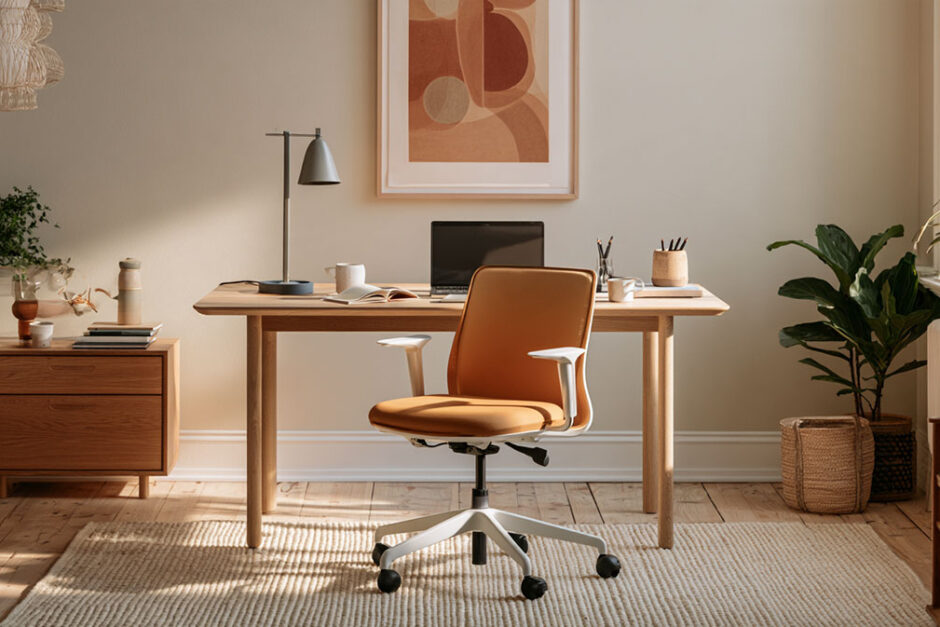
Look at the chair in almost any Japandi office photo. It’s usually a wooden dining chair with a paper cord seat, and it looks great.
That’s the main tension with the style. It grew out of Japanese minimalism and Scandinavian function, and nobody designed it around a monitor. OSHA’s Computer Workstations eTool calls for a seated desk adjustable between 20 and 28 inches, and a classic Wishbone chair adjusts to nothing.
Plenty of people are affected by this. In 2024, 33% of employed Americans did some work at home on days they worked (Bureau of Labor Statistics, 2025). Those hours add up, and the desk and chair take all of it.
The calm look holds up only when the desk and chair fit the body first, with wood, light and storage chosen around them.
What Is a Japandi Office?
Natural wood, a muted palette, very few objects and furniture that earns its place. That covers most of it. Japanese minimalism meets Scandinavian function and warmth, applied to a workspace.
Japan supplies wabi-sabi, which finds beauty in imperfect, natural things, and ma, which treats empty space as part of the design. Kanso, the habit of removing what you don’t need, backs up both. From Scandinavia come hygge (comfort) and lagom (just enough). A Japandi room ends up calmer than a typical Nordic one and softer than a strict Japanese one.
If the wider style is new to you, the basics of Japanese Scandinavian interior design apply here too. The office version just adds a monitor, a keyboard and eight hours of sitting.
That last part is why the look moved from living rooms to desks. In 2024-25, 34% of US wage and salary workers worked at home at least occasionally, per the Bureau of Labor Statistics (September 2026 release).
And a desk you see every day shows its flaws fast. A chipped ceramic cup or an uneven oak grain is fine, even welcome, because the wabi-sabi idea of imperfection treats wear as character rather than damage.
| Feature | Japandi office | Scandinavian office | Minimalist office |
|---|---|---|---|
| Palette | Warm neutrals, earth tones, black accents | Bright white, pale gray, pastels | White, gray, black |
| Wood | Light oak mixed with walnut or dark stain | Light woods (pine, birch, ash) | Often none, or laminate |
| Furniture | Low, clean lines, visible joinery | Light frames, tapered legs | Flat, geometric, glossy |
| Decor | One or two handmade pieces | Textiles, candles, prints | Almost none |
| Mood | Quiet and warm | Bright and cozy | Clean, sometimes cold |
Japandi Office Colors and Materials
Walls in warm neutrals, a real wood work surface, linen or wool textiles and a single dark accent to anchor the room. The most common miss is going gray and chrome.
Colors to Use and Avoid
Walls do best in warm white or soft off-white, with beige, greige and taupe on the large surfaces. A muted sage or clay can be the one accent. Charcoal or matte black suits lamps, hardware and frames.
Cool blue-grays and saturated brand colors push the room toward a generic modern office. High-gloss white does too.
A good test is to build the scheme from a neutral color palette first, then add the dark accent last. If the accent shows up in more than three places, it stops being an accent.
Woods and Natural Fibers
Mixing two wood tones works better than sticking to one. Matching every surface to the same light oak reads as Scandinavian, while all-dark walnut leans traditional Japanese.
The usual mix is a light floor or desk with a darker chair, shelf or picture frame. Keep the undertones related (warm with warm) so the contrast looks planned.
Textiles do most of the softening:
- Linen curtains or blinds
- A wool or jute rug under the chair
- Rattan or paper cord on a seat
- Bamboo trays and desk organizers
Paper, stone and clay also belong here, which is why the natural materials used in Japanese interiors translate so well to a desk setup.
Wall Finishes and Texture
Flat white paint can make a small office feel clinical.
Limewash, clay plaster or a matte paint with a slight texture catches daylight unevenly, and that soft variation does more for the look than any accessory.
Wood slat panels behind the desk are another option. They add depth and take some of the echo out of video calls, and they can hide a few cables too.
Which Desk and Chair Suit a Japandi Office?
A solid wood desk with slim legs, and a chair that looks like furniture rather than equipment. Those two pieces set the tone more than paint or decor.
The Desk
Start with a solid wood or thick veneer top in oak or walnut (ash works too). Beyond that, the details that matter are fairly short:
- Trestle or slim straight legs
- Visible joinery instead of metal brackets
- A matte oil or soap finish rather than lacquer gloss
- One shallow drawer at most
Karimoku Case shows where this look comes from. Launched in 2019 by Japanese maker Karimoku with Danish studio Norm Architects and Tokyo designer Keiji Ashizawa, its first collection of 12 pieces was designed for the Kinuta Terrace apartments in Tokyo (Karimoku Case, 2019).
The Chair
The chair is where the look and the work disagree.
| Chair type | Look | Long-hour comfort | Adjustability |
|---|---|---|---|
| Wood dining chair | Strongest Japandi fit | Low | None |
| Upholstered task chair (linen, boucle) | Good | Medium to high | Height, sometimes tilt |
| Mesh ergonomic chair | Weak unless neutral color | High | Full |
The Wegner Wishbone chair is the classic pick. Carl Hansen & Son lists the CH24, designed in 1949, with a fixed 45 cm seat height and a hand-woven paper cord seat. It’s lovely for a short session, but on a full workday you’ll feel that nothing on it adjusts.
Shelving and Cabinets
Most storage should be closed. Open shelves are fine for a few books and one object, but filled open shelving turns into visual noise.
A low wooden cabinet with sliding doors fits the style well. Japanese tansu chests are the traditional reference, with stepped drawers and iron hardware that works with matte black accents.
Leave gaps. An empty shelf is part of the design here, not wasted space.
Can a Japandi Office Be Ergonomic?
Yes, but only if the desk and chair fit your body first and the look second. Low furniture and fixed wood chairs are the parts of the style that work against healthy posture.
OSHA’s Computer Workstations eTool recommends a desk adjustable between 20 and 28 inches for seated work. A standard desk height is 28.5 to 30 inches, according to the Massachusetts Department of Labor Standards.
Put those two figures together and a standard solid wood desk is already at or above the top of OSHA’s seated range. For shorter users, that means raised shoulders and tense wrists unless the chair goes up and the feet get support.
The low-seating version of the style has the opposite problem. A legless zaisu chair gives back support on the floor, but it locks hips and knees into one position for hours.
Floor seating gives you the most authentic Japanese look and works in very small rooms. The price is no height adjustment at all, a lot of strain on the knees and lower back during a long workday, and a monitor that usually ends up far below eye level.
A standard-height desk is easier on the body. It works with ergonomic chairs and monitor arms, and converting it to sit-stand is simple. A fixed desk may still be too high for shorter people, though, and task chairs rarely match the wood-and-linen look.
Floor seating works best as a secondary spot. Keep Japanese floor cushions for reading or calls, and do the screen work at a proper desk.
Most of the fixes can stay in the style. A height-adjustable frame under a solid oak top keeps the wood on show. For the chair, an oatmeal linen or boucle task chair beats black mesh. If the desk still sits high, add a wooden footrest, and put the monitor on a white or black arm so the screen floats.
OSHA also suggests armrests that adjust between 7 and 10.5 inches above the seat. Almost no wooden dining chair meets that.
How to Hide Tech and Cables in a Japandi Office
Cables go under or behind the desk, and printers, routers and chargers go behind doors. One screen on an arm finishes the job. Visible tech breaks the calm faster than anything else in the room.
A metal or fabric tray screwed beneath the top holds the power strip and adapters. One grommet or cable spine gives every wire the same exit point, ideally in a dark finish that matches the desk legs.
A monitor arm lifts the screen off the surface and clears space for the empty desk the style depends on. Keyboard and mouse should be wireless, in white, beige or wood tones.
One monitor fits the style better than two. Dual screens are possible, but the desk then needs to be wider and the rest of the room even emptier to compensate.
Closed storage handles the rest. A low media cabinet with wood-look fronts, such as one built from IKEA Besta frames, hides a printer, router and paper stack for much less than custom joinery.
Paper counts as tech too. Files, notebooks and mail go in a closed drawer or a lidded box, never in a stack on the desk.
Lighting, Plants and Decor
Daylight first, then warm layered lamps, then one plant and an object or two. Everything else stays off the desk.
Natural and Artificial Light
Put the desk perpendicular to the window. Facing the glass causes squinting, and sitting with your back to it throws glare straight onto the screen.
Linen sheers or paper blinds soften harsh sun without killing it. The room still reads bright, just diffused.
The artificial light works best in layers. A paper pendant or a ceiling fixture with a diffuser covers the room. A matte black or wood desk lamp aimed at the work surface (not the monitor) handles the task, and a small table lamp or wall sconce takes over in the evening.
Paper lamps carry the look, but they only provide soft ambient lighting. They are not enough on their own for reading documents.
The European workplace standard EN 12464-1 sets 500 lux on the work surface for office and screen workstations. A washi pendant alone will not get close, which is why the task lamp matters.
The classic reference is Isamu Noguchi’s Akari series. Ozeki & Co. has handmade the lamps in Gifu, Japan, from washi paper and bamboo ribbing since 1951, according to the Noguchi Museum.
Plants
Drexel University researchers found it would take 10 to 1,000 potted plants per square meter of floor to match the air cleaning a building’s normal ventilation already provides (Cummings and Waring, 2019).
So skip the “air-purifying plant” pitch. In a Japandi office, a plant is there for its shape and a bit of life, not for air quality.
That frees you to choose by form. A single sculptural snake plant or an olive tree in a clay pot fits better than a cluster of trailing pothos, and a small bonsai works as well.
Cut stems are fine too. A single branch in a ceramic vase follows the logic of ikebana, where line and empty space count as much as the flowers.
Decor and Empty Space
Fewer objects, better ones.
One handmade ceramic piece and one framed artwork or ink print are plenty, plus a wooden tray for daily items. Motivational quotes, stacked gadgets, desk toys, extra frames and mixed-color organizers all go.
The bare part of the wall and the clear half of the desk are doing a job. That is ma in practice, and it is the first thing that disappears when a room fills up.
How to Set Up a Japandi Office Step by Step
Start by removing things and finish by adding decor. Buying first is the most expensive way to get this wrong.
- Edit the room. Take everything off the desk and shelves, and put back only what you use weekly.
- Fix the layout. Desk perpendicular to the window, chair with clear space behind it, outlets within reach.
- Paint the walls in warm white or soft greige, with a matte or limewash finish.
- Choose the desk and chair. Fit your body first (height, depth, lumbar support), then match the wood.
- Add closed storage. A low cabinet with doors for paper, printer and cables.
- Bring in textiles, meaning a rug under the chair and linen at the window.
- Layer the light, starting with a pendant or ceiling light, then the task lamp, then an evening lamp.
- Finish with decor. One plant, an object or two, then stop.
Paint gives the biggest visible change per dollar, and it is cheap to get right. A paint calculator tells you how many gallons a small office needs before you buy limewash, which costs more than standard paint.
The rug is the second most common sizing mistake after the desk. Chair casters should stay on the rug when you push back, and a rug size calculator helps you check that before ordering.
The mistakes I’d watch for are buying decor before the desk works, giving every wood surface the same tone, and picking a cool gray paint that turns the room cold.
Japandi Office Furniture by Budget
You can get the look at any price. What changes with budget is solid wood versus veneer, handmade versus flat-pack, and how long the piece lasts.
| Tier | Example pieces | Sample price | Best for |
|---|---|---|---|
| Budget | IKEA TONSTAD oak veneer desk, IKEA closed storage | $329.99 for the 55 1/8 x 29 1/2 in desk (IKEA US, October 2026) | Renters, first home office |
| Mid | Muji oak desk, HAY and Muuto accessories, solid wood from local makers | Varies by market | Daily use for several years |
| Designer | Carl Hansen & Son Wishbone chair, Akari lamps, Fritz Hansen chairs | Wishbone in oiled oak is $1,139 on sale, $1,340 regular price (Finnish Design Shop, October 2026) | One statement piece |
The TONSTAD desk is particleboard with oak veneer and solid wood legs, per IKEA’s product page. It looks right, but the top will not survive refinishing the way solid oak does.
Muji’s oak desk is 70 cm (about 27.6 inches) tall, per Muji’s own listing. That is lower than most Western desks and lands inside the seated range OSHA recommends, which makes it a quiet ergonomic win.
The chair and the desk top deserve the money, since you touch both every hour. Textiles, vases, trays and storage boxes can be cheap without anyone noticing.
Second-hand wood is the best shortcut at any budget. An older oak or teak cabinet already has patina, and upcycling a used piece with a fresh oil finish often beats a new veneer one on looks.
Japandi in a Commercial Office
It works, but a shared office needs tougher materials, better acoustics and room for a brand, which home-office guides never cover.
Takeda’s 10,700 sq ft Jakarta office, designed by AI Associates in 2022, is a documented example. The firm paired concrete-texture flooring with timber laminate and added moss walls, according to Office Snapshots.
The same project kept Takeda’s company color, but only on the sofa, the ceiling lighting and a desk accent. That is the template for branding a Japandi space: color as a detail, never as a wall.
Moss walls and planted dividers are the commercial version of the single desk plant. They borrow from biophilic interior design without needing daily watering.
Sound is the first problem you’ll hit, because hard wood, stone and empty walls bounce it around. Felt panels, wood slat ceilings with backing and thick rugs all help.
Soaped oak and paper cord mark quickly under heavy use, so shared spaces do better with lacquered or hardwax-oiled surfaces. For zoning, slatted partitions and paper-panel screens separate desks from meeting areas while keeping light moving.
Translucent shoji screens are the traditional model for that. Modern versions use acrylic or fabric instead of paper, which suits an office better.
When a Japandi Office Is the Wrong Choice
Japandi fails when the work itself needs a lot of visible stuff, or when the room cannot give you light and wood.
- Streaming, gaming or audio setups with several screens, mics and interfaces that cannot hide behind doors
- Shared family desks where clutter control depends on more than one person
- Creative work built on color, pinned references and mood boards
- Dark basement offices with no window
- Rentals where you cannot paint or drill for cable routing
The dark room is the hardest case. Warm neutrals and walnut in low light read as brown and heavy, not calm.
A brighter Nordic palette handles that better, and these Scandinavian home office ideas lean on white walls and pale wood to stretch what little light there is.
If you want wood and warmth but also bold color and statement pieces, the style is simply too restrained for you.
Look at mid-century modern office ideas instead. Walnut, tapered legs and mustard or teal accents give a similar warmth with far more personality on display.
And if the room has to be tidied before every call, the style is not failing. The storage plan is.
Japandi Office FAQ
How do you make a Japandi office work in a small room?
Go vertical and closed. A narrow wall-mounted desk, one floating shelf and a cabinet with doors keep the floor clear.
Stick to one wood tone plus one dark accent, since a third finish crowds a small space fast.
Is Japandi still in style in 2026?
Yes, though the look has shifted warmer. Darker woods, limewash walls and handmade ceramics now replace the pale, all-beige rooms of a few years ago.
The core ideas (fewer objects, natural materials) do not date.
Does a Japandi office actually improve focus?
No study tests the style itself. What it does is remove visual clutter, hide cables and add daylight, and those changes make a desk easier to sit at for long hours.
The chair and desk height still matter more than the decor.
Can a Japandi office use black or dark wood?
Yes. Matte black lamps, frames and hardware are part of the palette, and walnut or ebonized oak brings in the Japanese side of the mix.
Keep dark tones under a third of the room, or it tips into a moody study.
Can you set up a Japandi workspace in a bedroom or living room?
Yes, if the desk zone is visually separate. A rug, a slatted screen or a different light source marks where work stops.
Match the desk wood to the rest of the room. Pieces from a Japandi bedroom or living area then read as one scheme, not two.
What to Change First in a Japandi Office
The fastest upgrade costs almost nothing. Clear the desk, hide every cable and close the storage, and leave furniture for later.
After that, add a task lamp and one paper light. The chair comes next, with the desk top last.
That order works because the empty surface is what makes the style readable, and no oak desk survives a pile of chargers on it.
Budget forces a real trade-off at the chair. At October 2026 prices, one oiled-oak Wishbone chair costs as much as three to four TONSTAD desks, so a first setup gets more from an adjustable linen task chair than from the icon.
Closed storage has its own cost: items you reach for hourly now take a door to get to. Keep those on a wooden tray instead.
Before buying paint or textiles, test combinations with a room color scheme generator so the walls, wood tones and black accents work together from day one.

- Japandi Office Ideas for a Calm, Focused Workspace - November 28, 2026
- Entryway Rug Ideas Made Easy [+ Style Tips] - November 25, 2026
- Japandi Bathroom: Is It the Spa Style You Need? - November 22, 2026