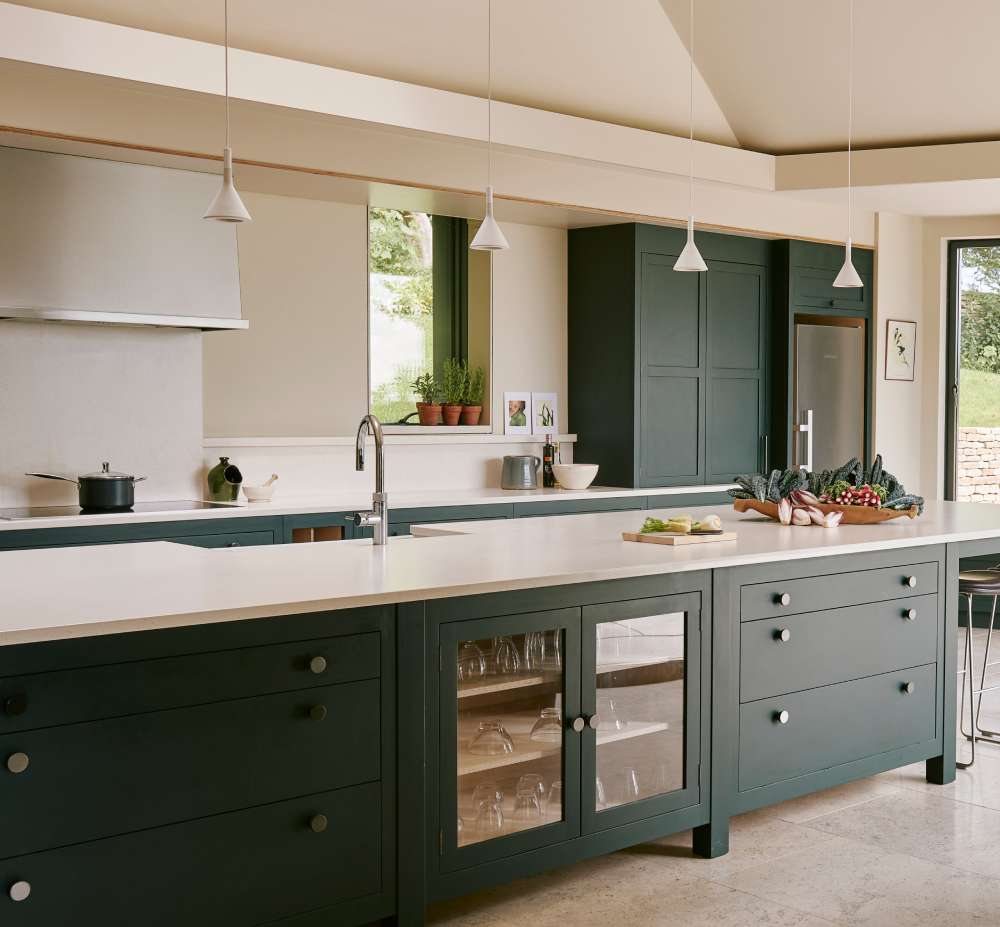
Kitchen Island
Practical Kitchen Island With Wine Fridge Ideas

A wine fridge fits in a kitchen island only if it vents from the front. An island base is a closed cabinet with no open air around it, so a unit that pushes heat out the back or sides has nowhere to send it. Undercounter built-ins and wine columns qualify, and so do front-vented freestanding units set in a cutout. Rear- and side-vented units do not.
Depth decides the rest. Sub-Zero’s July 2026 specification sheet lists its 424G/S at 24 inches deep, and the NKBA 2022 Kitchen Planning Guidelines call for 15 inches of knee space at a 36-inch counter. Counter-height seating on the same island therefore needs about 39 inches of total depth.
A 36-inch-deep island with a seating overhang leaves 21 inches of cabinet, which is too shallow for that unit.
Planning new colors as well? Our kitchen color schemes guide sorts cabinet, countertop and hardware pairings by cabinet color.
Which types of wine fridge can go inside a kitchen island?

Yes, as long as the vent is on the front. Undercounter built-ins are the usual choice. Front-vented freestanding units also work in a cutout, and so do wine columns or compact niche units, with a few limits covered below.
| Type | Vent location | Typical width | Island fit |
|---|---|---|---|
| Undercounter built-in | Front, below the door | 15, 24 or 30 inches | Standard base cabinet opening |
| Freestanding, front-vented | Front, below the door | 15 to 24 inches | Cutout, if the manual allows enclosure |
| Freestanding, rear or side-vented | Back, sides or top | Varies | No, needs open air around it |
| Wine column or niche unit | Toe kick or ventilation chimney | About 22 inches (24-inch niche) | Island end (tall) or base cutout (compact) |
According to Danby’s buying guide, most built-in models match the depth of the surrounding counters, so the front sits flush with the island cabinetry.
Freestanding units in a cutout
A freestanding unit only goes into an island when its vent is on the front. Vinotemp states that a unit specified as freestanding should not be recessed into cabinetry.
Brands don’t label this consistently, though. Caple’s WF334 releases heat through the top and sides and needs open space around it for ventilation to avoid overheating, while its WF1553 and WF1552 can be installed with furniture around them.
Read the installation manual for the exact model. The category name on the box tells you very little.
Wine columns and niche units
Liebherr’s HW8000 column stands nearly twice the height of a standard island, so it only works as a tall cabinet at the island end. The GrandCru niche units are the compact option. They hold 18 bottles in a case under 18 inches tall and need a ventilation chimney.
An island that seats people on two sides leaves less base cabinet to give away, so a compact undercounter unit is the safer fit than a column.
Panel-ready, stainless or glass doors

Doors come panel-ready, in stainless, or in glass. Sub-Zero’s DEU1550 has a UV-resistant glass door, and its design guide says not to install a solid panel on glass-door models, so settle the door style before the cabinets are ordered. Liebherr fits UV-resistant insulated glass to its wine cabinets.
On the cook’s side of the island, a panel-ready front is the quietest choice. Glass belongs where guests stand.
Ventilation rules for a wine fridge built into an island

Front venting is the rule. Heat leaves through a grille below the door, which is why the unit can sit in a closed cabinet. A rear- or side-vented unit needs open space around it (Danby, Vinotemp).
When an enclosed unit can’t vent, heat stays in the cabinet and the compressor overheats. Avintage notes that the unit then loses the ability to hold its set temperature, and Vinotemp adds that poor venting makes a compressor work harder.
Liebherr’s 2018 wine design guide calls for at least 31 square inches of clear ventilation cross section, and it states that a 31-square-inch grille cutout alone does not meet that.
An island base closes in on every side, so the air path has to come from the toe kick. Liebherr’s 24-inch undercounter models ventilate through the toe kick, which is why no slots are cut into the countertop.
Keep the toe kick grille open and match the cutout to the manufacturer’s dimensions. Stay away from ovens and other heat-generating appliances too (Avintage advises against stacking a wine cabinet over an oven).
Compressor or thermoelectric: which cooling holds up in an island?

Compressor cooling holds up better. A closed island base runs warmer than the room, and thermoelectric units lose cooling power as the surrounding air warms.
Compressor units
These reach serving temperatures for whites and sparkling wine and cope with warm rooms. They are also sold in larger capacities, which is why most built-ins use one (Vinoteca). The downside is more noise, weight and vibration than thermoelectric.
Manufacturers have narrowed the gap. U-Line’s 5 Class uses a variable-speed compressor for quieter running, and Liebherr lists low-vibration compressors across its wine cabinets.
Check the dB(A) rating on the spec sheet before buying, because an island sits where people talk.
Thermoelectric units

Thermoelectric units cool through the Peltier effect, so they have no compressor and no compressor vibration, according to Vintage Cellars.
The price is pull-down power. The cooling depends on the room, and Vinoteca.es states that these units cannot be built in or placed near or on top of heat-generating appliances. They suit small collections in mild rooms, standing on a counter or stand.
Where the sources disagree
Vintage Cellars calls a thermoelectric cooler a good choice for a small indoor collection. Vinoteca.es rules out building one in, and Vinotemp’s buying guide expects the technology to be restricted because it needs more energy to pull the temperature down, although other Vinotemp pages say thermoelectric units use less electricity than compressors.
The sources mostly disagree about use case. On the physics they agree that cooling depends on ambient temperature.
Two published limits point to the same ceiling. Vinoteca.es caps the gap between room and cabinet at 15 C, and Vintage Cellars puts the upper limit at about 80 F.
With wine stored at 55 F (about 13 C, the standard Wine Spectator gives), that 15 C gap works out to roughly 82 F of room air.
That figure is a room temperature. A closed island base beside a dishwasher or range runs hotter, so a built-in belongs with a front-vented compressor.
How many bottles and how many temperature zones do you need?
A 15-inch undercounter unit holds about 24 bottles, and a 24-inch unit holds 32 to 49 depending on its zones. Pick a single zone unless you serve white wine from the same unit regularly, because every extra zone costs bottle slots.
Bottle capacity by unit width

The 15-inch Sub-Zero DEU1550 and U-Line Wine Captain both hold 24 bottles. At 24 inches, U-Line’s 5 Class single-zone model holds 49. Dual-zone units at that width hold 32 to 40, including Perlick’s 24-inch wine reserve and Liebherr’s WU3400 and WU4000.
Across these spec sheets the single-zone 24-inch model holds 9 to 17 more bottles than the dual-zone ones. The brands differ, so read that as a pattern, not a rule.
Headline counts assume standard 750 mL bottles (U-Line). Liebherr publishes maximum bottle diameters for its shelves, so count the oversized bottles in your collection before trusting the number.
Single, dual or triple zone
Wine Spectator puts long-term storage at 55 F for every wine, whatever the color. Serving temperatures are what differ, and they are the only reason to want a second zone.
One setpoint at the storage standard holds everything in a single-zone unit. Pull reds half an hour before serving and chill whites separately, which is the workaround Wine Spectator’s Dr. Vinny suggests.
A dual-zone unit keeps one side at the storage standard and runs the other cooler for whites and sparkling wine. Dr. Vinny’s advice there is to reserve at least one zone for long-term storage. U-Line’s 15-inch Wine Captain goes further and splits the cabinet into three zones, with the user setting the middle one.
Check the usable range, not only the zone count. U-Line’s 24-inch 5 Class spans 33 to 70 F, and Liebherr’s WU3400 dual-zone cabinet spans 41 to 68 F (5 to 20 C).
For an island that holds everyday bottles, a single zone wins on capacity. Dual zone earns its slots only when whites go straight from the island fridge to the glass.
Where the wine fridge goes in the island layout

Put it on the work side or at an island end, not under the seating overhang. The overhang needs clear knee space, and a 24-inch-deep unit needs whatever cabinet depth is left.
Work side, seating side or end panel

The work side is easiest for the cook, who doesn’t have to cross the island, though the door swings into the work aisle. Guests can reach a seating-side unit, but a 24-inch unit takes the width of one seat and the knee space behind it disappears.
End placement avoids the overhang conflict entirely. The unit’s width runs across the island depth and its depth runs along the length.
Sub-Zero’s designer undercounter units ship with door-stop pins that hold the door at 90 degrees, a useful feature where the door opens toward a tight aisle.
Depth math with a worked example

Cabinet depth left for the unit equals island depth minus knee space. The unit has to fit inside that number.
Sub-Zero’s 424G/S needs a 24-inch-deep opening, and U-Line’s 24-inch Seamless unit measures 22 11/16 inches deep, per the two makers’ specification sheets.
Take a 36-inch-deep island with counter-height seating. Subtract 15 inches of knee space and 21 inches remain, too shallow for either unit.
Raise the seating side to a 42-inch bar and the knee space drops to 12 inches. That leaves 24 inches, an exact fit for the Sub-Zero opening and a little over an inch of margin for the U-Line.
Counter-height seating therefore needs about 39 inches of total island depth to carry a 24-inch unit, before any countertop overhang on the work side.
If the math fails, move the unit to the island end. Cutting the overhang below the NKBA knee-space figure ruins the seats to save a cabinet.
Aisle and seating clearances

The NKBA Kitchen Planning Guidelines (2022 edition) give these figures:
- A work aisle is 42 inches for one cook and 48 inches for more than one.
- Each diner gets 24 inches of seat width.
- Knee space is 15 inches at a 36-inch counter and 12 inches at a 42-inch counter.
- Behind the seating, leave 32 inches when there is no traffic, 36 inches to edge past, and 44 inches to walk past.
Sub-Zero lists 25 3/8 inches of door clearance for the 424G/S. Fully open, that door covers more than half of a 42-inch work aisle.
Checking an island against these numbers is space planning in its simplest form. Draw the aisle and the seats to scale, door arc included, before anything is ordered.
Design blogs often quote 36 inches as the minimum aisle. NKBA sets that figure for walkways only, and the aisle where a fridge door opens behaves as a work aisle in practice.
How to install and power a built-in wine fridge in an island
Start with the maker’s design guide and work forward from there.
- Get the design guide before the cabinets are cut. Sub-Zero’s guides say specifications are subject to change without notice and that dimensions can vary by 1/8 inch, so confirm the current sizes before anything is cut.
- Cut the opening to the listed size. For Sub-Zero’s 424G/S that is 24 inches wide, 34 1/2 inches high and 24 inches deep (specification sheet generated July 2026).
- Keep the toe kick vent path clear. Sub-Zero’s installation guides set toe kick height limits by model, and its Designer wine storage guide calls for a reduced toe kick accessory when the toe kick is 2 to 3 7/8 inches high, an accessory Customer Care says is not offered for the DEU undercounter units.
- Run a 15 amp dedicated circuit. Sub-Zero specifies 115 volts for the 424G/S, and its installation guide bars extension cords and two-prong adapters.
- Order the door panel to the maker’s limits. Panel-ready units ship without a front, Sub-Zero’s design guide lists panel weight and handle depth, and U-Line leaves the panel and handle on its 24-inch Seamless unit to the cabinet maker.
- Level the unit before sliding it into the opening, then check the door swing. Sub-Zero says not to load wine until installation is finished, and U-Line’s four legs adjust up to 1 inch.
Power and the 2023 NEC
The 2023 edition of NFPA 70 made island receptacles optional under 210.52(C)(2) but requires provisions for adding one later (Minnesota Department of Labor and Industry). A receptacle that serves the island countertop must now sit on or above the surface or in a listed countertop assembly under 210.52(C)(3), per Leviton’s reprint of the NFPA text.
Electrical Contractor magazine reports that receptacles meant to serve an island countertop can no longer sit below it.
None of that settles the fridge outlet directly. The unit’s own outlet does not serve the countertop, and a code change proposal in the City of Phoenix’s 2023 NEC amendment documents argues the rule does not bar every below-counter receptacle on an island. Whether an inspector agrees is a local call.
The 2023 edition also extends GFCI protection to all kitchen receptacles (Minnesota Department of Labor and Industry), and jurisdictions adopt NEC editions on their own schedules. Confirm the adopted edition with the local authority before rough-in.
How much does adding a wine fridge to a kitchen island cost?

The unit is most of the bill. Premium 24-inch built-ins cost thousands of dollars before any cabinet or electrical work.
U-Line’s panel-ready URWC424IS01A has a list price of $3,849, and AJ Madison showed it at $3,499. Sub-Zero does not publish prices on its site, so get a dealer quote for any Sub-Zero model.
Panel-ready units don’t include the front panel and handle, so the cabinet maker bills those separately. Cabinet changes for the opening and toe kick, plus a dedicated circuit, are not in Homewyse’s January 2026 estimate, which excludes modifications to structure and electrical systems. Homewyse also adds 13% to 22% when a general contractor supervises.
A front-vented unit that its maker approves for enclosure can be the cheaper route. Check that it publishes cutout dimensions and panel limits the way Sub-Zero does before assuming a lower price buys the same fit.
When the island is part of a bigger remodel, a renovation cost calculator can put the unit and all the cabinet and wiring work into one budget.
When a wine fridge in the island is the wrong choice
Skip it if the base cabinet runs hot or the wine is meant to age for years. A collection that needs more than one unit is another reason, and each case has a documented failure point.
An island base can run hotter than the room. Liebherr’s Monolith manual rates its wine cabinets SN-ST, which covers ambient air from 10 to 38 C (about 50 to 100 F), and says not to operate them outside the stated range.
Wine Spectator calls kitchen conditions a poor fit for long-term storage and puts a wine cooler between a counter and a cellar. For a growing collection it suggests offsite storage.
Two 24-inch Sub-Zero models need a 48-inch opening, plus a dual installation kit when they sit less than 2 inches apart, which adds trim and stops moisture forming between them (Sub-Zero Customer Care).
The climate class changes by model. Liebherr’s 18-bottle WKEes553 is rated SN, which stops at 32 C (about 90 F), while the WKEgb582 is rated SN-ST, according to the specifications Vinoteca lists.
When any of this applies, move the storage out of the island. A wall-run cabinet away from the range or a wine column in a tall cabinet both work, and an offsite locker is there if the collection keeps growing. The island keeps its job as the serving point.
Kitchen Islands With Wine Fridge FAQ
Can a wine fridge also hold beer or soft drinks?
Yes, in a combination model. U-Line’s 24-inch dual-zone beverage center holds 72 cans and two wine racks, with a lower zone that runs 33 to 45 F.
Vinoteca advises against thermoelectric units for beer or soft drinks, so choose a compressor model.
Is the door hinge side fixed or reversible?
It depends on the model. U-Line’s URWC424 ships right-hinged and is field reversible, while Sub-Zero sells the 424G/S as separate left- and right-hinge versions.
Confirm this before ordering, since the hinge decides which way the door swings into the aisle.
How often does the condenser behind the toe kick need cleaning?

Every six to twelve months, according to Sub-Zero Customer Care, and sooner in a home with pets. Most U-Line manuals say every six months.
A dirty condenser causes temperature loss or mechanical failure. Use a soft brush and a vacuum, and don’t bend the fins.
How much electricity does a wine fridge in an island use?
U-Line’s 43-bottle single-zone Wine Captain U2224WCS15A lists 85 kWh a year, per a 2024 dealer specification listing.
The same maker’s 24-inch beverage center lists about 220 kWh, so consumption depends on the model type, not only the width. U-Line’s 24-inch Seamless wine coolers carry ENERGY STAR certification.
Order the Wine Fridge Before the Island Cabinets
The wine fridge goes first, because its specification sheet fixes the cutout, the toe kick vent path, the circuit and the panel limits that the island cabinets and countertop must then match.
The order runs from the unit and its specification sheet to the cabinets, toe kick and wiring rough-in, then the countertop template, and finally the door panel. The template follows the finished opening. The panel comes last because it depends on the unit’s panel weight limit and handle depth.
The trade-off is lock-in. Ordering first ties the island to one model, and a late switch to another brand means re-cutting the opening.
Position verified October 12, 2026. Sub-Zero’s July 2026 specification sheet says to verify specifications before finalizing cabinetry, so recheck the current sheet and the locally adopted NEC edition before anything is cut.
More Kitchen Guides
- How to decorate a large kitchen island
- How to make a kitchen island with IKEA cabinets
- Kitchen cabinet crown molding ideas
- How to cover kitchen cabinets without painting
- All kitchen color schemes by cabinet color

- Kitchen Color Schemes by Cabinet Color: What Pairs Well - October 19, 2026
- Curtain Colors for Every Wall Color: Safe vs Bold Picks - October 18, 2026
- Interior Design Styles: Find Your Primary and Secondary - October 14, 2026