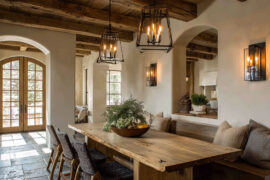
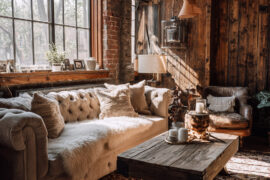
Worn wood, aged iron, warm neutrals. Few styles hold up as consistently as rustic farmhouse interiors do across decades of changing trends.
The style draws from 19th-century American homesteads and European country homes, where every material had a purpose and nothing was decorative without first being useful. That logic still drives it today.
But rustic farmhouse is not the same as modern farmhouse, cottagecore, or generic country decor. It has a specific material palette, color logic, and furniture typology that set it apart.
This guide covers everything: core materials, color palette, furniture, room-by-room application, lighting, textiles, architectural features, and how to blend the style with others without losing coherence.
What Are Rustic Farmhouse Interiors?

Rustic farmhouse interiors is a residential design style that combines raw, aged, or reclaimed materials with functional, unpretentious furniture and warm neutral color grounding. The style sits between primitive and livable, favouring worn texture alongside everyday comfort rather than decoration for its own sake.
Its roots trace to 19th-century American agricultural homesteads and European country homes, where utility drove every decision. Nothing was decorative without first being useful. That logic still defines the style today.
A Hovia study of Google Trends data found that modern farmhouse topped interior design searches in 32 U.S. states in 2023, with the highest search volumes in Texas, Ohio, and North Carolina (Interior Design Studio, 2023). Rustic farmhouse sits directly beneath that umbrella, as the warmer, more textured, more historically grounded version of the same instinct.
The key distinction worth knowing upfront: rustic farmhouse is not the same as modern farmhouse, not the same as cottagecore, and not the same as rustic interior design in its broader sense. It has a specific material palette, a specific color logic, and a specific furniture typology. Those three things together produce the style. Change any one of them substantially and you have something else.
| Design Style | 2026 Color Narrative | Tactile Materials | The “Defining” Shift |
|---|---|---|---|
| Rustic Farmhouse | Grounded Earth: Amber, terracotta, and “Tobacco” browns. | Aged Pine, hand-hewn beams, and raw linen. | Prioritizes Patina & Warmth; avoids any “shiny” or new finishes. |
| Modern Farmhouse | Graphic Neutral: Stark white, charcoal, and cool grays. | Painted shiplap, light Oak, and matte black steel. | Focuses on Contrast & Clean Lines; feels architectural and orderly. |
| Cottagecore | Muted Garden: Sage green, dusty rose, and buttermilk. | Distressed painted wood, wicker, and floral textiles. | Embraces Whimsy & Nostalgia; a maximalist approach to “cozy.” |
| Industrial Rustic | Moody Urban: Slate, graphite, and oxidized copper. | Live-edge slabs, raw iron pipes, and exposed brick. | Highlights Structural Rawness; balances hard metal with heavy timber. |
Understanding what interior design actually involves helps here. It goes well beyond surface decoration. Rustic farmhouse works as a complete design system, not a collection of accessory choices layered onto a neutral room.
What Makes It Different from Other Warm, Natural Styles
Patina over polish. The style values the look of age. Surfaces that appear worn, weathered, or hand-worked read as authentic. Surfaces that look new or refinished undercut the whole effect.
Function over ornament. Every piece in a true rustic farmhouse room should look like it could be used for something. Open shelving holds real objects. Baskets actually store things. A dough bowl on the kitchen counter isn’t just decor.
Low contrast by default. Unlike modern farmhouse’s strong black-and-white palette, rustic farmhouse operates in a narrow band of warm, close-value tones. Reclaimed oak beams, linen upholstery, aged iron hardware, and cream walls all read as different but close. That tonal closeness is the style’s visual signature.
What Are the Core Materials in Rustic Farmhouse Design?
The material palette is what separates rustic farmhouse from styles that only borrow its surface cues. Reclaimed wood, natural stone, wrought iron, aged brass, and natural-fiber textiles form the foundational five. Every other material decision should defer to these.
The global reclaimed lumber market was valued at USD 62.2 billion in 2024 and is set to reach USD 88 billion by 2033, growing at a 3.89% CAGR (IMARC Group, 2024). That growth tracks directly with rising consumer preference for aged, character-rich materials in residential interiors.
Reclaimed Wood

Reclaimed wood is the backbone of the style. Barn wood, hand-hewn beams, and pallet-derived planks bring the aged patina that new timber cannot replicate without extensive finishing work. The furniture segment accounts for 40.7% of global reclaimed lumber use (Market Data Forecast, 2024), reflecting how central it is to interior applications.
Key suppliers worth knowing:
- Pioneer Millworks (New York/Oregon) for wide-plank flooring and paneling
- Elmwood Reclaimed Timber (Kansas City) for beams and accent surfaces
- TerraMai for FSC-certified reclaimed hardwoods
Reclaimed wood flooring runs between $9 and $15 per square foot depending on species and finish (Maximize Market Research, 2024). New distressed wood runs considerably lower but lacks the density and structural integrity that comes from old-growth timber.
Reclaimed Wood vs. New Wood with Distressed Finish
Reclaimed: higher density, genuine patina, visible nail holes and saw marks, inconsistent grain that reads as authentic. Costs more and requires more lead time.
New distressed: consistent dimensions, easier to source, significantly cheaper. Wire-brushed or hand-scraped finishes simulate age, but the wood lacks the tonal variation and character that comes from actual decades of weathering.
For structural elements like exposed ceiling beams, reclaimed wood holds a clear visual advantage. For flooring in high-traffic areas, new wire-brushed wide-plank oak (5 inches and above) is a practical substitute that holds up well and costs less to install.
Natural Stone, Iron, and Textile

Natural stone (slate, limestone, fieldstone) works best in fireplace surrounds, kitchen flooring, and accent walls. It grounds the room visually and adds thermal mass.
Wrought iron and aged brass handle hardware, light fixtures, and curtain rods. Both finishes age naturally, which works in the style’s favour. Polished chrome and brushed nickel do not belong here.
Linen, burlap, and cotton canvas handle upholstery and soft furnishings. These fabrics wrinkle slightly in use, which adds rather than subtracts from the relaxed quality the style depends on. In 2024, 53% of homeowners planned to use natural materials like wood and stone in their decor (Market.us, 2024).
What Color Palettes Work in Rustic Farmhouse Interiors?
The base palette runs warm. Creamy off-whites, warm whites, greige, and soft taupe make up the wall colors. Not cool grays. Not stark whites. The distinction matters because cool neutrals visually disconnect from the warm amber tones of reclaimed wood and aged iron, breaking the cohesion the style depends on.
Understanding how color works in interior design is particularly useful here, since the rustic farmhouse palette operates on warm-cool contrast avoidance rather than the more typical complementary color logic.
Specific Paint References

These three cover most base situations:
- Benjamin Moore White Dove OC-17: warm white with slight yellow undertone, reads cream in natural light
- Sherwin-Williams Accessible Beige SW 7036: warm greige, sits between tan and gray without leaning cool
- Farrow and Ball String No. 8: deeper warm neutral, works well in low-light rooms or as a full-room color
Sixty percent of designers recommend neutral palettes for resale value (Realtor.com, via JDS All About Home, 2025). For rustic farmhouse specifically, that recommendation aligns with the style’s logic rather than conflicting with it.
Accent Colors and What to Avoid
Accent tones arrive sparingly. Deep olive, barn red, slate blue, and ochre each read as historically grounded and pull from the same warm, earthy register as the base palette. Use them on a single accent wall, in textiles, or in ceramic and pottery accessories. Not in multiple places at once.
High contrast is the main thing to avoid. Bright white trim against deeply saturated wall color, strong black hardware against light wood, graphic pattern against plain surfaces all work in modern farmhouse but break the low-contrast visual field that defines rustic farmhouse. The style reads coherent when the tonal range stays narrow. Widen it and the room starts to look like two different styles in the same space.
What Furniture Defines the Rustic Farmhouse Style?

Rustic farmhouse furniture is heavy, low, and built to last. The silhouettes come from American country and English country traditions: trestle tables, ladder-back chairs, Windsor chairs, farmhouse benches, and turned-leg case pieces. Nothing here is slim, elevated, or architecturally abstract.
Construction Characteristics
Mortise-and-tenon joinery, plank-top surfaces, and hand-turned legs signal the right construction language. Furniture that uses these details reads as period-appropriate regardless of whether it was made in 1890 or 2023.
Magnolia Home (Joanna Gaines’s furniture line) made farmhouse furniture mainstream, though its pieces trend toward the cleaner modern farmhouse end. For rustic farmhouse specifically, Pottery Barn’s Benchwright table and Farmhouse Collection offer accessible starting points. McGee and Co. fills the mid-range gap. For authentic antique and vintage pieces, Chairish and estate sales remain the most reliable sources.
Upholstered vs. Hard-Seating
| Room | 2026 Seating Strategy | Fabric & Finish Choice | The “Life-Proof” Factor |
|---|---|---|---|
| Living Room | Deep-seated sectionals with feather-wrapped foam. | Heavyweight Linen slipcovers; Grain sack stripes. | Machine Washable: Slipcovers allow for easy cleaning and seasonal updates. |
| Dining Room | Combination of Trestle Benches and spindle chairs. | Bare distressed oak or matte-painted “Cremèle” wood. | Wipe-and-Go: Hard surfaces are immune to spills and “age” into beauty. |
| Kitchen Island | Saddle-seat or Tractor-style stools. | Reclaimed timber tops with raw, hand-welded iron bases. | Structural Integrity: Welded iron is nearly indestructible in high-traffic areas. |
| Bedroom | Wingback headboards or End-of-bed storage benches. | Washed cotton-canvas or nubby wool bouclé. | Acoustic Softening: Upholstery helps dampen sound for a “cocoon” effect. |
Linen slipcovers are worth mentioning specifically. They wrinkle, they fade slightly over time, and they look better for it. That aging quality is exactly what the style calls for.
Mixing Antique Finds with Reproduction Pieces

A room made entirely of antiques can tip into museum territory. A room made entirely of reproduction pieces loses authenticity. The practical approach: anchor each room with 1 or 2 genuine antique or vintage pieces, fill out the rest with well-made reproductions.
Estate sales and Chairish consistently produce the best antique farmhouse furniture at reasonable prices. Flea markets work for smaller accessories and accent pieces. Buying vintage online without seeing finish quality firsthand is the main pitfall to avoid.
How Are Rustic Farmhouse Interiors Applied Room by Room?
The style translates across every room but with different material priorities. The kitchen leans hardworking and functional. The living room leans warm and settled. The bedroom leans quiet and layered. Each room uses the same material language but in proportions suited to how the space is used.
Kitchen

The farmhouse kitchen centers on 4 defining elements: open shelving, apron-front sink, wood hood or exposed range surround, and butcher block or stone countertops. Cabinet doors, where used, are shaker-style in a painted or wood-stained finish.
Kohler’s Whitehaven and Whitehaven undermount are the most widely specified farmhouse sinks in this style. Open shelving in reclaimed wood holds everyday objects: ironstone plates, enamelware, crockery, and glass. The shelves should look actively used, not staged.
For a practical example: the kitchens designed by Cara Fox of The Fox Group (featured in American Farmhouse Style magazine) consistently demonstrate how dark woods, stone, and open shelving can coexist without looking cluttered.
Living Room

A stone fireplace surround acts as the room’s visual anchor. Exposed ceiling beams, wide-plank hardwood floors, and a linen sectional or sofa fill the structural role. A woven jute rug under the seating area ties the floor and furniture together.
The fireplace matters here more than almost any other single element. A stacked stone fireplace or fieldstone surround reads as genuinely farmhouse in a way that a tiled or painted-brick fireplace does not. If a stone surround isn’t possible, a shiplap fireplace with a heavy wood mantel is the next best option.
Open-Plan Layouts in Farmhouse Homes
Most farmhouse-style homes built or renovated in the last decade use open kitchen-dining-living configurations. Maintaining material cohesion across that continuous space requires 3 specific decisions:
- Consistent flooring throughout (no transition strips between zones)
- Ceiling treatment that reads as one continuous plane (beams or no beams, consistently)
- A shared color palette with variation only in textiles and accessories
Zone the space with rugs in an open floor plan rather than walls or partitions. A large jute or braided wool rug under the dining table and a separate area rug under the living room seating create distinct zones without breaking the visual flow.
Bedroom

Iron bed frames or solid wood platform beds anchor the room. Quilt layering over linen bedding handles the textile layer. Vintage nightstands, ideally mismatched, add the right amount of asymmetry. The bedroom is where the style tolerates the most simplicity. Less is fine here.
Bathroom
Clawfoot tubs, shiplap walls, vessel sinks in ceramic or stone, and aged brass or oil-rubbed bronze fixtures define the bathroom application. Subway tile in a warm white or soft cream works on floors and shower surrounds without fighting the warm palette. Bright white subway tile with gray grout, a modern farmhouse staple, reads too cool and too graphic for rustic farmhouse bathrooms.
What Lighting Fixtures Suit Rustic Farmhouse Interiors?

Fixture type and finish matter equally here. The right fixture in the wrong finish breaks the palette. Aged bronze, matte black, rust, and antique brass belong. Polished chrome, brushed nickel, and satin brass do not.
The global decorative lighting market was valued at USD 41.60 billion in 2024 and is growing at 2.9% CAGR through 2030 (Grand View Research, 2024). Within that, fixtures with aged finishes and traditional silhouettes continue to gain share as the warm, natural interior trend persists.
Fixture Types by Room
Kitchen: lantern pendants or schoolhouse pendants over islands and sinks. Regina Andrew and Barn Light Electric both produce period-appropriate versions at multiple price points.
Dining room: wagon wheel chandelier or a linear chandelier in aged iron or bronze. Scale up: the fixture should feel substantial, not delicate, over a trestle dining table.
Living room: floor lamps with linen or burlap shades, table lamps on nightstands and consoles, and one overhead fixture if ceiling height allows. Layering matters more here than in any other room.
Entryway: lantern pendant or a single iron chandelier. Keep it simple.
Bulb Choice and Color Temperature
Bulb type affects whether the right fixture reads correctly. Edison filament bulbs in 2200K to 2700K color temperature produce the amber, warm-toned light that supports the aged material palette. Cool-white LED bulbs (4000K and above) visually conflict with warm neutrals and reclaimed wood tones regardless of how good the fixture looks.
Kichler’s Rustic Collection, Feiss, Rejuvenation, and Barn Light Electric cover the full price range from accessible to investment-grade. Rejuvenation is worth noting specifically because their schoolhouse and lantern pendants are made in the U.S. and carry genuine period authenticity rather than visual approximation.
Understanding ambient lighting as distinct from task and accent applications helps when planning a farmhouse room. Rustic farmhouse interiors depend heavily on warm, diffused ambient light. Task lighting handles functional needs over sinks and counters. Accent lighting is used sparingly, usually to highlight a stone fireplace surround or a wall of open shelving.
What Textiles and Soft Furnishings Complete a Rustic Farmhouse Room?
The textile layer adds warmth and tactile depth to what is otherwise a hard-material-dominant interior. Without it, a rustic farmhouse room looks correct but cold. The materials that belong here are natural-fiber, low-sheen, and slightly rough in texture.
Sales of sustainably sourced textiles and natural-fiber materials rose 25% in 2023, according to industry reports cited by Technavio. That growth reflects the same consumer instinct driving rustic farmhouse’s continued relevance: preference for materials that feel real rather than engineered.
Rugs

Jute and sisal rugs are the default choice. Both materials are coarse enough to read as farmhouse-appropriate and durable enough for high-traffic areas. Braided wool rugs in neutral tones work equally well. Faded Persian-style rugs in muted reds and blues add warmth and pattern without fighting the palette, especially in living rooms.
The layered rug approach works particularly well: a large natural fiber rug as the base, a smaller vintage or patterned rug centered on top. This adds visual depth without requiring a single large statement piece. A rug size calculator helps confirm that proportions work before purchasing.
Pillows, Throws, and Window Treatments
Grain sack throw pillows, buffalo check wool blankets, and cotton canvas accent pillows handle the soft layer on seating. These materials wrinkle and compress in use. That’s appropriate here.
Window treatments stay simple. Plain linen panels, natural roman shades, and simple cotton curtains in off-white or cream. No heavy drapes. No high-sheen fabric. Window treatments in rustic farmhouse rooms should filter light softly rather than controlling it dramatically.
What Not to Use
High-sheen fabrics (velvet, silk, satin) read as too refined for the style. Polyester blends in any form break the natural-material rule. Overly graphic modern prints, strong geometric patterns, and anything with a contemporary industrial edge belongs in a different style category entirely. The textile layer should feel collected and worn-in, not curated and pristine.
How Does Rustic Farmhouse Differ from Modern Farmhouse?
These two styles share a DNA but produce very different rooms. Modern farmhouse skews cooler, crisper, and higher contrast. Rustic farmhouse skews warmer, rougher, and lower contrast. Choosing the wrong reference point when shopping or renovating is the most common reason farmhouse rooms look incoherent.
Search interest for modern farmhouse surged 7% year-over-year through 2024, generating over 2.3 million social media posts tagged with the aesthetic (Stonewood, 2024). By 2025, 92% of designers surveyed believed modern farmhouse was actively transitioning toward warmer, more authentic material choices, which pulls it closer to rustic farmhouse territory.
| Design Element | Rustic Farmhouse (The Heritage) | Modern Farmhouse (The Contemporary) |
|---|---|---|
| Atmospheric Tone | Warm & Enveloping: Amber, ochre, and deep “Tobacco” browns. | Bright & High-Contrast: Crisp white, charcoal, and cool grays. |
| Timber Profile | Raw & Irregular: Reclaimed barn wood with original saw marks. | Refined & Uniform: White Oak with clear matte or painted finishes. |
| Metal Accents | Forged & Living: Wrought iron or oil-rubbed bronze. | Precision & Matte: Industrial black steel or brushed nickel. |
| Silhouette Style | Substantial: Thick plank tops and chunky “turned” legs. | Minimalist: Tapered legs and slim, clean-profile surfaces. |
Where the Styles Overlap
Both styles use shiplap, apron-front sinks, exposed beams, and open shelving. The shared vocabulary is real. What separates them is the finish on every one of those elements.
In a modern farmhouse kitchen, shiplap is painted crisp white with matte black hardware. In a rustic farmhouse kitchen, shiplap is left in a natural wood finish, whitewashed, or painted in a warm cream that reads close to the reclaimed wood tones around it.
Key test: if the room reads high-contrast graphic from across the space, it is modern farmhouse. If it reads tonal and warm, it is rustic farmhouse.
What Breaks the Blend
Mixing elements from both styles is common and usually works, with one exception.
Chrome and polished surfaces pull immediately toward modern and cannot be offset by warm materials around them. Once polished chrome appears on faucets or hardware, the warm patina of reclaimed wood and aged iron reads as inconsistent rather than layered.
The shift Stonewood’s custom home designers observed in 2024 and 2025 says everything: clients moving away from all-white kitchens toward Benjamin Moore Edgecomb Gray and Sherwin-Williams Accessible Beige, replacing barn doors with more refined door hardware, and choosing real reclaimed white oak flooring over manufactured distressed finishes. That evolution is modern farmhouse moving toward rustic farmhouse values.
What Decorative Objects and Accessories Belong in Rustic Farmhouse Interiors?

The accessory layer is where rustic farmhouse rooms get personal. But it is also where they get cluttered. The rule is simple: every object should look like it has a use, a history, or both. Purely decorative objects without either quality read as out of place regardless of their aesthetic.
The global antique furniture market reached USD 28.7 billion in 2024 and is growing at 6.1% CAGR through 2033, driven by rising consumer preference for pieces with heritage and craftsmanship (Growth Market Reports, 2024). That growth directly supports the rustic farmhouse approach of sourcing through estate sales and antique markets rather than big-box retailers.
Object Types That Belong
Vintage crockery, ironstone, and enamelware form the kitchen and dining layer. These materials were made for actual use, which is exactly why they read as authentic rather than staged. A collection of ironstone plates on open shelving, mismatched but consistent in glaze tone, works better than a matched set from a contemporary retailer.
Wooden dough bowls, galvanized metal containers, and wicker baskets handle storage and surface display. All three read as farmhouse-appropriate because all three have agricultural origins.
Botanical and agricultural references handle the natural element:
- Dried wheat stems, lavender bundles, and cotton stems in simple crockery vases
- Pressed botanicals in simple wood frames
- Fresh greenery in galvanized or ceramic vessels
Artwork and Wall Decor
Subject matter matters more than medium here. Landscape prints, botanical illustrations, agricultural scenes, and hand-lettered text all belong. Abstract or graphic contemporary art does not, regardless of how neutral the color palette.
Simple frames are always correct. Raw wood, painted white or cream, and thin black metal are the three that work. Ornate gilded frames belong in a different style entirely.
Where to Source and What to Avoid
The second-hand homeware market reached USD 29.9 billion globally in 2024 (GM Insights, 2024), with Chairish, estate sales, and Etsy among the highest-volume platforms for vintage and antique farmhouse-adjacent pieces.
The practical sourcing hierarchy:
- Estate sales: best for genuine antique crockery, vintage tools, and original farm objects
- Chairish: reliable for vintage furniture with photographed condition details
- Etsy: best for handmade items (grain sack pillows, dried botanicals, hand-lettered prints)
- Local flea markets: best for lower-cost accent pieces, crockery, and ironstone
What to avoid: themed rustic accessories sold as sets (the “farmhouse bundle” approach), resin faux-wood objects, and anything printed with words like “gather,” “family,” or “home” in a distressed font. These items define the parody of the style rather than the style itself.
What Architectural Features Support Rustic Farmhouse Interiors?
Architectural features make rustic farmhouse rooms possible. Without them, the style is surface-level decoration applied to a generic box. With them, the material language of the style has something structural to anchor to.
Wide-plank hardwood flooring, exposed ceiling beams, board-and-batten walls, and stone fireplace surrounds are the four that matter most. Every other architectural choice in a rustic farmhouse room should defer to these.
Exposed Ceiling Beams
Real hand-hewn beams are the ideal. They add genuine structural weight, age naturally, and read as authentic across every light condition. The practical alternative for homes where structural beams are absent or covered is faux beams made from hollow wood or high-density foam.
Real beams vs. faux beams:
- Real hand-hewn: $25-$50 per linear foot installed, genuine aging, structural weight visible
- Faux foam beams: $8-$15 per linear foot, lightweight, easier installation, no structural contribution
- Faux hollow wood: mid-range cost, better visual depth than foam, more convincing at close range
Faux beams work well in rooms with 9-foot ceilings where the detail reads from below. In rooms with 12-foot or higher ceilings, the larger scale and closer viewing distance make real or hollow-wood beams worth the additional cost.
Wide-Plank Hardwood Flooring
Wide-plank flooring starts at 5 inches. Below that width, the floor reads as standard hardwood rather than farmhouse-specific. Species choices that work: white oak, red oak, pine, and hickory. Wire-brushed or hand-scraped finish treatments add visual texture while protecting the surface.
The properties of reclaimed wood make it particularly suited to farmhouse flooring. Old-growth timber, denser than new-growth wood, resists denting and wear better than comparable new lumber. Pioneer Millworks’ wide-plank reclaimed flooring is the most specified product in this category among professional designers working in the farmhouse genre.
Shiplap and Board-and-Batten
Both are correct for rustic farmhouse. They work in different locations and produce different results.
| Treatment | 2026 Trend Shift | Optimal Location | The “Atmospheric” Result |
|---|---|---|---|
| Modern Shiplap | Vertical Orientation: Moving from horizontal to vertical to add height. | Fireplace surrounds, primary bathrooms, accent ceilings. | Rhythmic & Clean: Provides a sophisticated, textured backdrop. |
| Board-and-Batten | “Skinny” Battening: Thinner, more frequent slats for a graphic look. | Entryways, mudrooms, formal dining wainscoting. | Architectural & Sturdy: Adds immediate structural “soul” to new builds. |
| Micro-Fluted Panels | Tactile Minimalism: Extremely narrow vertical ridges in oak or walnut. | Kitchen islands, media walls, headboard alternatives. | Sleek & Luxury: Creates a high-end “boutique hotel” feel. |
| Panel Drenching | Full Envelope: Wrapping the entire room in a single texture. | Home offices, “snugs,” or library nooks. | Cocooning & Unified: Erases the boundary between wall and ceiling. |
In rustic farmhouse specifically, shiplap in a natural or whitewashed finish outperforms painted white shiplap. Painted white shiplap reads as modern farmhouse.
When Faux Architectural Elements Work
The practical answer: faux works when viewed from a normal distance and fails when examined closely. Foam beams pass the test in living rooms. They fail in small bathrooms or hallways where a person stands directly beneath them.
Peel-and-stick shiplap and vinyl plank in rustic wood finishes are worth mentioning separately. Both belong in rental situations or low-budget renovations. Neither belongs in a room where the other materials are genuine. The visual inconsistency between real and imitation surfaces next to each other is more distracting than starting with consistent budget materials throughout. Reclaimed wood ideas that use genuine material selectively, in one strong accent element rather than everywhere, outperform faux applications across the entire room every time.
How Do You Mix Rustic Farmhouse with Other Interior Styles?
Most interiors blend styles. A pure single-style room exists in magazines more than in real homes. The question is not whether to blend, but which combinations produce coherent results and which produce visual chaos.
Rustic farmhouse has a strong material identity, which makes it easier to blend than styles defined primarily by color or surface treatment. The shared material language is the bridge. When the adjacent style also uses natural materials, the blend usually works. When it uses synthetic, high-gloss, or highly geometric materials, it usually does not.
Rustic Farmhouse and Industrial
This is the most compatible pairing. Both styles use reclaimed wood and iron. Both prefer aged finishes over polished ones. Both prioritize material honesty over surface decoration.
The blend works because the rustic industrial aesthetic shares structural DNA with farmhouse. Exposed pipe, steel shelving brackets, and factory-style pendant lights coexist naturally with wide-plank floors and trestle tables. The key is keeping the metal finishes consistent, aged bronze or raw steel, rather than mixing polished and matte.
Rustic Farmhouse and Scandinavian
This pairing is popular and works when both sides restrain their most distinctive elements.
What to keep from Scandinavian: clean silhouettes, functional simplicity, and light-toned woods. What to restrain: the Scandinavian tendency toward stark white and minimal layering. Add warmth through rustic farmhouse textiles and accessories.
The Scandinavian interior design approach to function and restraint actually complements rustic farmhouse well, provided the color palette is shifted from cool Nordic whites toward warmer creamy neutrals. The blend produces what designers now call “warm minimal farmhouse,” a direction that accounts for much of the style evolution observed in 2024 and 2025.
Rustic Farmhouse and Traditional
Furniture silhouettes overlap substantially between these two styles. Turned legs, plank tops, ladder-back chairs, and Windsor chairs appear in both.
The conflict area is finish and color. Traditional interior design tolerates higher polish, richer fabric, and more formal color arrangements than rustic farmhouse. The blend succeeds when traditional furniture pieces are chosen in their more rustic, less formal variants and finished in matte or distressed treatments rather than high-gloss lacquer.
The 60-30-10 Rule Applied to Style Blending
Applied to rustic farmhouse blending, the rule works as follows:
- 60%: dominant style (rustic farmhouse materials, color palette, and furniture typology)
- 30%: secondary style (silhouettes, proportions, or specific material from the adjacent style)
- 10%: accent (a single element that signals the blend without competing)
Reversing these proportions, putting the secondary style at 60%, produces a room that reads primarily as that style with farmhouse accents. That is a different result and a legitimate one. The mistake is trying to split 50-50. Equal-proportion blending produces neither coherent style, just visual noise.
West Elm’s “Rustic meets Modern” collections, introduced in their 2023 and 2024 catalogs, demonstrate this principle commercially. Their most successful pieces use reclaimed wood construction (rustic farmhouse) with cleaner, slightly pared-back silhouettes (modern) rather than trying to make both styles equally present in each piece.
FAQ on Rustic Farmhouse Interiors
What defines rustic farmhouse interior design?
Rustic farmhouse interiors combine reclaimed wood, natural stone, wrought iron, and warm neutral tones. The style prioritizes aged patina over polish, functional furniture over ornamental pieces, and low-contrast color fields rooted in 19th-century American and European agricultural homesteads.
What is the difference between rustic farmhouse and modern farmhouse?
Modern farmhouse uses crisp white, matte black hardware, and high contrast. Rustic farmhouse runs warmer, with amber wood tones, aged bronze, and cream neutrals. The material finishes differ more than the furniture forms. One reads graphic; the other reads tonal.
What colors work best in a rustic farmhouse interior?
Warm whites, creamy off-whites, greige, and soft taupe. Benjamin Moore White Dove OC-17 and Sherwin-Williams Accessible Beige SW 7036 are widely used. Accent tones include deep olive, barn red, and ochre. Avoid cool grays and stark whites.
What furniture suits a rustic farmhouse style?
Trestle tables, ladder-back chairs, Windsor chairs, and farmhouse benches. Mortise-and-tenon joinery, turned legs, and plank-top surfaces signal the right construction language. Scale runs generous and low to the ground. Slim or elevated silhouettes do not belong here.
What materials are central to rustic farmhouse design?
Reclaimed wood is the backbone. Natural stone, wrought iron, aged brass, linen, burlap, and cotton canvas complete the palette. All five material categories should be present. Synthetic, high-gloss, or cold-finished surfaces break the style’s visual coherence.
What lighting fixtures work in a rustic farmhouse room?
Wagon wheel chandeliers, lantern pendants, and schoolhouse pendants in aged bronze or matte black. Edison filament bulbs at 2200K to 2700K maintain the amber visual tone. Polished chrome and cool-white LED bulbs visually conflict with warm reclaimed wood surfaces.
What rugs belong in rustic farmhouse interiors?
Jute, sisal, and braided wool are the defaults. Faded Persian-style rugs in muted reds and blues also work well. Natural fiber rugs provide the right coarse texture. High-sheen or synthetic-fiber rugs break the material logic of the style.
How do exposed ceiling beams work in a rustic farmhouse interior?
Real hand-hewn beams are ideal. Faux hollow-wood beams are a practical substitute for rooms without structural beams. Foam faux beams work at standard ceiling heights but fail visual inspection up close. Genuine reclaimed timber reads more authentically at any scale.
Can rustic farmhouse style work in a small space?
Yes, with restraint. Prioritize one or two strong material statements, wide-plank flooring and a reclaimed wood accent wall, rather than layering every element. Keep the color palette tight and warm. Overcrowding with accessories is the most common mistake in smaller farmhouse rooms.
How do you mix rustic farmhouse with other interior styles?
The 60-30-10 rule applies. Rustic farmhouse as the dominant 60% pairs well with industrial and Scandinavian styles, which share natural material logic. Equal-proportion blending produces incoherence. Avoid introducing polished chrome, high-gloss surfaces, or strongly geometric patterns from adjacent styles.
Conclusion
This conclusion is for an article presenting rustic farmhouse interiors as a complete design system, not a collection of surface choices.
The style holds together through material consistency. Reclaimed wood furniture, natural stone, aged iron, warm neutral paint colors, and natural-fiber textiles all pull in the same direction.
Get the material logic right and the rest follows. Wide-plank hardwood flooring, hand-hewn ceiling beams, and a stone fireplace surround do more for a room than any accessory layer ever will.
Vintage crockery, ironstone, dried botanical stems, and grain sack textiles add the lived-in quality the style depends on. Source deliberately from estate sales and antique markets rather than themed retail sets.
The goal is a room that looks collected over time. Not decorated overnight.

- Paint Colors That Go with Gray Floors - August 20, 2026
- What Color Bedding Goes with Dark Wood Furniture - August 18, 2026
- What Color Walls Go with Oak Floors - August 16, 2026