White Cabinets
White Cabinets And Black Island Ideas For You

White cabinets and black island is a two-tone kitchen scheme that sets one dark focal point against a light perimeter, adding contrast without darkening the room.
Most pages treat it as a paint decision, but the floor plan decides first. The NKBA calls for at least 42 inches of work aisle for one cook and 48 inches for two or more (NKBA, 2023).
For a one-cook island with stool seating, those minimums plus 44 inches behind the stools add up to about 12.5 feet of room width. A narrower room takes a smaller island or none at all.
How do you choose the white for the cabinets?

Choose the white by the light in the kitchen first, then by the black on the island. Warm whites soften the island in dim or north-facing rooms, and crisp whites sharpen the contrast where daylight is strong.
- Warm: Benjamin Moore Simply White (OC-117) has a soft yellow undertone and reads clean without going cold
- Balanced: Sherwin-Williams describes Alabaster (SW 7008) as a balanced white and named it its April 2022 Color of the Month
- Crisp: Benjamin Moore Chantilly Lace (OC-65) and Sherwin-Williams Extra White (SW 7006), with Farrow & Ball All White (No. 2005) at the premium end
As of October 2026, Sherwin-Williams lists Alabaster, Pure White (SW 7005) and Extra White among its ten most popular colors. Alabaster also works outside the kitchen, and this rundown of colors that pair with Alabaster helps when the walls need a decision too.
Simply White reads crisp in a sun-filled room and creamy in a dim one, according to a Benjamin Moore color review from By Design and Viz. Chantilly Lace can look flat in low light or on north-facing walls.
The same chip behaves differently from kitchen to kitchen, which is why a sample on two walls beats one swatch. This guide to how light works in a room explains the mechanism.
Light reflectance value (LRV) puts a number on brightness, from 0 for black to 100 for white. Published figures for the Benjamin Moore pair disagree: reviewers citing Benjamin Moore data list Simply White at 91.7 and Chantilly Lace at 92.2, while other listings show 89.52 and 90.04.
Both sets put the two whites within about half a point of each other. Treat LRV as a way to compare whites, not as a promise of how one will look on your wall.
Decision rule:
- Dim or north-facing kitchen: Simply White or Alabaster
- Bright south or west light: Chantilly Lace or Extra White
- Warm wood floors: a warm white, since Simply White is described as a match for wood and natural textures
Which black paint works best on the island?
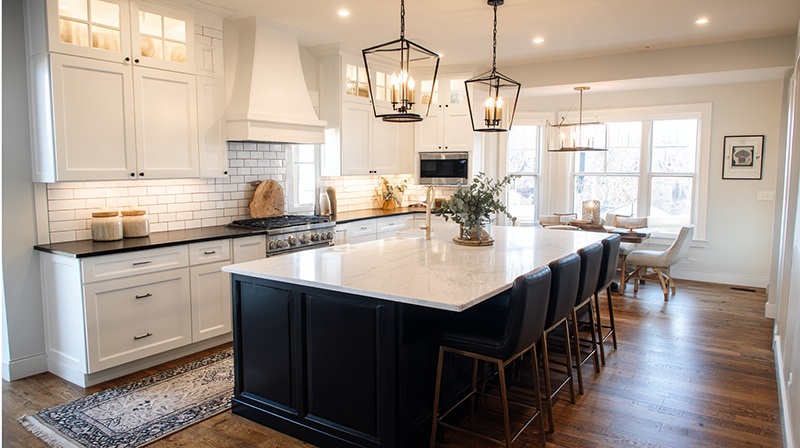
Sherwin-Williams Tricorn Black (SW 6258) is the safe pick for true black, and Iron Ore (SW 7069) is the softer option when pure black feels heavy. Kylie’s Interiors calls Tricorn the brand’s most popular black because it carries no blue, violet or green cast.
| Paint | Code | What sources say | Suggested white |
|---|---|---|---|
| Tricorn Black | SW 6258 | True black, no color cast | Chantilly Lace or Extra White |
| Iron Ore | SW 7069 | Filed under neutrals, softer than true black | Alabaster or Simply White |
| Black | Benjamin Moore 2132-10 | Classic black, no surprises | Simply White |
Sherwin-Williams files Iron Ore under neutral paint colors rather than black, which fits its role as the softer choice. It sits in the brand’s top ten as of October 2026.
Farrow & Ball Pitch Black (No. 256) is the premium alternative.
Where blacks go wrong: many black paints lean blue, violet or green (Kylie’s Interiors). Next to a warm cabinet white, that lean is easy to spot.
An island is a small share of a kitchen’s surface area, so it can take a bold color, per Houzz. The same article advises against large amounts of bright yellow or orange next to black, and a guide to colors that go with black covers the safer choices for stools and walls.
Matte, satin or gloss: which finish suits the black island?

Satin is the default for a black island because it wipes clean and still looks deliberate. Matte and gloss are choices for a look, not for durability.
Matte: absorbs light, so the island feels heavier and denser (Houzz).
Satin or eggshell: hardwearing and easy to wipe, which is why Homes & Gardens names them the best finishes for an island.
Gloss: reflects light and amplifies the island’s visual impact.
The two sources answer different questions, one about how light behaves and one about wear. Put together, they give a rule: pick satin unless the look matters more than the wiping.
A matte black island under glossy white cabinets is a documented pairing (Overflowing). Mixing sheens is one more way to build the contrast that designers treat as a principle of its own.
Paint versus stain and glaze

A black stain or glaze gives a softer effect than opaque paint, according to Houzz, which pairs the suggestion with a traditional kitchen.
Paint costs less to redo. Kylie’s Interiors points out that painting an island is cheaper than painting every cabinet, and cheap to change later.
What countertop goes on a black island?

White quartz or marble gives the highest contrast and the classic black-and-white look, per Lily Ann Cabinets. Soapstone and wood tops lower the contrast on purpose.
| Material | Look on a black base | Main limit |
|---|---|---|
| White quartz (Caesarstone, Cambria, Silestone) | Crisp, uniform, highest contrast | Heat from pots and small appliances |
| Calacatta or Carrara marble | Veined white, traditional | Acids etch the surface |
| Soapstone | Gray to near black, low contrast | Soft, scratches |
| Butcher block | Warm wood against black | Finish and sealing vary by product |
Heat is the quartz weak point. Caesarstone’s US care guidance advises against placing pots hotter than 300 degrees F directly on the surface, and Cambria states its quartz is not heat-proof and recommends a hot pad or solid trivet.
Marble: sealer slows staining but does not stop etching, which is a surface reaction to acids such as lemon juice, vinegar and wine (Marble Institute of America guidance, as relayed by Slabwise).
Soapstone: the Natural Stone Institute notes that it scratches, and that mineral oil or sandpaper removes most marks. Untreated it is soft gray, and oiling darkens it toward charcoal or black, with full patina taking 7 to 9 months according to East Coast Surfaces.
Waterfall edge: Cambria states that its product is not seamless and seams are visible, so ask the fabricator how the pattern wraps around the corner.
Butcher block: Houzz suggests wood as a warm partner for a black island. Follow the maker’s care sheet for sealing, since products differ.
Which hardware, backsplash, flooring and lighting finish the look?

Brass or satin nickel pulls, a quiet backsplash, a warm wood floor and pendants hung 30 to 36 inches above the countertop finish the scheme. Keep one surface loud and the rest calm, because the black island already carries the contrast.
Hardware

Brass or satin brass: Houzz lists warm metal accents as a quick way to add zing to a black island. Satin and brushed finishes also hide fingerprints best, according to the Knobs.co finish guide.
Satin nickel: hides prints the same way, while polished chrome and polished nickel show them most.
Matte black: flat matte black shows fingerprints more than most finishes (Knobs.co), and a black pull on a black island disappears.
Mixed metals work. Overflowing describes black hardware on the white cabinets with brass fixtures on the island.
Construction matters more than color once the finish is chosen. Most mid-market brass is plated over zinc or steel, and solid-brass lines come from makers such as Top Knobs, Smedbo and Alno. PVD coatings resist scratches and tarnish better than lacquered or electroplated finishes, per Knobs.co.
Backsplash and flooring

Zellige is where backsplash advice splits. Artistic Tile tells installers to seal after installation, while Riad Tile says glazed zellige needs no sealer and only unglazed tile does.
Follow the maker’s sheet for the exact tile. Zia Tile also warns that traditional zellige arrives with crazing, pits and edge chips, which is part of the look.
A plain white subway tile keeps the island as the only loud surface. Atlane & High makes the point directly: a contrasting backsplash competes with a contrasting island. Lily Ann Cabinets lists black and white herringbone as an option, which works only if the island is not meant to be the star.
Order quantity is the easy part once the pattern is set, and calculating how much tile the wall needs takes a minute.
For floors, white oak and dark hardwood both hold up against the island. Christopher Scott Cabinetry & Design built a kitchen with a Benjamin Moore Onyx island, Simply White cabinets and plain-sawn white oak in an oil finish, laid in herringbone.
Atlane & High shows the opposite direction, a white kitchen with a very dark island over dark hardwood. Before ordering boards, estimating how much flooring the room takes avoids a short run.
Pendants and stools

Hang pendants 30 to 36 inches above the countertop.
Quoizel puts the spacing between fixtures at 24 to 30 inches, measured center to center. A short island that takes three pendants looks crowded, so count the fixtures against the length.
- Black or white pendant shades both appear in island galleries
- Decorpad shows ivory bamboo and white upholstered stools at black islands
- Wood or upholstered seats soften the island more than black metal ones
Which kitchen styles suit a black island against white cabinets?

The pairing fits farmhouse, Scandinavian, traditional, industrial and modern kitchens, and the cabinet door profile decides which one the room reads as. Shaker doors lean farmhouse, flat-panel doors lean modern, and glass fronts soften either.
- Modern farmhouse: Overflowing says a black island modernizes a traditional farmhouse-style white kitchen, with Shaker-style white cabinets and a rustic wood paneled or butcher block island
- Scandinavian: handle-less white cabinets and a sleek black island, the minimalist version of the look
- Traditional: Houzz shows a black island sitting comfortably in a decidedly traditional kitchen
- Industrial: black island plus industrial elements for an edgier room, also per Overflowing
The Scandinavian version leans on the restraint behind Scandinavian interior design, so keep the hardware and styling minimal.
Backsplash.com pairs white flat-panel cabinets with a stone island and clean lines for the modern version. For a traditional room, the cabinet details and trim carry more weight, which is covered in these traditional interior design characteristics.
Glass-front doors on the white uppers balance the boldness of the island, per Overflowing.
How big should the island be, and how much clearance does it need?

The room sets the island size, not the other way around. The NKBA Kitchen Planning Guidelines call for a work aisle of at least 42 inches for one cook and 48 inches for multiple cooks, measured between counter fronts, tall cabinets and appliances.
Key figures (NKBA Kitchen Planning Guidelines):
- Work aisle, one cook: 42 inches minimum
- Work aisle, two or more cooks: 48 inches minimum
- Walkway with no work: 36 inches minimum
- Seat at a 36-inch counter: 24 inches wide by 15 inches deep
Seat width matters when planning stools. An island that seats people on two sides eats clearance on both, so see this guide on islands with seating on two sides before drawing the plan.
Worked example for a one-cook seating island:
- Island depth: 48-inch base plus a 15-inch overhang plus about 1.5 inches of lip on the kitchen side gives 64.5 inches (Lily Ann Cabinets)
- Working aisle on the kitchen side: 42 inches
- Space behind the stools: 44 inches, the NKBA figure for a comfortable walk-past
- Total room width: 150.5 inches, about 12.5 feet
Captivating Cabinets puts the figure for a standard 3-foot-deep island at about 13 feet, so the two sources land within half a foot of each other.
An oversized black base is the failure mode here. Tasting Table warns that a bulky island packed with storage reads as a solid, unforgiving block in the middle of the room.
When does white cabinets with a black island not work?

The scheme fails in small, dim kitchens, in rooms where the center is already the heaviest element, and for households that will not wipe dark paint regularly. Everywhere else it holds.
Designers split on small kitchens. Livingetc quotes Beams advising against dark colors on a small island, while Homes & Gardens quotes the founder of Living with Lolo calling a painted island a stunning moody accent, as long as the whole room is not wrapped in the same tone.
The difference is where the dark goes. A white perimeter with one black island is the second case, and the first applies when the kitchen has little daylight. Which colors make a room read bigger is covered in this guide to colors that make a room look bigger.
Sources also disagree on marks, and the groups are worth reading side by side.
Black hides: kitchencabinetdesign.us says black hides fingerprints and minor smudges better than lighter colors, and Kitchen Cabinet Depot says it hides scratches and minor stains better.
Black shows: Lily Ann Cabinets says fingerprints and smudges show more easily, and Christopher Scott Cabinetry says black shows fingerprint oil and dust more than any other color.
They measure different things. Scratches and stains hide on black, while dust, fingerprint oil and chips show, because a chip exposes the lighter material underneath (Christopher Scott).
Sheen splits the sources again. Kitchen Cabinet Depot says matte hides fingerprints better than gloss, while Dremax and Tasting Table say matte makes every print stand out.
Balance is the last failure mode. Kylie’s Interiors describes a room where a stone fireplace and dark sectional already anchor the center, so a white island balances it better than a dark one.
Pros of a black island:
- Instant contrast, since one black island can carry a white kitchen (Lily Ann Cabinets)
- Hides scratches and minor stains better than lighter paint
- A low-risk way to test dark cabinets before committing to a full set (Kitchen Cabinet Depot)
Cons of a black island:
- Shows dust and fingerprint oil
- Chips reveal the material underneath
- Reads heavy in a small or dim room
- Can unbalance a room that already has a dark center
FAQ About White Cabinets and Black Island
What is this kitchen scheme called?
Designers file it under two-tone kitchens, or kitchens with a contrasting island. Lily Ann Cabinets describes the version where the black goes on the island only and every other cabinet stays white.
Can the lower cabinets be black instead of just the island?

Yes. Overflowing describes white uppers over black lower cabinets as a layered look, and Cincinnati Cabinet Painter suggests a lighter white above and a darker gray-black below.
That puts dark paint on far more of the room, so the island stops being the single focal point.
Do black appliances work with this scheme?
Yes. Kylie’s Interiors says black appliances against white cabinets make a high-contrast palette, and a dark island helps tie them in.
Matching the island’s black to the appliance finish keeps the room to one dark tone.
How do you paint an existing island black?

Sand, degrease, remove lint, then prime and apply the paint with a roller or spray gun. 136 Home advises allowing at least 5 days for the paint to cure and warns that matte paint under a clear topcoat peels.
How much does a black island add to the budget?
No published price covers the scheme, because cost depends on whether the island is new or repainted. Kylie’s Interiors notes that painting an island costs less than painting all the cabinets.
Get quotes against your actual island size and finish.
Testing Samples in Your Own Kitchen Light

Sample both paints inside the kitchen before committing to white cabinets and black island, and check them in morning, midday and evening light. Showroom lighting flattens the gap between whites, while the room’s own daylight decides how warm the cabinet white reads beside the black.
Order the decisions by what a repaint cannot fix:
- Room width and aisle clearance
- White beside black, on two different walls
- Sheen and hardware, on a painted board
Paint can be redone in a weekend, while a floor plan cannot, so layout comes first. The trade-off is time, since sampling delays the order, and that delay costs less than repainting an island.
The aisle figures here follow NKBA guideline text as verified in October 2026, so a revised edition would change the room-width math. Once the samples settle, work out how much paint the cabinets, walls and island need.

- Kitchen Color Schemes by Cabinet Color: What Pairs Well - October 19, 2026
- Curtain Colors for Every Wall Color: Safe vs Bold Picks - October 18, 2026
- Interior Design Styles: Find Your Primary and Secondary - October 14, 2026


