Bohemian Interior Design
Modern Bohemian Interior Design: Stylish Spaces to Inspire

Modern bohemian takes the collected, handmade look of boho and trims it down. Global textiles, plants, natural materials and vintage finds still do most of the work, but they sit on clean-lined furniture and a neutral-led palette, with fewer colors and less stuff on every surface.
Warm neutrals and earth tones carry it, with terracotta, sage and rust showing up most. Designers seem to be heading the same way. 33% of the 468 designers surveyed named chocolate brown the top color for 2026, up from 17% in 2022 (1stDibs, 2025).
What Is Modern Bohemian Interior Design?
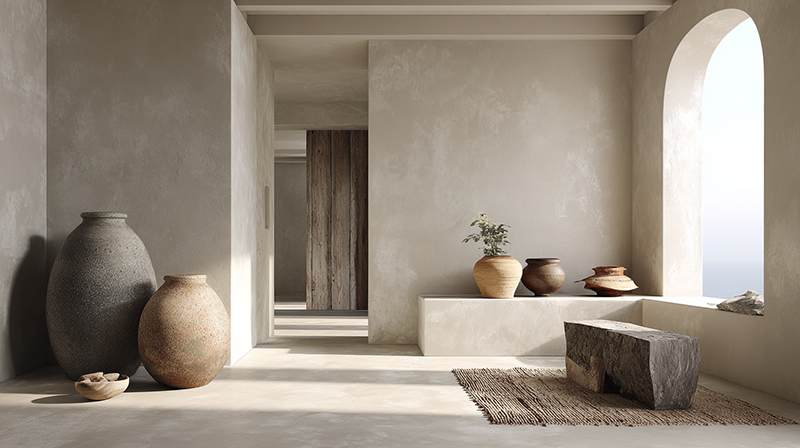
The label gets used loosely, but the idea is simple enough. Global textiles, natural materials, plants and collected vintage pieces get layered over clean-lined furniture and a neutral-led palette.
You’ll also hear it called modern boho, urban boho or boho modern. What separates it from classic boho is editing. Fewer colors, calmer surfaces, more open floor.
A typical room ends up with
- neutral walls and large furniture in plain shapes
- layered rugs, throws and cushions
- rattan, jute, linen and raw wood
- a handful of vintage or handmade pieces, not a room full of them
The modern half comes from the clean-lined, uncluttered side of modern design, which supplies the simple sofa, the open layout and the restrained color.
Where the Style Comes From
The word started as a mislabel. French speakers in the 15th century applied it to Roma people, who were wrongly believed to come from Bohemia (Britannica).
The artistic meaning took hold in Paris in the 1830s. Henri Murger began publishing stories about poor artists in the Latin Quarter in 1845 and collected them as Scenes of Bohemian Life in 1851, according to Britannica.
Those stories helped spread the idea beyond Paris. Britannica notes that translations of some of them appeared in a New York magazine in 1853, which carried the lifestyle to the United States.
How Bohemian Became Modern
The hippie counterculture of the 1960s and 1970s brought back handmade goods and global textiles, along with layered rooms that ignored most rules.
Justina Blakeney published The New Bohemians with Abrams on April 14, 2015, profiling 20 homes. Jungalow, the brand she grew out of a blog, carried the look into retail.
These days designers pair the layered look with mid-century modern shapes and pared-back palettes, as Saffron Marigold documents in its modern boho room examples.
How Does Modern Bohemian Design Differ From Traditional Boho, Eclectic and Maximalist Styles?
It comes down to editing. Modern bohemian keeps boho’s materials and textiles but caps color and surface density and keeps the furniture plain. The other styles each loosen at least one of those limits.
| Style | Palette | Surface density | Rule set |
|---|---|---|---|
| Modern bohemian | Warm neutral base, earth tones, few jewel accents | Layered, with open floor and bare wall areas | Edited: one anchor piece, clean-lined furniture |
| Traditional boho | Saturated jewel and earth tones throughout | High, textiles on most surfaces | Few rules, personal taste leads |
| Eclectic | Varied, often bold | Moderate, contrast between pieces | Balance, rhythm and proportion hold the mix |
| Maximalist | Bold, often several hues at once | Highest | Abundance is the point |
Eclectic sits closest to boho and gets mixed up with it most often. An eclectic approach to mixing periods and styles still obeys balance, rhythm and proportion. Boho drops the rulebook and leans on warm, earthy materials.
Guides disagree on color here. Quiet Minimal calls boho the more vibrant style and eclectic the earthier one, while Decoory says the reverse.
My guess is the gap tracks which era each writer treats as the baseline, 1970s jewel tones or the earthier 2010s version.
Maximalism sits at the far end. Houzz’s 2025 home design predictions describe homeowners asking for a more-is-more mix of bold color, pattern and texture, labeled maximalism or cluttercore.
Bohemian maximalism overlaps heavily with traditional boho, which is exactly the version modern bohemian edits down.
A quick way to tell where a room lands: if it keeps an open sightline and a neutral wall color, it reads modern bohemian. Once textiles cover most surfaces, it has slid into traditional boho.
Which Colors Make Up a Modern Bohemian Palette?

Think in layers. Warm white, cream, sand or light gray cover the walls and large furniture. Earth tones such as terracotta, rust, mustard, sage and olive show up in rugs, wood and ceramics. Sapphire, emerald or burnt orange get a small role, and only in textiles and art.
A palette built from earth tones holds together easily because the colors share warm undertones.
Mainstream color data points the same way. Houzz’s 2025 predictions describe a shift from cool whites and grays toward off-whites, creams, beiges, tans and browns, and Pantone named warm brown Mocha Mousse (17-1230) its 2025 Color of the Year, the first brown it had ever chosen.
Accents are the harder call. Houzz’s Fall 2025 design trends report, built on a survey of 50 home design pros, shows jewel tones, wallpaper and playful patterns gaining ground.
Sources also split on whether the base has to be white. Retailer Eternity Modern says clean white walls are the only way to show the modern half, but the Houzz data shows homeowners moving away from stark white toward warmer tones.
Cream or sand walls keep the neutral-base logic without the chill.
Before buying paint or textiles, run the mix through a color scheme generator built for rooms to check that terracotta, sage and one jewel accent sit well together.
Where this usually goes wrong is accents spreading across every surface. At that point the neutral base stops reading as a base and the room tips into traditional boho.
What Materials Define the Style?

Anything natural and handmade wins. Rattan, jute, linen, raw wood, leather and ceramic carry the look, while smooth modern surfaces like polished floors or glossy counters sit underneath as contrast.
Rattan and cane go into seating, headboards, pendant lights and mirror frames. Jute and sisal make good base rugs and baskets, though they’re coarse underfoot, so a softer rug usually goes on top. Linen and cotton work best in sheer or washed weaves for curtains and bedding.
Tables, consoles and shelving look right in raw or reclaimed wood. Leather works best as one sofa or accent chair, not the whole seating group. Handmade ceramics cover vases, planters and lamp bases.
Wood salvaged from older buildings adds age to a clean-lined table without adding ornament, which fits the editing logic of the style.
Rattan is the signature material and the one with the messiest sourcing story. A 2020 FAO announcement with INBAR describes the palm as fast-growing and quick to regrow after harvest.
INBAR’s own Technical Report 42 (2020) says significant quantities still come from natural forests in an unregulated way, which has depleted stocks and genetic diversity.
Both statements hold. The plant is renewable, and the supply chain often is not, so ask a seller where the cane was harvested before paying extra for a “sustainable” label.
Guides split on synthetics too. Saffron Marigold accepts metal, glass and faux leather in dining sets, while purist guides keep to natural fibers only.
One faux leather chair is harmless. A room built from synthetic copies of rattan and jute loses the texture that makes the style work.
How Do You Layer Textiles and Mix Patterns Without Clutter?

Layer by weight, mix pattern by scale, and let one shared color tie the pieces together. Start with a neutral base rug and add one dominant pattern. Supporting patterns should stay clearly larger or smaller than the first.
Understanding how pattern behaves in a room comes down to scale and repetition more than to style, which is why a large geometric and a small floral can sit together while two medium florals fight.
| Textile | Origin | Role in the room |
|---|---|---|
| Kilim | Flat-woven rugs from Anatolia and nearby regions | Layered over a jute base |
| Beni Ourain | Middle Atlas, Morocco; ivory wool, dark geometry | Neutral anchor under bolder pieces |
| Mudcloth | Mali; mud-dyed cotton | Cushions and throws for black-and-cream contrast |
| Suzani | Uzbekistan and Tajikistan; silk on cotton | Wall hanging or bed cover as the color focal point |
| Block print | India; hand-printed cotton | Bedding and cushions |
Mudcloth carries meaning along with pattern. The Smithsonian’s National Museum of African Art notes that bogolan patterns encode medical, historical, social and moral ideas.
The Met describes suzanis as dowry textiles made by women, and notes that examples from Nurata use a very soft palette. A soft suzani suits a restrained room better than a saturated one.
Ikat patterns, woven from yarns dyed before weaving, have blurred edges that work well as a supporting print beside crisp geometrics.
Houzz’s Fall 2025 report adds that designers now treat texture as the new neutral, layering boucle, grasscloth, plaster and zellige for depth.
No published study sets a pattern limit, and design guides disagree. A workable ceiling is three patterns in any one sightline, and no two of them should share a scale.
Matching scales is where it goes wrong. Three medium florals read as clutter, and a room of solids reads as minimalism.
How Do You Choose Furniture and Plan the Layout?

Start with one clean-lined anchor, usually the sofa, then add a few vintage or handmade accents around it. The anchor carries the modern half of the room and the accents carry the bohemian half.
For the anchor, look for a straight-lined sofa or sectional with a low back. A plain wood dining table or flat-fronted storage does the same job in other rooms.
Accents are where the bohemian side comes in:
- a Moroccan pouf or floor cushions for extra seating
- a rattan or cane armchair
- a vintage coffee table or side table
- a wooden stool that doubles as a plant stand
Low legs, tapered feet and little ornament come straight from mid-century modern design, which is why the two styles pair so easily.
A Havenly designer’s living room shows the pairing. A boucle sofa and a vintage rug anchor the space, with woven textures and trailing greenery layered on top.
Sources split on where the bohemian element should sit. Eternity Modern keeps statement pieces modern and pushes the boho into accents, while Grace in My Space argues for a velvet sofa that already does both, with clean lines, high texture and a color pop.
In a small room the second approach saves floor space, because one piece does both jobs.
Layout follows the same editing logic. A space plan that keeps the floor open lets layered rugs and cushions read as intentional instead of crowded.
Vintage is mainstream sourcing now. On average 36% of the items designers sourced per project in 2025 were vintage or antique, the highest share since 2021, according to the 1stDibs 2026 Designer Trends Survey of 468 designers.
The same survey reports interest in 1970s pieces falling while 1920s to 1950s pieces gain ground. A 1950s walnut chair fits a clean-lined anchor better than a 1970s piece does.
An all-vintage room is the usual failure. Without a clean-lined anchor, it reads as a collection instead of a design.
How Do Lighting, Plants and Wall Decor Finish the Room?
Each of these layers adds warmth, and each needs its own limit. Light should come from several low sources, plants work best grouped at different heights, and wall decor belongs on one dense wall.
Layered Lighting

The U.S. General Services Administration’s high-performance building guidance calls layered light, with daylight as the base, the best proven lighting strategy.
In this style that means lamps at several heights instead of one ceiling fixture. Build the ambient layer first from a woven pendant and a floor lamp, then fill in with table lamps and candles.
Houzz’s 2025 High Point Market coverage says rattan and seagrass fixtures have run through its trend reports for about a decade, and the newer versions add brass, beads and linen. Four Hands’ Winslet pendant, with a shaped linen shade and brass details, is one example.
Accent light on art or a plant corner usually runs about three times the ambient level, per Lumens’ lighting guide.
Plant Placement

Plants do two jobs in this style, and only one of them has solid evidence.
Cummings and Waring (Drexel University, 2019) reviewed a dozen studies spanning 30 years and found that potted plants cleared airborne volatile organic compounds orders of magnitude more slowly than a building’s normal air exchange.
Mood and focus hold up better. A 2014 study of three field experiments in large commercial offices in the UK and the Netherlands measured a 15% productivity gain in one experiment after plants were added, plus higher perceived air quality (Journal of Experimental Psychology: Applied).
That was an office study, and both bodies of research used live plants, so neither speaks to faux ones. The case for plants here rests on the biophilic approach to interiors, which works through mood and attention rather than air chemistry.
Further reading on biophilic design in interiors covers the principle in more depth.
For the arrangement itself, cluster plants at different heights so the group reads as one shape. Macrame hangers lift trailing plants and keep the floor clear. Woven baskets and ceramic pots look right, and plastic nursery pots don’t.
Wall Decor and Gallery Walls

One dense wall per room is the limit.
Group framed art, a woven hanging and a mirror into a single arrangement and center the whole group near eye level, so it reads as one composition instead of scattered pieces.
- Mirrors bounce light into darker corners
- Woven hangings and macrame add texture without adding color
- At least one wall stays bare
How Do You Build a Modern Bohemian Room Step by Step?
Work from the largest surfaces down to the smallest objects, and edit last. The order matters because each layer sets the limits for the next one.
- Confirm the neutral wall base
- Place the anchor sofa or bed
- Measure and lay the base rug
- Add the vintage and handmade accent pieces
- Layer curtains, throws and cushions
- Hang lighting at several heights
- Group the plants and hang the wall decor
- Remove one item from each surface before calling the room done
Measure before laying the rug. A rug size calculator shows whether a given size reaches under the front legs of the sofa and chairs.
The anchor you place early also sets the room’s focal point, so put it where the eye lands first.
Living Room
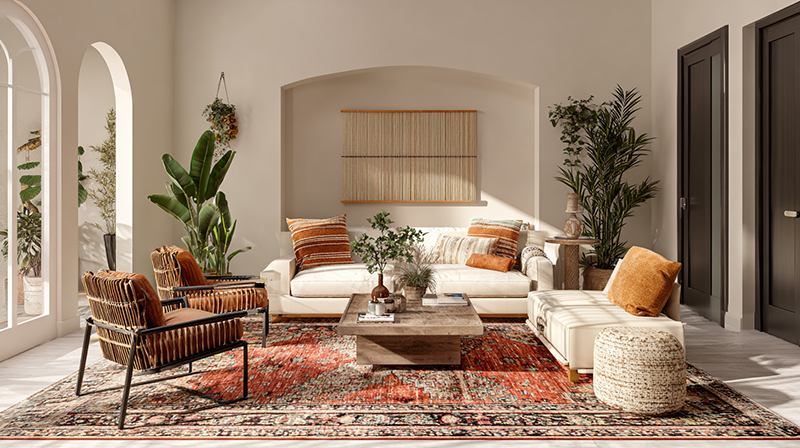
One sofa and a layered rug, plus two accent seats.
Everything else stays small. A side table, a few ceramics, one plant group. Skip the matching coffee table and end table set, because matched furniture pulls the room toward a showroom look.
Bedroom
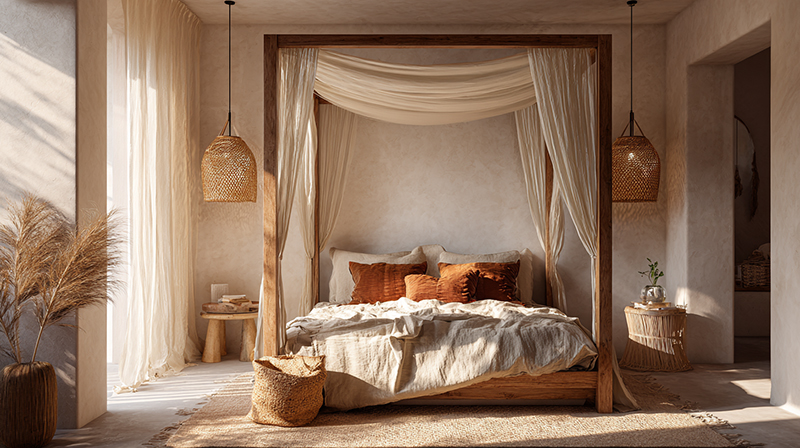
A low bed frame works best, and a rattan headboard is a fine option. Layer neutral linen first, then add one patterned layer such as block print. Sheer curtains and a single hanging or print above the bed finish it.
Dining Area
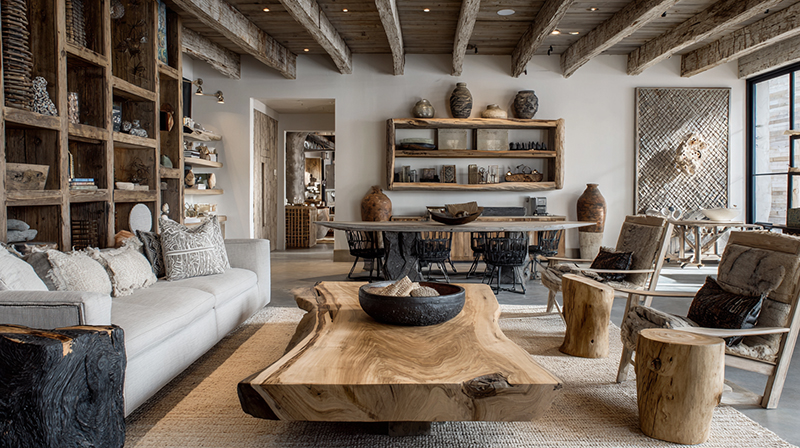
Saffron Marigold recommends non-fussy chairs with wide, often low, open backs and streamlined legs.
- A wooden table in a simple shape
- Low, open-back chairs
- A woven pendant above the table
- A ceramic bowl or a single plant as the centerpiece
Small Spaces
Spend the bohemian elements where they take no floor space.
Keep large items neutral and put the pattern into textiles, rugs and wall decor, the approach Jaipur Rugs recommends for small rooms.
When Does Modern Bohemian Design Not Work?
Small rooms with no spare floor are the first problem. A layered rug, a pouf, a plant stand and a floor lamp all compete for the same few square feet. Furniture scale and proportion usually decide the outcome here, because a deep sofa and a large rug can fill the room before the first accent arrives.
Strict architecture is another. Hard-edged, minimal shells fight collected objects, and the room ends up looking like a sparse space with clutter added, not a layered one.
Then there are owners who simply want abundance. Designers still report maximalism (39%) and eclecticism (38%) as the most requested styles, per the 1stDibs 2026 Designer Trends Survey.
Someone who wants a full, dense room will find the edited version too restrained. The better pick is traditional boho or maximalism.
| If you want | Better fit | Why |
|---|---|---|
| Abundance | Traditional boho or maximalism | Higher density, fewer limits |
| Sparse calm | Minimalist bohemian | Same materials, fewer layers |
| Order inside a mix | Eclectic | Balance and proportion hold it together |
For calm and very little clutter, a minimalist take on the bohemian living room keeps the natural materials and drops most of the layers.
When a room still feels busy, group similar objects into one vignette and keep one focal piece per wall. Scattered singles are what make a room read as clutter.
Modern Bohemian Interior Design FAQ
Is minimalist boho the same as modern bohemian?
No. Minimalist boho is the sparser branch. It keeps the natural materials and a few textiles but drops most of the layers, while modern bohemian keeps layering and edits it.
Can you get the look on a budget?
Yes. Spend on the anchor sofa and base rug, since they carry the room, and source the accents secondhand.
Thrifted ceramics, baskets, stools and framed prints fill a room well. Textiles are the cheapest layer to swap later.
Does the style work in a rental?
Yes, because almost nothing in it is fixed. Rugs, throws, lamps, plants, leaning mirrors and freestanding furniture all move with you, so the walls can stay as they are.
Does it work in kitchens and bathrooms?
Yes, in small doses. Keep the fixed surfaces plain and add the bohemian layer through movable pieces, like a block-print shower curtain, woven baskets, ceramics or a runner.
Keep jute out of splash zones.
How do you clean rattan, jute and layered textiles?
Vacuum jute and wool rugs regularly and blot spills fast, because soaking can stain jute. Dust rattan with a soft brush and wipe it with a barely damp cloth.
Check care labels on linen and cotton throws before machine washing.
Is modern bohemian still in style?
Its core materials still sell. In 1stDibs’ 2026 Designer Trends Survey, 27% of designers named wicker and rattan furniture as a trend for the year.
Keeping a Modern Bohemian Room Edited Over Time
The room stays edited when each new piece replaces one that leaves. A room that only accumulates drifts toward traditional boho.
Buy in this order. Anchor sofa and base rug first, then secondhand accents one at a time, with textiles and wall decor last.
That sequence puts the money into pieces that stay for years and leaves the cheapest layers free to rotate. Secondhand finds that arrive worn suit upcycling projects for old furniture.
The downside is that the room looks unfinished for months while accents arrive singly.
Houzz recorded searches for color drenching, which paints walls, trim and furniture in one hue, up 325% year over year in early 2025. A household moving that way has left the neutral-base logic and should choose a different style.

- Kitchen Color Schemes by Cabinet Color: What Pairs Well - October 19, 2026
- Curtain Colors for Every Wall Color: Safe vs Bold Picks - October 18, 2026
- Interior Design Styles: Find Your Primary and Secondary - October 14, 2026


