Minimalist Interior Design
Minimalist Bohemian Living Room Ideas & Inspiration

A minimalist Bohemian living room keeps the handwoven rug and the plants and drops most of everything else. The sofa sits low, the floor stays mostly open, and the colors stay warm and quiet.
The look falls between maximalist Bohemian design and spare minimalism. From the Bohemian side it takes the woven rug and the rattan chair, and from the minimalist side the bare wall. The palette stays at warm neutrals plus one or two earth tones.
One warning before the plant shopping starts. Snake plant and monstera show up on nearly every boho plant list, and both are toxic to dogs and cats according to the ASPCA’s Animal Poison Control Center. Parlor palm is listed as non-toxic to both, and it tolerates low light.
What makes a living room minimalist Bohemian?

Boho minimalism takes Bohemian handmade textiles and natural materials and holds them back with minimalist restraint, so the room feels layered without feeling crowded.
Woven rugs, rattan, ceramics and greenery are the Bohemian part. The minimalist part is mostly subtraction: an open floor and not much furniture, in a palette that stays quiet.
| Style | Palette | Furniture | Decor and pattern |
|---|---|---|---|
| Minimalist | White, gray, black | Few pieces, clean lines | Almost none |
| Maximalist Bohemian | Jewel tones, many colors | Mixed, plentiful | Dense, layered patterns |
| Minimalist Bohemian | Warm neutrals, 1 to 2 earth tones | Few low pieces | Sparse, textural, one pattern |
| Japandi | Muted neutrals, dark wood contrast | Few, sleek | Minimal, imperfect objects |
What separates this from maximalist Bohemian design is density. The ingredients overlap almost completely. Quantity is where they split, and here everything stops at a handful.
Japandi is the nearest neighbor. The Japanese and Scandinavian blend known as Japandi also uses low furniture and natural materials, but it grows out of wabi-sabi and hygge. This style pulls from handmade global textiles instead.
Boho minimalism, modern bohemian and minimalist boho are all names for the same room. The updated Bohemian look reached a mainstream audience through designer Justina Blakeney’s 2015 book The New Bohemians, a New York Times best-seller.
Color palette for a minimalist Bohemian living room

Walls and large furniture go in warm neutrals. Then one or two earth tones come in through small objects and textiles, and all of it should stay in the same warm family so nothing competes.
Sources split on whether bright color belongs at all. Hunker (2023) pairs neutral walls with a few vivid accents, Moroccan poufs for example. StyleGuru (2026) wants muted tones only, such as faded terracotta and taupe, plus cream.
Both camps keep the walls neutral, so the disagreement is smaller than it looks. What actually decides it is how many saturated pieces are in the room. One reads as an accent. By three you’re sliding into maximalism.
Warm whites and neutral bases
Alabaster (Sherwin-Williams SW 7008) is the creamy one, with an LRV of 82 on the manufacturer’s page as of October 2026. White Dove (Benjamin Moore OC-17) is a softer warm white, and published LRV figures run from roughly 83 to 85 depending on the color database you check.
Then there’s Accessible Beige (Sherwin-Williams SW 7036), a mid-depth greige. It’s better on a single sofa wall than on all four.
Brightness is nearly identical between the two whites, so the choice comes down to undertone. White Dove holds its warmth in low light instead of graying out (The Color Concierge, 2026).
Alabaster has its own weak spot. In a very bright south-facing room it can read almost flat white and lose the warmth you picked it for (The Design Confidential, 2026).
Earth-tone accents
Terracotta and clay cover the warm accents, and sage covers the green.
Stack shades inside one family, cream and sand say, or oatmeal, and add a single deeper tone. Sand and clay belong to the same wider earthy palette as olive, so any two of them pair without a clash.
Terracotta works in a planter or a pillow, and sage in one throw. If the room needs a cool counterpoint, dusty blue in a piece of pottery does it.
Before buying any paint, it’s worth running the shortlist through a color scheme generator built for rooms to see how the pairings hold together.
How to choose furniture and plan the layout
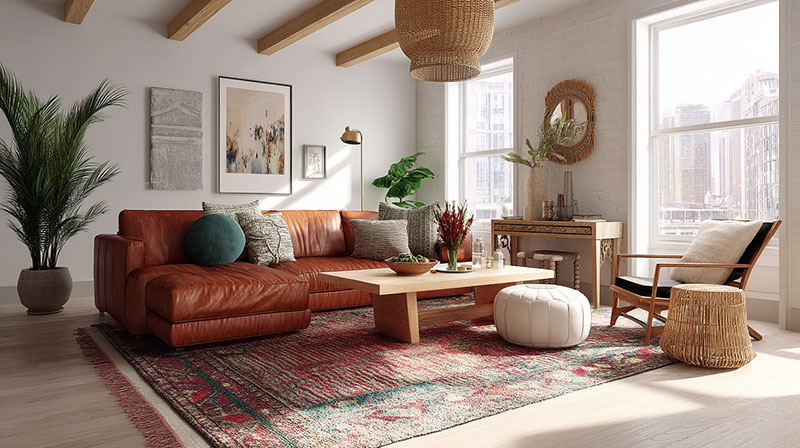
Go with a low sofa and one statement piece, add flexible floor seating if there’s room, and keep the center of the floor and the upper walls open. With so little furniture, the textiles do the Bohemian work.
Seating that stays low
Start with a low-profile sofa in linen or cotton-linen, a neutral tone, slim arms and legs.
A Moroccan pouf is the cheapest way to add a Bohemian accent. It’s leather floor seating that doubles as a footrest. If there’s space for a chair, make it rattan or cane, angled toward the sofa.
Linen has a real downside. Flax fiber is not very elastic, so the fabric creases and does not spring back (Houzz).
Blends with cotton or viscose add elasticity and reduce the creasing (The Stated Home, 2025).
One statement piece
One hero piece is enough.
A rattan lounge chair or a sculptural wood coffee table can carry the room’s personality, and so can a single oversized macrame hanging. It becomes the focal point, and everything around it stays plain enough that the eye lands there first.
Clearances and spacing
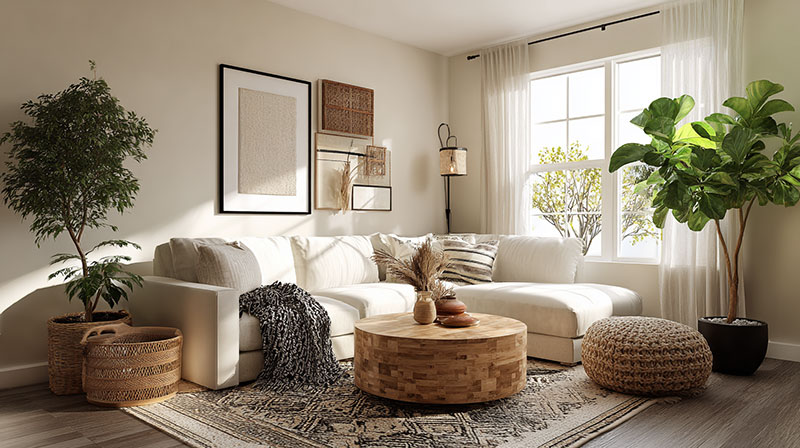
Leave 14 to 18 inches between sofa and coffee table, and 30 to 36 inches for main walkways, according to Apartment Therapy’s living room measurements guide.
Those gaps do double duty here. They keep the floor visible, and the visible floor is the negative space. Getting them right is a small exercise in space planning, and it’s where most overfilled rooms go wrong.
Float the sofa off the wall in a larger room. In a small one, push it back and let the rug define the seating area.
Layering rugs, pillows and throws without clutter
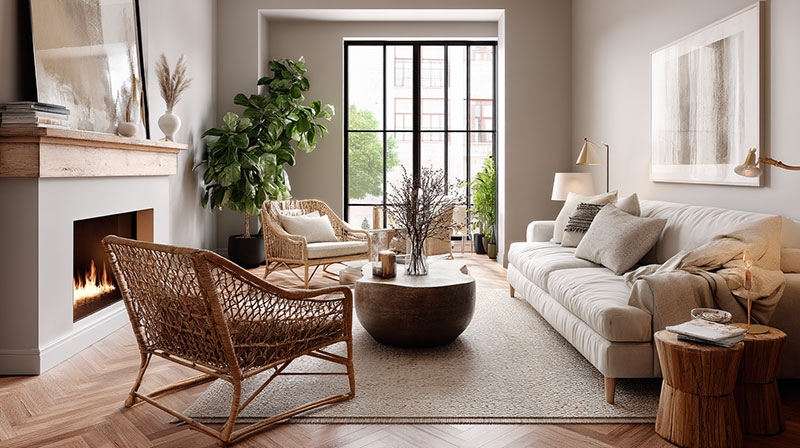
One large neutral rug goes down first, with a smaller accent rug on top. Pillows and throws stay inside the palette and carry a single pattern between them. Layering is done with texture, so pattern stays rare.
Choosing and sizing the rug
Jute is the natural fiber base layer. It sheds when new and discolors when wet, so keep it out of kitchens, bathrooms and other spill zones (Curran Floor, 2025).
Kilim is flat-woven with no pile, which lets it lie flat over jute, and it’s the usual choice for the single patterned accent. Beni Ourain is the thick wool pile rug from the Middle Atlas in Morocco, traditionally undyed and ivory (1stDibs, 2024).
Check the label if provenance matters. Many rugs sold as Beni Ourain are made elsewhere to copy the look (Nazmiyal Antique Rugs, 2025).
For sizing, the front legs of the sofa and chairs should sit on the rug. Run the room measurements through a rug size calculator before ordering, since a rug that stops short makes the seating look like it is floating.
Rug Fashion Store’s styling guide (2025) recommends a bold statement rug as the focal point of a minimalist room. It works only when the rest of the room stays solid, and when it doesn’t, the muted base wins.
Pillows, throws and the pattern limit
Pick one pattern family and repeat it.
Mudcloth, a Malian cotton textile, is the usual pick for that single pattern. Bamana women paint the design with fermented river mud onto cloth woven by men, according to the Saint Louis Art Museum.
A workable ceiling for one sofa is three pillows, in two textures and one color family. The same rules as pairing throw pillows apply, just with fewer pieces.
Solid pillows in the base neutral make up most of it. Add one in an earth tone, and one patterned piece, mudcloth or kilim.
Which natural materials and handmade pieces belong in the room?
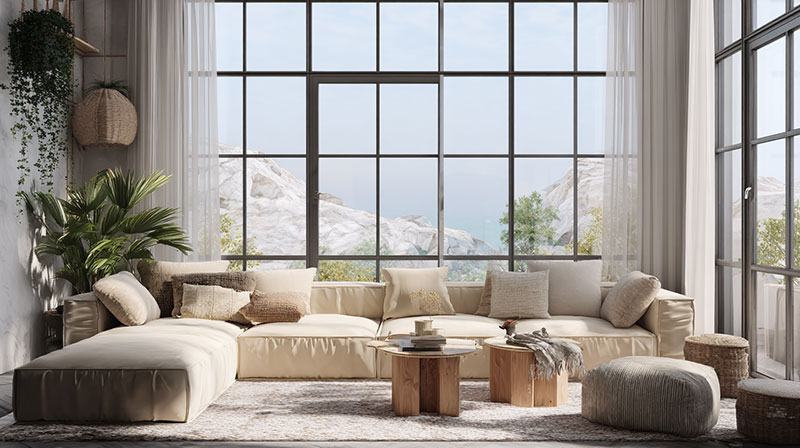
Rattan, jute, linen, wood and ceramic carry the Bohemian side of the room. Use each in one or two places so the texture reads as chosen rather than accumulated.
- Rattan suits an accent chair or a pendant shade, and a serving tray if you want one.
- Jute stays mostly underfoot, in the rug base and floor baskets.
- Linen covers the sofa, curtains and pillow covers.
- For wood, a coffee table, one shelf and one bench in a pale or mid tone is plenty.
- Ceramics should be two or three matte vessels, hand-thrown if the budget allows.
Texture does the work color does in other rooms. With a neutral palette, texture is what stops the space from looking flat.
About 80% of the world’s rattan comes from Indonesia, according to the country’s Industry Ministry (July 2024). The forestry ministry cites the same share for raw rattan and also names synthetic rattan as a competitor to the natural product (2024), so check the product label for natural versus synthetic fiber.
Macrame works as a single wall hanging or plant hanger, not a cluster.
Vintage and artisan pieces supply the Bohemian history, but each one adds visual weight. Measure before buying, because an oversized carved chest breaks the open floor faster than any trend piece.
Plants and light for a minimalist Bohemian living room
Pick one or two large, low-maintenance plants and light the room with 2700K to 3000K bulbs behind a woven or paper shade. The plants add the only green, and the shade adds texture overhead.
Which plants to use and which to skip
The two plants most Bohemian guides recommend sit on the ASPCA toxic list.
Snake plant is toxic to dogs and cats and causes nausea, vomiting and diarrhea. Monstera deliciosa is toxic to both as well, and its calcium oxalate crystals cause mouth irritation and drooling (ASPCA).
Parlor palm is non-toxic to dogs and cats per the ASPCA, and it’s happy in low light. Cast iron plant, also on the ASPCA non-toxic list, is the most forgiving pick for a dim room.
Snake plant is fine in a home without pets, though in a dim corner it survives but grows much more slowly (Lively Root, 2026).
Pampas grass is the dry alternative. It sheds when moved, and fluffy grasses can trigger allergies in sensitive homes (Dried Flowers Decor, 2025).
Set plants in baskets or on low stands near the window, not on every surface. For a longer shortlist, browse these indoor plant ideas.
Setting up the light
ENERGY STAR’s lamp specification recommends calling 2700K soft white and 3000K warm white, and that band is the target here.
Use one Kelvin value in every bulb so the shades and the walls read as a single warm tone. Together the bulbs form the room’s ambient lighting layer.
A woven pendant in rattan or sedge goes over the seating area. Add a linen-shaded table lamp, and one paper lantern, either floor or ceiling.
The paper lantern has a real pedigree. Isamu Noguchi’s Akari lamps, built from washi paper and bamboo ribbing, have been made by the family company Ozeki and Co. in Gifu, Japan, since 1951 (Noguchi Museum).
Editing decor: items per surface, wall art and negative space
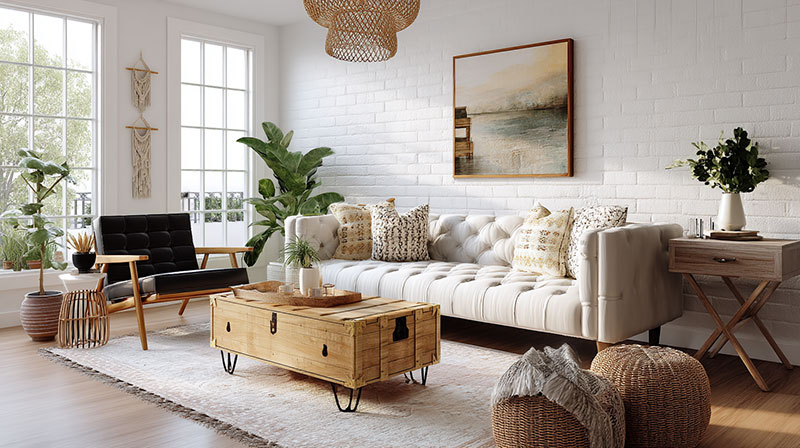
Each surface gets about three objects. The main wall gets one large piece, and one other wall and most of the floor stay bare. Negative space is part of the design, not leftover room.
Lab work backs the instinct. Princeton researchers found that multiple stimuli in view compete for neural representation and suppress each other’s response (McMains and Kastner, Journal of Neuroscience, 2011).
- On the coffee table, a tray, one ceramic piece, and either one small plant or a stack of books.
- Shelves get two groupings with empty space between them.
- A console takes a lamp and one object.
- On the main wall, one oversized artwork or one tight frame grouping.
One large piece creates emphasis on the wall, while a spread of small frames splits the attention. If a gallery wall is the goal, keep the frames in one color and the art in one tonal range.
The same restraint runs through any minimalist approach to living room design, but here the editing has a second job. It decides which handmade pieces earn a place.
To test whether a room is decluttered enough, remove one item from each surface and look again. Repeat until the statement piece reads first.
How to build the room, step by step
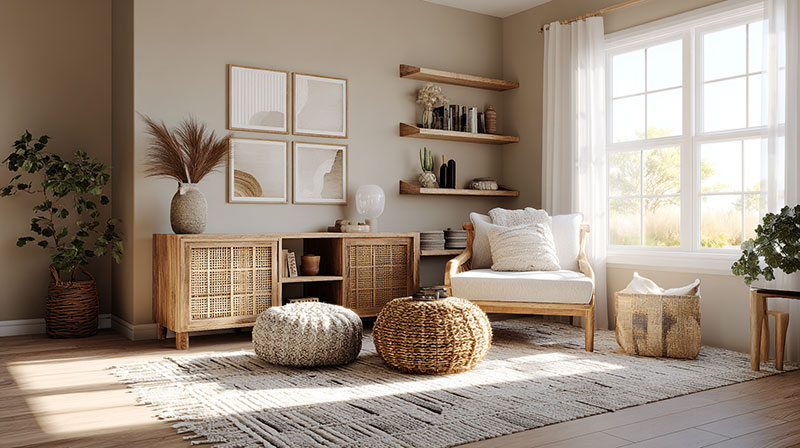
The order that works is paint, rug, sofa, statement piece, lighting, plants, textiles and art. Large and fixed items go first, so the small ones get placed around them.
- Measure the room and tape the walkways on the floor.
- Paint the walls and trim in the base neutral, and test two samples in morning and evening light.
- Lay the base rug and set the sofa on it.
- Add the statement piece and the floor seating.
- Hang the pendant, place the lamps and put one Kelvin value in every bulb.
- Bring in plants one at a time.
- Layer pillows and throws in the palette.
- Hang the art, place the objects, then remove one item per surface.
Quantities are worth checking before you buy. You can calculate the paint a room needs from its dimensions, which avoids a second trip for a mismatched batch.
Lighting works the same way. Use a tool to calculate the LED light the room requires before choosing bulb output.
Most first builds go wrong at steps 7 and 8, when decor arrives before the rug and sofa are settled. If a pillow or a vase has no place yet, it waits.
Budget, sourcing and rental-friendly options
Most of the budget goes to the sofa, and decor takes the least. Spend on the sofa and the rug. Save on shades, ceramics and baskets.
Where the money goes
- A jute rug in IKEA’s LOHALS, 5 ft 3 in by 7 ft 7 in, lists at $129.99 (IKEA US, 2026).
- The KAPPELAND rattan shade on a HAVSDJUP cord set, 17 3/4 in, lists at $71.99 (IKEA US, 2026).
- For the sofa, IKEA’s Soderhamn 3-seat corner sectional in light beige lists at $1,188 (IKEA US, 2026).
- Command’s 20 lb strips hold frames up to 24 by 36 inches (3M, 2025), which covers the hanging.
For layouts built from IKEA pieces, these IKEA living room setups are a useful starting point.
Vintage and thrifted finds carry the handmade side cheaply. Knowing the main vintage furniture styles helps you tell a period piece from a reproduction before you pay for it.
Rental-friendly choices
Plug-in pendants and lamps work in place of hardwired fixtures. Removable strips hold frames, on painted walls only. The rug, plants and textiles do most of the transformation, and nothing needs repainting since the palette lives in the textiles.
Check the pack in your hand. Weight claims on Command packaging have changed over the years, and 3M says the product itself did not.
The packaging also warns against use on wallpaper and over beds.
When does a minimalist Bohemian living room not work?
It struggles in rooms with no daylight and in homes that need a lot of open storage. It also fails whenever the editing swings too far toward bare or toward crowded, and each of those has a specific fix.
| Failure look | Signs | Fix |
|---|---|---|
| Sterile | Flat walls, one material, no texture | Add jute, linen and one handmade object |
| Cluttered | Several patterns, crowded surfaces | Remove one item per surface, keep one pattern |
| Dim and cold | Neutrals read gray, plants stall | Warmer bulbs, lighter palette, low-light plants |
Conditions that rule it out or change it
A windowless room leaves artificial light to do everything. Look at how light behaves in a room before committing, because warm neutrals depend on it.
Heavy storage needs make open surfaces impossible, so closed storage (a sideboard, lidded baskets) has to carry the load. Pets rule out snake plant, monstera and shedding pampas. Dust sensitivity is another problem, since textured decor collects dust over time, and woven fibers and dried grasses collect the most.
If the household needs more color, pattern or storage than this style allows, a fuller modern Bohemian approach is the closer fit.
For upkeep, the rule is one in, one out. When a new piece arrives, an old one leaves, and the room stays where the build left it.
Minimalist Bohemian Living Room FAQ
Can a small living room carry a minimalist Bohemian look?
Yes, and small rooms suit it, because the style already favors low furniture and open floor.
Choose a compact sofa and a 6×9 rug (Boutique Rugs lists the size for medium living rooms, so in a very small room check that it leaves 12 to 18 inches of bare floor around the edges), with one large plant.
Where should the TV go?
On a low wood console, or mounted, with decor kept off the surround. A dark screen adds visual weight, so a basket or a plant beside it softens the block.
Does mid-century modern furniture work with this style?
Yes. Clean-lined mid-century modern pieces share the low profile and warm wood tones, so a walnut sideboard or an armchair slots in easily.
Stay with one era so the room does not drift toward eclectic.
How do I clean rattan pieces?
Dust them. IKEA’s care instruction for its rattan KAPPELAND shade is to clean with a duster, and wet cleaning is not part of it.
Is macrame easy to make at home?
A basic wall hanging needs cotton cord, a wooden dowel and two or three knot types.
Make one piece, not a cluster, so it stays the single handmade accent.
Which curtains suit the style?
Gauzy linen panels, which Hunker (2023) recommends for keeping daylight and privacy, in warm white or oatmeal. They add no pattern.
Size them with a tool that calculates curtain width and drop, and hang them to the floor.
Keeping a Minimalist Bohemian Living Room Balanced Over Time
The room stays balanced when every new piece replaces an old one and a monthly review resets the surfaces. Replacement holds the object count steady while the textures change.
The review goes floor and walkways first, then surfaces and walls, then textiles and plants. Largest comes first because floor and wall space set the proportions that small objects cannot repair.
The cost of the rule is speed. A flea-market find waits until something else leaves the room, which slows how fast the collected look builds.
Verified as of October 2026. A new sofa, a new pet or a move to a darker room each change the starting conditions, so rerun the full build before resuming the monthly review.
For the principle behind the review, see how balance works in interior design.

- Color Combinations for 32 Colors and 10 Wood Tones - October 22, 2026
- Kitchen Color Schemes by Cabinet Color: What Pairs Well - October 19, 2026
- Curtain Colors for Every Wall Color: Safe vs Bold Picks - October 18, 2026


