Bohemian Interior Design
What Is Bohemian Maximalism? A Guide to This Bold Style

Walk into a bohemian maximalist room and nothing is trying to hide. A kilim covers the floor, a suzani hangs over the bed, and the walls are painted a color most people would keep to a single accent wall.
Interior designers use the name for rooms that stack pattern, saturated color and collected objects, drawn from global, handmade and vintage pieces. Boho chic edits the same ingredients down, and this style doesn’t.
Working designers lean on vintage heavily. In 2025, 85% of the 468 designers in the 1stDibs Designer Trends Survey used vintage pieces made between the 1920s and 2000, the highest share in five years (1stDibs, 2025).
What Is Bohemian Maximalism?

The “more is more” attitude comes from maximalism. The sourcing comes from bohemian decor: kilims, suzanis, carved wood, rattan, thrifted furniture and objects brought home from travel. Everything gets layered on purpose, which is the part people tend to miss.
You’ll also see it called boho maximalism or bohemian maximalist decor. “Boho” is the short form of bohemian and means the same thing here.
General maximalism can run glam, baroque or strictly formal, so it’s a wider category than this one. Boho chic is the edited, neutral-base version of the look. And clutter, which has no anchor piece and no repeated element, is something else altogether.
Compared with other styles of interior design, this one leans heavily on what the owner has actually collected. Two rooms rarely look alike.
Where Bohemian Maximalism Comes From
The name is French and goes back to mid-19th-century Paris. The density comes from a much later argument against minimalism.
Bohemian roots
Henri Murger’s Scènes de la vie de bohème came out as a book in 1851. Serial stories and a 1849 stage play, co-written with Théodore Barrière, had come first. The story follows poor writers and artists around the Latin Quarter, and the Metropolitan Opera’s education guide credits it with fixing the popular image of the bohemian artist.
Sources don’t agree on when the serial ran. The Metropolitan Opera’s guide says 1845 and Britannica says 1847, though the 1851 book date holds up everywhere.
None of it was about decor, though. Murger described a way of living, and the interior look attached to the word showed up much later.
The maximalist reaction to minimalism
The trail for maximal rooms sits inside the longer history of interior design, and most of it is taste swinging back and forth.
- From 1837 to 1901, the Victorian period, a bare room counted as poor taste, so every surface carried objects that reflected the owner’s interests.
- Edith Wharton and Ogden Codman’s The Decoration of Houses attacked heavy curtains and bric-a-brac in 1897, and overstuffed furniture too.
- Dorothy Draper opened her firm in 1925. Her “Modern Baroque” mixed black-and-white schemes with bold stripes and oversized bouquets (Cooper Hewitt), and her 1948 redesign of The Greenbrier hotel in West Virginia is often called her masterpiece.
- Robert Venturi’s Complexity and Contradiction in Architecture, published by MoMA in 1966, answered Mies van der Rohe’s “less is more” with “less is a bore”.
- Ettore Sottsass formed Memphis in Milan in 1980, and the group showed its first collection in 1981. Its bold forms and patterns dominated early 1980s design (Design Museum).
Draper worked in baroque and Hollywood Regency. Memphis borrowed from Art Deco and Pop Art, plus a good amount of 1950s kitsch. Neither built on global handmade textiles, and that’s the bohemian contribution.
You can see the demand for the maximal side in the numbers. In the 1stDibs 2026 Designer Trends Survey (468 designers, July to August 2025), 39% cited maximalism, up from 34% in 2023.
What Keeps Layering Curated Instead of Cluttered?

A collected room has one big piece everything is arranged around, a color or motif that keeps coming back, and visible empty space between groups of objects. Miss any of those and the room reads as crowded.
Start with the anchor. A large rug, a strongly colored sofa or one oversized artwork will do. It works as a focal point, so the eye lands there first and then moves out to the smaller layers.
Then something has to repeat. Pick a color or motif that appears in at least three places, say a rust red in a rug, a cushion, a vase and the curtain trim. That repetition is what holds unrelated objects together. Designers call the result unity across unlike pieces, and it’s why a Moroccan pouf and a Victorian chair can share a room.
Empty space is the one people skip. Leave clear surface or wall between groups of objects.
Layered rugs have a simple order too. The larger, quieter rug goes underneath and the smaller, bolder one goes on top, so the floor doesn’t compete with everything above it.
William Morris had a Victorian version of this test. In 1880 the wallpaper and textile designer told people to keep nothing in the house unless they knew it to be useful or believed it to be beautiful (V&A).
None of this works if every layer has the same intensity. When the rug, walls, upholstery and art are all at full strength, nothing reads as the anchor and the room tips into clutter.
Which Colors Define Bohemian Maximalism?

Jewel tones do most of the work. Earth tones ground them, and a few pastels soften the contrast. Saturated color needs a warm, natural counterweight, or the room turns harsh.
| Color family | Examples | Role in the room |
|---|---|---|
| Jewel tones | Emerald, sapphire, ruby, plum | Saturated base on walls, velvet and large pieces |
| Earth tones | Terracotta, ochre, warm brown | Grounds the saturation, ties in wood and rattan |
| Pastels | Blush, powder blue | Softens contrast in small doses |
Designers’ own palettes back this up at both ends. In the 1stDibs survey, interest in burgundy tripled from 7% to 21% of designers, and butter yellow climbed from 14% in 2024 to 30% in 2025.
I’d pick the rug or main textile first and pull the other colors from it. A palette taken from one object stays coherent even at high saturation.
Repeating a few hues across the rug, wall and upholstery is basic color theory for interiors, where shared hues unify rooms that have no matching sets.
Sources split here. Toll Brothers’ bohemian style guide recommends a muted neutral backdrop, while 1stDibs found 35% of surveyed designers naming color drenching as a rising element for 2026.
They’re describing different things, though, general bohemian decor in one case and a design trend in the other. A neutral backdrop fits the lighter end of this style, and drenched walls belong at the maximalist end.
A room color scheme generator is a quick way to test a jewel-tone and earth-tone pairing before any paint is bought.
How to Mix Patterns and Textiles
Pattern works when scale varies. Put a large pattern next to a small one, add something in the middle, and run one shared color through all of them. Each layer also needs its own texture, otherwise two patterns end up competing for the same job.
Named textiles and what they bring
| Textile | How it is made | What it adds |
|---|---|---|
| Kilim | Flatwoven wool, no pile, slit weave | Sharp geometric edges, thin enough to layer over a larger rug |
| Ikat | Yarn resist-dyed before weaving | Soft-edged repeating pattern for cushions and upholstery |
| Suzani | Silk thread embroidered on cotton or silk | Floral, sun and vine motifs for walls and beds |
| Block print | Hand-stamped with carved wooden blocks | Repeating motifs for bedding and tablecloths |
With ikat pattern, the yarn gets dyed before it’s woven. The warp, the weft or both are tied to resist the dye, and the double form is the most complex, per the Fashion Institute of Technology’s fashion history reference.
Suzani means “of needle” in Persian. The panels were embroidered by women in what is now Uzbekistan and Tajikistan as part of a bride’s dowry, and they went on to decorate the home (Metropolitan Museum of Art).
Because suzani is embroidered, it suits a wall hanging or a bedcover much better than a floor rug. A cushion cover works too.
Scale and repetition
A large floral rug with a medium geometric on the sofa and small stripes on the cushions works, provided one color runs through all of it. Four medium-scale florals in unrelated colors don’t. That just reads as noise.
Keeping to two motif families, florals and geometrics for example, keeps the mix readable. It’s how pattern works in a room generally. Repeat motifs and the room holds together, and the contrast between them stops it going dull.
Texture is the second layer. Velvet on the seating and jute or wool underfoot give the eye a break between patterns, and so does linen on the bed.
Which Materials, Furniture and Decor Belong in the Style?
Provenance is the test. A piece should look like it was found or inherited, or made by hand, and not bought as a set. Natural and handmade materials, mixed-era furniture and collected decor all pass.
Furniture and materials
Rattan is a climbing palm native to tropical Southeast Asia, Africa and Australasia. Wicker is the weaving technique, not the material, and natural rattan is meant for indoor use.
Velvet on sofas and armchairs deepens jewel tones. Brass lamps, trays and hardware add a warm metal that sits well next to earth tones, and carved wood side tables, panels and screens bring weight and age. Vintage pieces in mixed eras and shapes beat a matching suite.
Designers do the same on real projects. On average 36% of the items sourced per project in 2025 were vintage or antique, the highest share since 2021, according to the 1stDibs Designer Trends Survey.
A Victorian chair beside a mid-century table works when a repeated color links them. That’s the repeated element rule applied to furniture.
Walls and rugs
Walls carry the second layer of pattern. A gallery wall, a macrame hanging or a large textile all work, and so do mirrors in mixed shapes.
Lay the frames out on the floor first and keep the gaps even. One oversized piece can break the grid.
Rugs set the floor layer, and size matters more than pattern. A rug that is too small makes a layered room look broken up, so run the numbers with a rug size calculator before buying a statement rug.
Plants and lighting

Justina Blakeney’s Jungalow began as a blog in 2009 and grew into a product line with Anthropologie and Target collaborations (TODAY). Plants are part of the look there, not an accessory.
Mix heights. One floor plant and one hanging pot already beat a row of identical pots, and something trailing off a shelf makes it better. Picking species that suit the room’s light starts with ideas for indoor plants.
For lighting, table and floor lamps at different heights work well, along with Moroccan-style lanterns. String lights over a bed or a reading corner fit too.
One bright overhead fixture flattens a room built on layers. Low, warm sources keep each layer visible.
How Does Bohemian Maximalism Differ From Boho Chic, Minimalism and Related Styles?
Quantity and sourcing are what set it apart. Minimalism subtracts objects and boho chic edits them down, while cluttercore and dopamine decor are described more by motive than by materials.
| Style | Quantity | What defines it |
|---|---|---|
| Boho chic | Edited, fewer pieces | Coordinated, store-available look |
| Minimalism | Few objects | Subtraction, neutral palette |
| Eclectic style | Any amount | Mixed periods and origins, no fixed thread |
| Grandmillennial | Layered, pattern on pattern | Traditional decor: chintz, needlepoint, dark wood |
| Cluttercore | Dense, often unthemed | Sentimental personal collections |
Boho chic began as a fashion label. The Sunday Times Style magazine was already covering the look in May 2005, long before it became a decor category.
A middle path exists in the minimalist take on a bohemian living room. It keeps the boho sourcing and cuts the quantity.
Eclectic interior design mixes periods and origins, and a room can be eclectic with a dozen objects. Bohemian maximalism adds the density and a global, handmade thread.
Emma Bazilian coined “grandmillennial” in House Beautiful in 2019 for people drawn to “stuffy” or “outdated” traditional design. It layers pattern too, but from traditional sources, not global handmade ones.
Sources disagree on whether cluttercore is a separate style. Houzz groups it with maximalism under one trend, while an AOL explainer quotes designer Beth Martin saying cluttercore rests on personal collections and has no unifying theme.
The sourcing thread and the color and pattern system are what cluttercore’s definition lacks, so this article treats it as a looser relative, not a synonym.
Dopamine decor takes its name from fashion psychologist Dawnn Karen’s “dopamine dressing” (University of Michigan Museum of Art). It’s defined by mood-lifting color, so a dopamine room can be built entirely from new, mass-produced pieces. Bohemian maximalism rarely can.
A quick way to sort a room: if one store could supply the whole thing, it’s boho chic. Pieces that share no sourcing thread make it eclectic or cluttercore. When global, handmade or vintage pieces share a repeated color, you’re looking at bohemian maximalism.
How to Build a Bohemian Maximalist Room
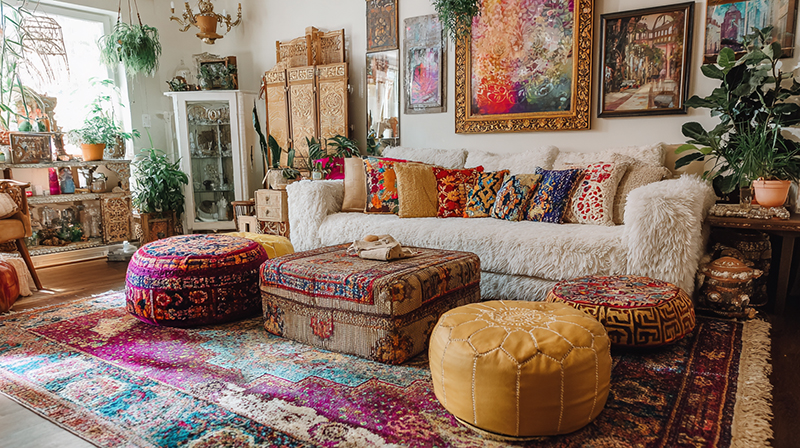
Work from the biggest, least movable layer down to the smallest. Walls come first and loose objects last, with everything else in between. Each smaller layer gets chosen against the one before it, so the order protects the budget too.
Order of work

- Settle the wall color. Drench the room in one saturated color, or paint a deep neutral and layer color on top.
- Place the anchor rug and the largest furniture. Every later color comes from them.
- Add the textiles. Curtains and throws go in, cushions too, and a smaller rug on top of the big one.
- Hang the walls with a gallery wall, mirrors and large textiles.
- Bring in plants at three heights and lamps at several levels.
- Place loose objects last, then remove one item from each surface.
Measure before buying paint. A paint calculator gives the quantity for a drenched room, and deep colors usually take more coats than pale ones.
The order fails when small objects come first. Cushions and ceramics bought before the rug have no color to relate to, and plenty of them end up returned.
Sourcing and budget
“Vintage” has no single definition, and that affects what you pay.
Etsy requires an item to be at least 20 years old to list it as vintage, which in 2026 means made in 2006 or earlier. Chairish co-founder Anna Brockway puts vintage at 30 to 100 years old and calls anything newer pre-owned (The Washington Post, 2022).
The same chair can be vintage on one site and merely pre-owned on the other. Check the stated age before paying a vintage premium.
Chairish launched in 2013 as a consignment marketplace for pre-owned furniture and sources most of its inventory from dealers, collectors and galleries.
Spend on the rug and the main seating, since the room is anchored there. Cushions, throws, frames and ceramics are easy to swap, so economize on those.
A thrifted piece in the wrong color can be repainted or reupholstered instead of replaced, and upcycling a thrifted piece is the cheapest way to fit it to the palette.
When Bohemian Maximalism Does Not Work
It struggles in very small rooms with no empty wall, on budgets that can’t absorb slow accumulation, in households that can’t keep up the cleaning, and for owners who find dense rooms stressful. Basically it needs space, time, upkeep and a tolerance for visual density.
Small spaces
Small rooms keep the style by cutting the number of colors, not the number of layers. Drop color families, large furniture and floor clutter first. Layered textiles, wall art and the one anchor rug can all stay.
Cost and time
The share of pieces designers bought internationally fell to 28% in 2025 from a 32% peak in 2024 (1stDibs survey). The survey ties the drop to tariffs, which 92% of surveyed designers said had hurt their businesses.
A style built on global textiles and vintage finds is exposed to that. Local flea markets and estate sales cover most of the gap, and resale marketplaces help too.
Time is the other cost. Collected rooms are assembled over months, and a single shopping trip produces boho chic instead.
Upkeep and allergies
Layered rugs, textiles and objects multiply the surfaces that collect dust. The EPA advises vacuuming carpets and furniture every week and dusting often with a damp cloth. Humidity matters as well, since dust mites do well where it’s above 50% (Kaiser Permanente). Kaiser Permanente also recommends smaller area rugs that can be washed.
For allergy households the guidance runs against the style. Kaiser Permanente lists removing rugs and wall-to-wall carpeting among its dust mite measures, and it notes that vacuuming stirs dust into the air.
Signs a room has tipped into clutter
The giveaways are easy to spot. There’s no anchor piece, so the eye has nowhere to land, and no repeated color or motif linking the objects. Some objects have no surface or shelf of their own, walkways are narrower than a person, and you catch yourself describing the room with words like “mess” or “chaotic”.
Clear walkways are a space planning question before they are a styling one. Move furniture first, remove objects second.
Princeton researchers McMains and Kastner (Journal of Neuroscience, 2011) found that stimuli in view at the same time compete for neural representation, and that grouping processes resolve part of that competition automatically.
In a UCLA study of 60 dual-income spouses in Los Angeles, Saxbe and Repetti linked wives’ use of words about clutter and unfinished projects during home tours to flatter daily cortisol slopes, a pattern associated with poorer health outcomes (Personality and Social Psychology Bulletin, 2010).
Neither study tested a decorating style, and the UCLA result tracked how residents described their homes, not how many objects they held. Read together, they support the test used here. Grouped objects reduce competition, and the owner’s own reaction decides whether the room works.
Bohemian Maximalism FAQ
Can you do Bohemian maximalism in a rental?
Yes, if you build it from movable layers like rugs, throws, cushions, plants, plug-in lamps and leaning frames.
Check the lease before painting or drilling, since walls are the one layer that is hard to undo.
Which room should you start with?
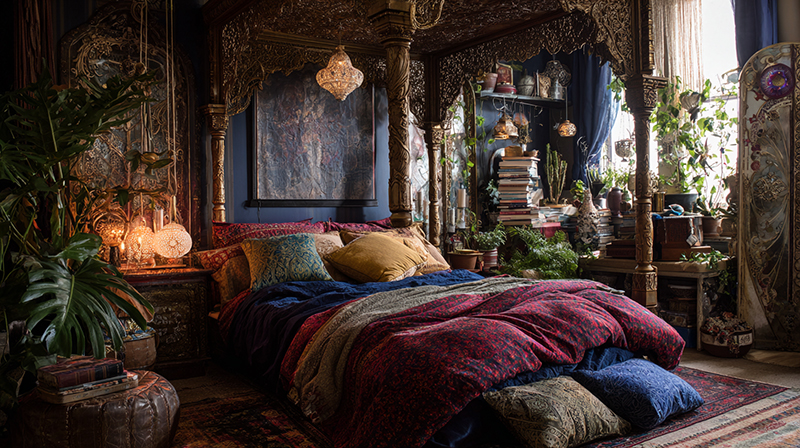
Start small and low-stakes, such as an entryway or one bedroom corner. Houzz designers have pitched a small space as a starter project for people who are not ready to commit a full living area to bold color and pattern.
Can Bohemian maximalism use dark, moody wall colors?
Yes, and deep emerald, plum and burgundy suit the style. Dark walls absorb light, so pair them with warm lamps, brass and lighter textiles to keep each layer visible.
Do you need real antiques, or do reproductions work?
Reproductions work in the supporting layers, such as cushions, frames and ceramics. The anchor pieces read better with real age, because the style depends on objects that look found or inherited.
Etsy, for one, excludes reproductions and vintage-style new items from its vintage category.
Keeping a Bohemian Maximalist Room Curated Over Time
A room stays curated when every new piece repeats an existing color or motif and has a place of its own. A piece that fails either test waits.
Before anything new comes home, check that its color or motif is already in the room, that there’s a free surface, shelf or wall for it, and that one older item can go in exchange.
The order follows cost. A color mismatch shows before purchase, while a lack of space shows only at home. The one-for-one swap then holds the object count steady.
The cost is speed. Finds that match no existing color get passed over, so the room fills more slowly than the shopping trips that built it.
The same checks apply in any style, and the principles of interior design explain why they work.

- Kitchen Color Schemes by Cabinet Color: What Pairs Well - October 19, 2026
- Curtain Colors for Every Wall Color: Safe vs Bold Picks - October 18, 2026
- Interior Design Styles: Find Your Primary and Secondary - October 14, 2026


