
Scandinavian kitchen decor keeps showing up in renovations for a reason. It works. The style balances clean lines, natural wood tones, and functional layouts in a way that feels both current and permanent.
But getting it right takes more than painting your cabinets white and adding a few birch shelves. The difference between a Nordic kitchen that feels authentic and one that feels like a Pinterest screenshot comes down to specific choices in materials, color, lighting, and storage.
This guide covers everything from color palettes and cabinet styles to lighting layers, furniture picks, and realistic budget breakdowns. Whether you’re planning a full renovation or just refreshing what you already have, you’ll walk away with a clear picture of how to build a Scandinavian kitchen that actually holds up to daily life.
What Is Scandinavian Kitchen Decor

Image source: Normandy Remodeling
Scandinavian kitchen decor is a design approach built on Nordic functionality, natural materials, and an obsession with light. It started in mid-20th-century Denmark, Sweden, Norway, and Finland, where designers like Alvar Aalto and Arne Jacobsen shaped kitchens around the idea that daily spaces should be practical and beautiful without being complicated.
The style leans on clean lines, neutral tones, and organic textures. Think light wood cabinetry, matte finishes, and white walls that bounce whatever daylight is available around the room.
A lot of people confuse it with plain minimalism. But the two are different animals. Minimalist design often strips a room down until it feels almost clinical. Scandinavian kitchens keep warmth in the equation through wood grain, woven textiles, and ceramic accessories. The goal isn’t emptiness. It’s intention.
The Swedish concept of lagom, meaning “just enough,” sits at the center of every layout decision. Not too much, not too little. Every item in the kitchen earns its place through function or genuine aesthetic contribution. Nothing decorative just sits there.
According to the NKBA’s 2026 Kitchen Trends Report, 60% of surveyed industry professionals identified minimalism and clean-line aesthetics as a popular style over the next three years. That includes flat slab cabinet doors and panel-faced appliances, both hallmarks of the Nordic kitchen.
Scandinavian vs. Minimalist vs. Japandi Kitchens

Image source: Paper Moon Painting
These three styles share DNA but split in personality. Here’s where they actually differ:
| Style | Core Influence | Material Focus | Mood |
|---|---|---|---|
| Scandinavian | Nordic functionality | Birch, ash, white oak | Warm, bright, lived-in |
| Minimalist | Reduction, restraint | Concrete, steel, lacquer | Cool, stark, deliberate |
| Japandi | Japanese + Scandinavian fusion | Dark wood, stone, bamboo | Serene, grounded, contemplative |
Scandinavian kitchens feel approachable. You can picture kids doing homework at the island. Zen-influenced designs and Japandi spaces tend to feel more curated, sometimes to the point where you’re afraid to leave a coffee mug on the counter.
The Bauhaus movement’s crossover into Nordic design during the 1930s is partly responsible for the functional ethos. But where Bauhaus went industrial, Scandinavian designers went organic. That’s the split that still defines the style.
Nordic Design Principles That Shape Kitchen Layouts

Image source: Alair Homes Decatur
Function before form. Every drawer, shelf, and cabinet placement starts with how the kitchen actually gets used, not how it photographs.
Light as a material. In Nordic countries with limited daylight for months at a time, kitchens are designed to capture and distribute whatever natural light exists. Large windows, minimal window treatments, and reflective surfaces all serve this purpose.
The NKBA’s 2025 Kitchen Trends Report found that 95% of homeowners consider natural lighting a top design priority. That number shows how much Nordic thinking has influenced kitchen design globally.
Honest materials. Wood looks like wood. Stone looks like stone. Nothing pretends to be something else. Understanding these principles of interior design is what separates a coherent Scandinavian kitchen from one that just happens to be white with some IKEA shelves.
Color Palettes for a Scandinavian Kitchen
White dominates Scandinavian kitchens. Not because it’s trendy, but because Nordic countries get so little daylight during winter months that white walls and cabinets act as light multipliers. Took me a while to appreciate that. It’s not a style choice. It’s a climate response.
But the palette has shifted in the last couple of years. Fixr.com’s 2026 Kitchen Design Trends Report (surveying 101 design experts) found that 67% agree warm neutrals and earth tones are replacing all-white kitchens. The days of pure white everything are winding down, even in Scandinavian-inspired spaces.
Warm Neutrals and Base Tones

Image source: Barnes Vanze Architects, Inc.
The new Scandinavian base layer includes greige, oatmeal, soft clay, and warm beige. These colors that pair well with beige create a foundation that feels calm without reading as sterile.
Jotun Lady (a Norwegian paint brand) and Farrow & Ball both offer Scandinavian-adjacent palettes. Benjamin Moore’s “White Dove” and “Simply White” remain popular picks for homeowners going the Nordic route in North America.
NKBA data shows 96% of respondents identified neutrals as the most popular kitchen color choice heading into 2026. That’s not a slight preference. That’s near-unanimous agreement across 634 industry professionals.
Accent Colors That Stay Within the Style

Image source: Yama Architecture
Muted sage, dusty blue, and charcoal gray work as accents without breaking the calm. You’ll also see deep greens showing up on islands and lower cabinets. The NKBA reports greens at 86% popularity and blues at 78% among surveyed designers.
Colors that complement sage green pair naturally with the birch and white oak tones found in Scandinavian cabinetry. And charcoal gray combinations add depth to an otherwise light room without making it feel heavy.
Quick rule I always follow: if the accent color demands attention from across the room, it’s probably too loud for this style. Scandinavian accents whisper. They don’t shout.
Matte vs. Satin Finishes
Matte finishes are the default in Nordic kitchens. They resist fingerprints, hide minor imperfections, and absorb light in a way that feels soft rather than flat.
Satin works on trim and hardware where a slight sheen adds definition. But glossy cabinets? Almost never. Laurysen Kitchens’ 2026 trend report notes that matte finishes are actively replacing glossy surfaces across the industry, offering both practical benefits and a contemporary feel.
Materials and Textures That Define the Style
The Houzz 2026 Kitchen Trends Study, surveying over 1,700 homeowners, confirmed a significant shift: 29% of renovating homeowners now choose wood cabinets, overtaking white (at 28%) for the first time. Medium wood tones lead at 15%, followed by light wood at 11%.
That’s a data point that would have been unthinkable five years ago. And it aligns perfectly with what Scandinavian kitchens have been doing all along.
Wood Species and Grain Patterns for Cabinets and Shelving

White oak is the clear front-runner. The NKBA’s 2026 report shows 51% of surveyed professionals naming it the most in-demand wood type. Its tight, straight grain works beautifully with both natural and matte finishes.
Birch and ash are traditional Nordic choices. Pine shows up in more rustic Scandinavian kitchens, especially in Norwegian and Finnish contexts. Each species brings a different personality:
- White oak: neutral tone, tight grain, pairs with virtually any countertop
- Birch: lighter, slightly pink undertone, a classic IKEA staple
- Ash: pronounced grain, works well for open shelving
- Pine: knotty, warm, better suited for rustic kitchen decor with Nordic influence
The role of texture matters here. Scandinavian kitchens rely on visible wood grain to add visual interest without introducing extra pattern or color. Letting the material show its character is the whole point.
Countertop Materials That Work (and Ones That Don’t)

Image source: Jessica Koltun Home
Natural stone works. Engineered stone works. High-gloss laminate does not.
The NKBA’s 2026 data shows quartz (62%) and quartzite (61%) as the dominant countertop materials across kitchen designs. Both come in matte or honed finishes that suit the Scandinavian aesthetic.
Dekton and Caesarstone offer specific lines in muted, stone-like finishes that blend with light wood cabinetry. Marble remains popular for its natural veining, and the Houzz study confirms marble’s enduring appeal for kitchens seeking a unique visual identity.
What doesn’t work: anything too polished or synthetic-looking. Busy granite with heavy veining. Bright quartz with sparkle flecks. If the countertop fights with the calm of the room, it doesn’t belong there.
Ceramic and handmade tile for backsplashes fit perfectly. The slight irregularity of handmade tile adds the kind of small details that make a kitchen feel crafted rather than assembled.
Cabinet Styles and Open Shelving
Cabinets set the visual tone for any kitchen. In Scandinavian spaces, that tone is always “quiet confidence.” No raised panels, no ornate molding, no visible hinges if you can avoid them.
Flat-Panel Doors and Shaker Profiles

Image source: William Quarles Photography
Flat-panel (slab) doors are the default for Nordic kitchens. The NKBA’s 2026 report lists slab-style cabinet doors at 69% popularity among professionals, and panel-faced appliances even higher at 72-85%.
Shaker-style cabinets also work within the Scandinavian context, especially when painted in warm whites or left in natural wood. Nordiska Kok’s 2026 trend analysis mentions Shaker profiles as a natural fit for “Scandi Elegance,” a style blending clean Scandinavian lines with subtle classic charm.
The choice between the two comes down to how stripped-back you want the kitchen to feel. Slab doors disappear into the wall. Shaker doors add just enough shadow line to create dimension.
Handle-Free vs. Minimal Hardware

Image source: DESIGN 4 CORNERS
Push-open systems create the cleanest look. No hardware visible at all. The cabinet face becomes one unbroken surface, and the kitchen reads as furniture rather than cabinetry.
Leather pulls are a distinctly Scandinavian detail. You’ll see them on Reform kitchens out of Copenhagen and across Pinterest boards from Swedish homes. They add warmth and a handmade feel.
Brushed brass or nickel handles work when they’re small and simple. Anything decorative or oversized breaks the clean lines that define the style.
Open Shelving: When It Works, When It Doesn’t

Image source: William Guidero Planning and Design
Open shelving is almost synonymous with Scandinavian kitchens at this point. But here’s the thing people don’t talk about enough: it only works if you actually maintain it.
Styled open shelves with matching ceramics from Iittala or Royal Copenhagen look stunning. Open shelves with mismatched mugs, a box of cereal, and a dusty bottle of olive oil look terrible.
IKEA’s METOD system remains the most accessible framework for building a Scandinavian kitchen globally. Superfront and Kvik offer mid-range alternatives with better finishing. Reform (based in Copenhagen) sits at the higher end, producing custom fronts that fit IKEA cabinet frames.
IKEA generated total retail sales of EUR 45.1 billion in fiscal year 2024, making it by far the largest furniture retailer in the world. Their Scandinavian kitchen systems remain the entry point for most homeowners approaching this style for the first time.
Lighting in Scandinavian Kitchens
Lighting isn’t decoration in a Nordic kitchen. It’s infrastructure. Scandinavian design developed around managing scarce natural light, and that thinking still defines how every fixture, window, and bulb gets placed.
The NKBA’s 2025 report found that 88% of industry professionals agree lighting is used to create different moods throughout the day. And 74% say homeowners now use lighting specifically to support physical and mental well-being.
Natural Light as the Starting Point
Maximizing natural light in the kitchen always comes first. Large windows, skylights, and minimal curtains are standard.
The NKBA 2025 data shows 67% of respondents agree that large windows are growing in popularity specifically to bring more natural light into kitchens. In Scandinavian design, this isn’t a trend. It’s been the baseline for decades.
South-facing kitchens are ideal for Nordic-style spaces in the Northern Hemisphere. North-facing kitchens need more help from artificial sources, but the approach stays the same: let in as much daylight as the architecture allows, then supplement with layers.
Pendant Lights and Statement Fixtures

Image source: Abramson Architects
Pendant lighting over islands and dining areas is where Scandinavian kitchens get expressive. This is usually the one spot where the design makes a statement.
Louis Poulsen’s PH series is the classic choice. Designed by Poul Henningsen, these fixtures distribute light evenly without visible glare, which is exactly the Nordic philosophy in lamp form.
Muuto and &Tradition offer modern alternatives. HAY’s pendant lines work for tighter budgets. Any of these brands keep you within the Scandinavian design language.
The NKBA’s 2026 data confirms that 87% of professionals now view kitchens as spaces for decorative, statement lighting. Pendant lights specifically ranked at 63% popularity among the top fixture types.
Task Lighting and Ambient Layers
Image source: Jessica Koltun Home
Under-cabinet task lighting at work surfaces is non-negotiable. It ranked at 82% popularity in the NKBA’s latest survey, with interior cabinet lighting at 72%.
The warm color temperature matters. Stick to 2700K-3000K bulbs. Anything cooler starts to feel institutional, and that kills the warmth Scandinavian kitchens depend on.
Candles deserve mention too. In Denmark, Norway, and Sweden, candles are ambient lighting sources used daily, not just for special occasions. A few candles on the counter or dining table at 5pm in November is completely standard in a Nordic household. It’s functional, not decorative.
Furniture and Fixtures for a Scandinavian Kitchen
The furniture in a Scandinavian kitchen tends to blur the line between built-in and freestanding. A good Scandinavian kitchen doesn’t look like everything came from one showroom. It looks collected over time, even when it wasn’t.
Dining Tables and Seating

Image source: Masterpiece Design Group
Hans Wegner’s Wishbone Chair (the CH24) is probably the single most recognized piece of Scandinavian furniture in the world. It’s been in production since 1949 and still shows up in new kitchen installations constantly.
HAY offers more affordable dining chairs that stay within the Nordic design vocabulary. IKEA’s solid wood dining lines (like LISABO) work as entry points, though the quality difference from something like a Wegner original is obvious up close.
Kitchen tables tend to be simple. Rectangular or oval, light wood, without heavy pedestal bases or ornate legs. The table supports the meal. It doesn’t compete with it.
Faucets, Sinks, and Hardware Finishes
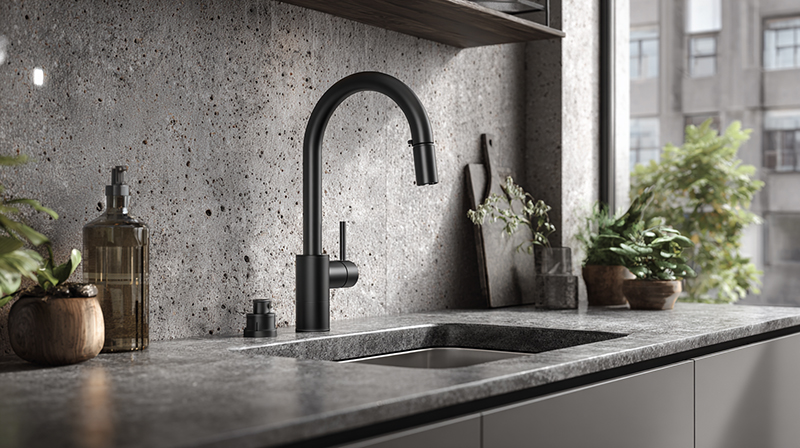
Matte black fixtures remain the strongest trend in Scandinavian kitchens. Brushed nickel is the alternative for people who want something softer.
Integrated sinks (where the sink and countertop form one continuous surface) fit the style perfectly. They remove visual clutter and make the workspace feel seamless.
Choosing the right hardware finish involves thinking about unity across the whole room. If the pendant lights are brass, the cabinet pulls should match. If the faucet is matte black, the light switches and outlet covers should follow. These small decisions separate a polished Scandinavian kitchen from one that feels like it was pulled from different mood boards.
Mixing Vintage and New Pieces

Image source: Buckminster Green LLC
This is something a lot of Scandinavian homes do naturally that gets lost in the “Instagram version” of the style.
An inherited wooden stool next to a new HAY dining chair. A vintage kitchen clock on a wall of otherwise modern cabinetry. A ceramic bowl from a flea market on an open shelf next to Iittala glassware.
That mix is actually what makes Scandinavian kitchens feel real. The style has roots in design history that valued longevity over disposability. Keeping a piece because it works, not replacing it because something newer exists, is very Nordic.
The Houzz 2026 study found the median spend for a major kitchen remodel sits at $55,000. Among the top 10% of spenders, that number climbs to $150,000 for larger kitchens. But Scandinavian style doesn’t require the high end of that budget. The look rewards restraint, not spending.
Storage and Organization in Nordic Kitchen Design
Scandinavian kitchens look clean because the storage actually works, not because people who live in them own fewer things. The whole approach comes down to one idea: if you can see it, it was meant to be seen. Everything else goes behind a door.
The NKBA’s 2025 report found that 87% of surveyed professionals say homeowners want pantries concealed behind cabinet doors or panels. That stat lines up perfectly with how Nordic kitchens have always operated.
Concealed Storage and Handleless Systems
Floor-to-ceiling cabinetry with push-open mechanisms is the backbone of Scandinavian kitchen storage. No handles, no visual interruption.
The NKBA’s 2026 data shows panel-faced appliances at 72-85% popularity. Dishwashers, refrigerators, and even microwaves disappear behind matching cabinet fronts. The kitchen reads as one continuous surface.
IKEA’s METOD/SEKTION frames paired with integrated Blum soft-close hardware make this accessible at lower price points. Custom versions from Kvik or Reform push the finish quality higher but follow the same principle.
Drawer Systems and Insert Organizers
Grand View Research data shows the kitchen storage market growing at a 9.5% CAGR through 2032, driven by demand for modular, space-saving solutions.
IKEA UPPDATERA: modular bamboo inserts that fit METOD drawers, customizable per drawer width.
Blum ORGA-LINE: higher-end stainless steel dividers for cutlery, spice jars, and utensils. Precise fit, premium price.
The difference between a functional Scandinavian kitchen and a frustrating one usually lives inside the drawers. Spending an extra $200-$400 on proper inserts saves years of daily annoyance.
Pegboard Walls and Rail Systems
Not everything needs to hide. The use of wall space in Scandinavian kitchens includes deliberate display through rail systems and pegboards.
- IKEA KUNGSFORS rail system: stainless steel, holds hooks, shelves, and containers
- String Furniture wall panels: classic Swedish design from 1949, still in production
These work best on a single wall section. Cover every wall with rails and you’ve crossed from organized into cluttered. One wall. Curated items. That’s the sweet spot.
Decor and Accessories That Fit (and Ones That Don’t)
This is where most people go wrong with Scandinavian kitchen decor. The finishing layer looks simple but it’s actually the trickiest part to get right. Too little and the room feels cold. Too much and you’ve lost the whole point.
Ceramics, Pottery, and Glassware
Iittala (Finland) produces glassware and tableware that has been a Scandinavian kitchen staple since the 1880s. Their Teema line is in thousands of Nordic homes.
Royal Copenhagen (Denmark) offers hand-painted porcelain that sits at the higher end. Marimekko (Finland) brings bold pattern through textiles and serveware, though it works best as an accent, not a theme.
The rule with ceramics: pick pieces that could function as both tableware and display objects. A handmade stoneware bowl on an open shelf should look just as good holding fruit as it does empty.
Plants and Natural Elements
The NKBA 2025 report shows 72% of respondents agree homeowners want kitchens with a stronger connection to nature. Incorporating biophilic elements into the kitchen isn’t a fad. It’s baked into how Nordic spaces have always worked.
Plants that suit kitchens well: pothos (tolerates low light), trailing ivy, potted herbs on the windowsill. A small herb garden near the prep area is functional and decorative at once.
Cutting boards propped against the backsplash, woven baskets under open shelving, glass jars for dry goods. These are the kind of kitchen decorating details that earn their place through daily use.
What Breaks the Scandinavian Look
| Works | Doesn’t Work |
|---|---|
| Matte handmade tile backsplash | Glossy subway tile in bright colors |
| Simple brass or leather hardware | Ornate crystal or decorative knobs |
| Linen tea towels, woven runners | Polyester printed dish towels |
| 2-3 coordinated accent colors | 5+ competing colors and patterns |
The biggest offender? Overcrowded open shelves. If every shelf is packed edge to edge, the kitchen reads as messy, not curated. Leave breathing room. A few inches of empty space between objects is the difference between “styled” and “stuffed.”
How to Combine Scandinavian Decor with Other Kitchen Styles
Most kitchens aren’t blank canvases. You’re usually working with an existing layout, some appliances you’re keeping, and maybe a floor you can’t afford to replace yet. Blending Scandinavian elements into what’s already there is realistic. A full Nordic overhaul often isn’t.
Fixr.com’s 2026 survey found that 30% of experts identified whole-home design continuity as a rising trend. Kitchens that connect visually to the rest of the house feel more intentional than kitchens designed in isolation.
Scandinavian-Industrial Combinations
These two styles share a love for clean form and honest materials. The overlap is bigger than people think.
What to borrow from industrial: concrete or polished cement flooring, stainless steel appliances left exposed (not paneled), Edison bulb pendants or matte black fixtures, open metal shelving.
What to keep Scandinavian: warm wood tones on cabinets or the island, soft neutral walls, natural textiles. The wood is what prevents the room from going full warehouse.
Nordiska Kok’s 2026 trend report specifically highlights stainless steel paired with warm wood as a defining combination for next year. The industrial design influence in Nordic kitchens has been growing since around 2019, and it’s now a recognized subcategory.
Scandinavian-Farmhouse (“Scandi-Farm”)
This is the most popular crossover in North America, probably because farmhouse kitchen decor was already everywhere when Scandinavian trends picked up steam.
The blend works when you keep it restrained:
- Shaker cabinets in white or light wood (Scandinavian base, farmhouse profile)
- Apron-front sink with a matte finish, not the glossy fireclay version
- Open shelving with stoneware, not mason jar collections
Where it fails: shabby chic accessories, distressed paint finishes, or “live laugh love” signage. Scandinavian design and kitsch don’t mix. At all.
Scandinavian Meets Mid-Century Modern
This pairing is almost cheating because they share roots. Mid-century modern design and Scandinavian design both emerged in the same post-war period, and designers like Arne Jacobsen and Hans Wegner worked across both movements.
The Houzz 2026 study confirms that transitional and timeless design leads at 72% popularity among professionals. Scandinavian-mid-century fits squarely in that category.
Key consistency rule: when blending any style with Scandinavian, keep the color temperature consistent. All warm or all cool. Mixed temperatures (cool gray walls with warm honey oak cabinets) create visual confusion that undermines the sense of harmony the style depends on.
Budget Ranges for a Scandinavian Kitchen Renovation
The Houzz 2026 U.S. Kitchen Trends Study puts the median spend for a major kitchen remodel at $55,000. For smaller kitchens under 250 square feet, that drops to $46,000. Among the top 10% of spenders, larger kitchen remodels reach a median of $150,000.
Scandinavian kitchen decor doesn’t require the top end of those numbers. The style actually rewards budget discipline because restraint is the whole aesthetic.
Low Budget: Under $5,000
This is an accessory and surface refresh, not a renovation. But it can shift a kitchen’s personality significantly.
- Paint cabinets in a warm white or soft greige (Benjamin Moore White Dove, Jotun Lady equivalent)
- Swap hardware for simple brushed brass or leather pulls ($2-$15 per piece)
- Add 2-3 open shelves in birch or white oak ($50-$150 each, DIY installed)
- Replace textiles: linen tea towels, woven runner, simple cotton curtains
- Bring in ceramic accessories from Iittala’s more affordable lines or IKEA’s stoneware
This budget won’t change the bones of the kitchen. It changes the feeling. And feeling is where Scandinavian style actually lives.
Mid Budget: $10,000-$25,000
IKEA METOD/SEKTION cabinets for a standard 10×10 kitchen run between $3,000 and $6,500 including installation. That leaves room for countertops, lighting, and fixtures.
| Component | Estimated Cost |
|---|---|
| IKEA cabinets (10×10) | $3,000-$6,500 |
| Quartz countertops (installed) | $3,000-$7,000 |
| Pendant lighting (2-3 fixtures) | $300-$1,200 |
| Sink and faucet (matte black) | $400-$900 |
| Installation labor | $2,000-$3,500 |
Third-party door companies like Semihandmade produce custom fronts that fit IKEA frames, letting you upgrade the look without going fully custom. Reform (Copenhagen) and Superfront offer European options but shipping to North America adds cost.
High Budget: $25,000 and Up
This is where custom millwork, designer fixtures, and potential layout changes come in. White oak cabinetry from a custom shop runs $400-$600 per linear foot, compared to $150-$300 for IKEA.
At this level, you’re looking at Louis Poulsen pendants ($500-$2,000 each), natural stone countertops, and potentially rethinking the floor plan entirely.
The Houzz study found that 98% of homeowners spending $50,000+ hire at least one professional. General contractors lead at 60%, followed by building specialists at 53% and cabinetmakers at 43%.
Where to Spend and Where to Save
Spend on: countertops (you touch them every day), cabinet hardware (it sets the tactile tone), and one statement light fixture.
Save on: cabinet boxes (IKEA’s SEKTION frames are solid), backsplash tile (simple white ceramic reads as Scandinavian at any price point), and accessories (the best minimalist decor is often the cheapest because you’re buying less of it).
Regional cost differences matter too. Kitchen renovations in Scandinavia itself tend to run higher due to labor costs. North American homeowners can get closer to the look for less, especially with IKEA’s global distribution network. UK prices fall somewhere in between, with brands like Kvik and Wren offering Scandinavian-adjacent cabinetry at competitive rates.
FAQ on Scandinavian Kitchen Decor
What defines Scandinavian kitchen decor?
It’s a design approach rooted in Nordic functionality, natural materials, and maximizing light. Think light wood cabinetry, matte finishes, neutral tones, and clutter-free layouts. Every item earns its place through daily use or genuine visual contribution.
What colors work best in a Scandinavian kitchen?
White remains the base, but warm neutrals like greige, oatmeal, and soft clay are taking over. Muted accents in sage green, dusty blue, or charcoal add depth without disrupting the calm palette.
What type of wood is used in Scandinavian kitchens?
White oak leads in popularity right now. Birch, ash, and pine are traditional Nordic choices. Light-toned species with visible grain patterns are preferred because the style relies on natural texture rather than applied decoration.
Are Scandinavian kitchens expensive to create?
Not necessarily. IKEA’s METOD system makes the style accessible starting around $3,000 for cabinets. A full refresh with paint, hardware swaps, and new textiles can shift a kitchen’s feel for under $5,000.
What is the difference between Scandinavian and minimalist kitchens?
Minimalist kitchens strip rooms to bare function, often feeling stark. Scandinavian kitchens add warmth through wood grain, woven textiles, and ceramic accessories. The Nordic approach values coziness alongside simplicity, not just reduction.
What lighting works in a Scandinavian kitchen?
Layered lighting is standard. Pendant fixtures from brands like Louis Poulsen or Muuto over the island, under-cabinet task lights at work surfaces, and candles for ambient warmth. Stick to 2700K-3000K bulbs for a warm tone.
Is open shelving necessary for a Scandinavian kitchen?
Not required, but common. Open shelving works when you curate what goes on it. Matching ceramics and a few plants look great. Cluttered shelves with random items defeat the purpose entirely.
Can I mix Scandinavian style with other kitchen designs?
Yes. It pairs well with industrial, farmhouse, and mid-century modern elements. The key is keeping color temperature consistent across styles. Warm tones throughout, or cool tones throughout. Never both competing.
What countertop materials suit a Scandinavian kitchen?
Quartz and quartzite in matte or honed finishes work best. Natural stone with subtle veining fits too. Avoid anything high-gloss or heavily patterned. The countertop should complement the wood, not fight it.
What accessories should I avoid in a Scandinavian kitchen?
Ornate hardware, glossy subway tile in bright colors, and too many competing patterns. Polyester textiles and overcrowded open shelves also break the look. When in doubt, remove something rather than add it.
Conclusion
Scandinavian kitchen decor isn’t about following a rigid formula. It’s about making deliberate choices with materials, storage, and color that serve how you actually cook and live.
The style holds up because its foundations are practical. White oak cabinetry, matte finishes, layered lighting from brands like Muuto or Louis Poulsen, and a neutral palette rooted in warmth rather than sterility. These aren’t trend-dependent decisions.
Whether you’re working with an IKEA METOD budget or investing in custom millwork from Reform or Nordiska Kok, the approach stays the same. Edit ruthlessly. Choose natural over synthetic. Let the wood grain and the daylight do most of the work.
Start with one room. Get the balance right there. The rest of the home tends to follow naturally, from your living room to the bedroom.

- Paint Colors That Go with Oak Floors - August 22, 2026
- Paint Colors That Go with Gray Floors - August 20, 2026
- What Color Bedding Goes with Dark Wood Furniture - August 18, 2026


