Home Decor
Warm and Welcoming Southwestern Interior Design Ideas
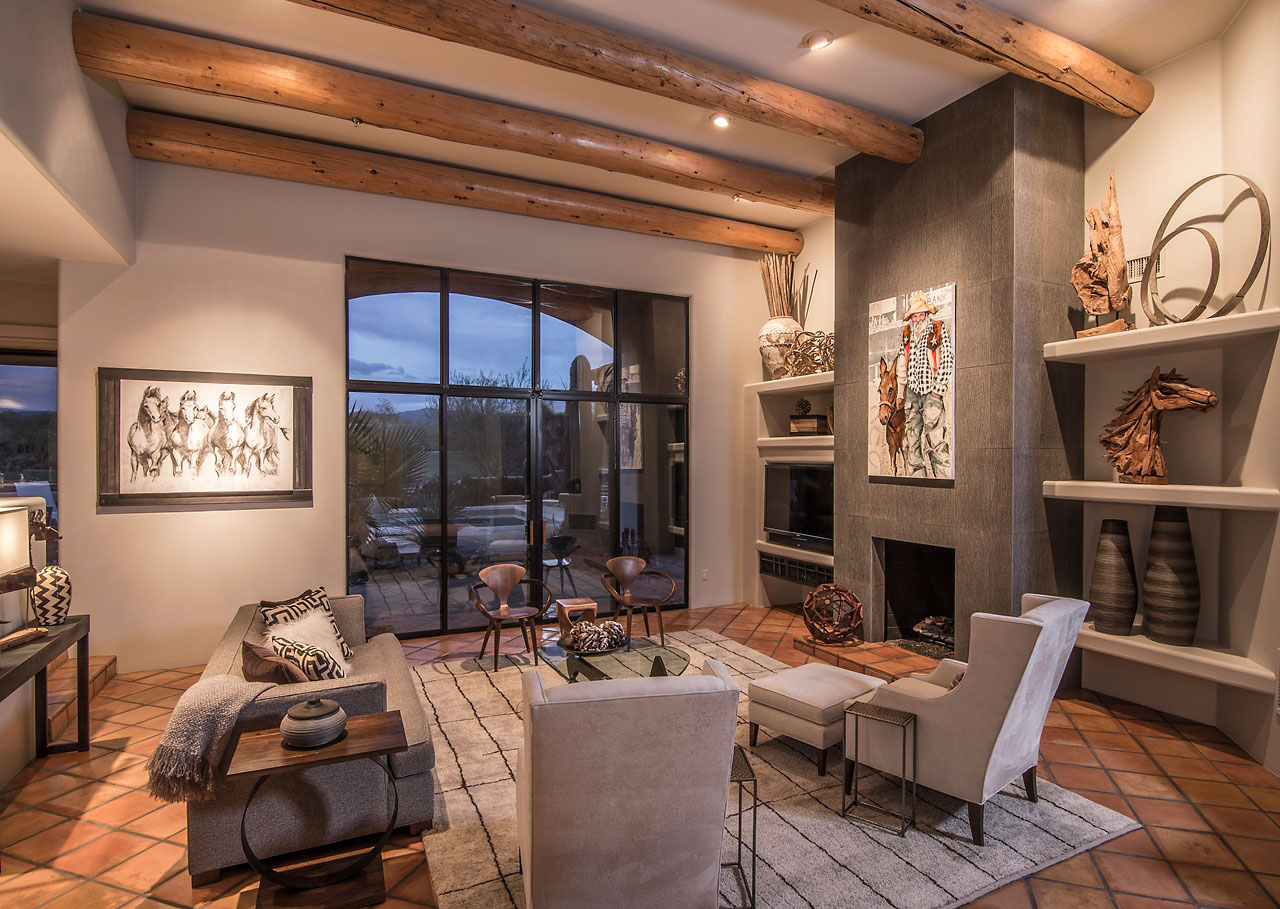
Walk into a good Southwestern room and you’ll see plaster walls, exposed vigas, a woven rug and a few handmade pots, all in warm desert colors. The style mixes Native American and Spanish Colonial influences with Mexican ones, and every idea worth copying has a documented source in New Mexico’s architecture, craft or furniture traditions.
Part of the look was built for travelers. In the 1920s the Fred Harvey Company hired designer Mary Colter to do the interiors of La Fonda in Santa Fe, a hotel that displayed Native art for train passengers, according to La Fonda’s own art history.
A few of these names are legally protected now. Talavera has a protected designation of origin, and Native-made arts fall under the Indian Arts and Crafts Act of 1990.
What defines Southwestern interior design?
It’s a regional look, and it stays tied to one place more than most. Native American, Spanish Colonial and Mexican influences all feed into it, along with desert color, handmade objects and natural materials.
Among interior design styles, few are as tied to one place. The rooms are meant to feel warm and textured, and a little rough. Nothing should look factory-perfect.
Design guides tend to agree on the palette, which comes from sand, clay and desert sky. Handmade pieces matter too, from pottery to carved pine, and so do natural materials like plaster, tile, wood and iron. Patterns are woven and geometric.
Each influence leaves its own mark. Pueblo building traditions account for the adobe walls and exposed beams, while Spanish settlers brought ironwork and furniture forms. Mexican design traditions add tile, pottery and leather seating.
The named version took shape in New Mexico. In November 1912, Museum of New Mexico staff staged the New-Old Santa Fe exhibition at the Palace of the Governors to promote adobe building as a regional identity (El Palacio, the museum’s magazine).
It began as a promotion, not a trend. Santa Fe New Mexican coverage of the museum’s centennial notes that only two of roughly 19 homes built there in 1912 conformed to the style.
Some design guides date the whole style to the 1920s, which skips the groundwork. Pueblo adobe building and Spanish Colonial settlement came much earlier, and the 1912 campaign still beat the 1920s by a decade.
Which colors make a room look Southwestern?

Mostly earth tones. Terracotta, sand, rust and sage green go on the walls, floors and big furniture, and turquoise or another blue comes in as an accent.
Sources disagree on how much color sits on top of that earthy base.
Windermere describes sandy yellows, light pinks, greens, browns and reds, with texture added through layered plaster. Toll Brothers goes for an earthy base punctuated with brighter accent hues. And a San Antonio designer quoted by Designers Today (2023) describes Texas hill country homes in browns, tans and creams.
That same roundup notes that the traditional neutral palette, tied to adobe Pueblo architecture, is giving way to more interior color. Designer Joseph Pubillones, writing in 2021, traces the 1990s Santa Fe look to adobe earth tones touched by dusk-sky shades, from faint amethyst to cornflower blue.
Read together, the sources agree on the base and split on the accent. Choose wall and floor tones from an earthy color palette that matches the building. Sandy plaster tones suit an adobe home, and browns and tans suit a hill country house.
In practice the plaster walls carry the base tone, tile and floors lean terracotta and brown, and textiles and pottery take the accents.
Turquoise needs a warm partner. Against rust and sand it reads as desert, and against white and pale wood it drifts toward coastal.
Test which colors pair well with turquoise before committing to a blue sofa. I’d do that with a cheap pillow first.
Which architectural features and materials carry the style?

Most of the structural work comes from features that descend from adobe building: vigas, latillas, plaster walls, nichos, a corner kiva fireplace and tile or flagstone floors.
| Feature | Where it sits | Material or finish |
|---|---|---|
| Vigas | Ceiling, wall to wall | Rough-hewn logs |
| Latillas | Across the vigas | Peeled branches or wood strips |
| Nichos | Wall, as a recessed shelf | Plastered adobe |
| Kiva fireplace | Room corner | Adobe, finished in plaster |
| Saltillo tile | Floor | Fired clay |
Ceilings and beams
The New Mexico Architecture Guide describes vigas as large, thick, roughly milled logs that serve as ceiling beams.
Laid across them to close the ceiling are latillas, small sapling-sized pieces that are either peeled branches or wood strips.
In modern Pueblo Revival buildings, vigas can be decorative or functional, according to the New Mexico Museum of Art.
Heavy, rustic wooden beams suit rooms with higher ceilings, since exposed timber lowers the ceiling line.
Walls and niches
Adobe is Spanish for mudbrick. It came to New Mexico as a building technique from Spain, though Pueblo builders used a puddled (hand-formed) adobe construction before European contact (New Mexico Architecture Guide; Su Casa magazine). Plaster goes on in layers or by hand, which gives the walls a soft, uneven surface.
Nichos are recessed shelves cut into thick walls, a spot for small objects such as pottery or religious pieces. Arched openings, meaning rounded doorways, repeat the rounded edges of Spanish-Pueblo Revival buildings.
Rounded edges rank among the defining traits of that building style, along with room-block massing and protruding vigas (Santa Fe New Mexican). In a new build without adobe walls, softened corners do more of the work than the plaster finish.
Floors and fireplaces
Saltillo tile is the default floor, and it needs sealing.
The tile is formed and finished by hand from natural clay in Saltillo, Coahuila, according to importer Clay Imports. Like most terracotta tiles, it absorbs oils and moisture until it is sealed.
Unsealed or lightly sealed Saltillo stains and darkens, especially in bathrooms and other wet areas. Sealer applied carelessly leaves streaks and permanent marks. Resealing is due once water soaks in, and Clay Imports’ test is to pour a little water on the tile.
Grout joints run from 1/4 inch to 3/4 inch, and handmade tiles vary in width, so tight joints show the variation more (Clay Imports).
Flagstone and wide-board wood floors turn up in Southwestern homes as well, often under beamed ceilings.
Kiva fireplaces sit in a room corner, traditionally built of adobe in a beehive shape. The name borrows from the kiva, a round ceremonial chamber still used in Pueblo communities (New Mexico Architecture Guide).
Nichos and bancos (built-in benches) often sit beside it. Because most kivas curve in several directions, a certified chimney sweep quoted on Hearth.com calls them poor candidates for a modern insert.
How do rugs, blankets and patterns work in a Southwestern room?
Textiles do a lot of the work here. Dine (Navajo) rugs and Pendleton blankets supply most of the vocabulary, Zapotec rugs from Oaxaca cover the Mexican side, and geometric motifs such as stepped lines, diamonds and stripes hold it all together.
Dine rugs come first historically. Spanish explorers brought Churro sheep to the Southwest in the 16th century, and the breed’s wool has been used for Navajo weaving ever since, according to Utah State University’s Museum of Anthropology.
Pendleton blankets are machine-woven trade blankets. Early designs drew on Plateau tribal patterns such as diamonds, arrows and eight-point stars, and they were woven to suit tribes across the American West. Pendleton Woolen Mills opened in 1909 in a defunct Pendleton mill, established in 1896, that had already marketed Indian blankets (Oregon Encyclopedia).
Zapotec rugs are wool, made in Teotitlan del Valle in Oaxaca and dyed with natural materials such as cochineal. Mexico News Daily dates the weaving tradition back more than 2,000 years.
The “Navajo look” has always been a negotiated one. Vassar College’s design collection notes that Dine weavers adapted their designs for traders, tourists and collectors, and Four Corners Free Press reports that patterns such as Two Gray Hills and Teec Nos Pos originated with traders.
So the pattern names on a rug tag carry commercial history as well as cultural history.
Keep one motif dominant and let the others play supporting roles, the same logic behind pattern use in any interior.
Rugs go under the main seating group. Blankets work over a sofa arm or at the foot of the bed, small weavings become pillow covers and wall hangings, and a cowhide adds a neutral layer beside or over a woven rug.
Size comes before pattern. Check the room dimensions with a calculator built for rug sizing before falling for a design.
Some patterns carry religious meaning. The Yei pattern depicts Navajo spirit beings (Lam Museum, Wake Forest University), so check what a design represents and buy from Native weavers where you can.
What furniture fits Southwestern interiors?

Most of the forms come from Spanish Colonial furniture made in New Mexico. Equipale seating from Mexico gets mixed in, and carved pine shows up across both.
Fine Woodworking lists the traditional New Mexican furniture types as the caja (chest), trastero (cabinet), repisa (shelf), silla (chair), banco (bench) and mesa (table).
The chest ranks first. The Museum of International Folk Art reports that 18th and 19th century estate inventories list it as the most common furniture piece in New Mexican households, because it did duty as storage and a seat and doubled as luggage.
Much of what reads as traditional is a 1930s revival. Gallup New Deal Art describes New Deal workshops that employed Hispano artists to recreate Spanish Colonial designs, and the Spanish Colonial Arts Society had formed in 1925 and launched its Spanish Market in 1926.
Architecture and furniture were both codified by early twentieth century revival efforts. That makes a revival piece part of the tradition rather than a copy of it.
The name equipale comes from the Nahuatl word icpalli, meaning seat. Makers in Zacoalco de Torres, Jalisco, cover wood frames in pigskin, which they favor because the hide is porous and lets air circulate (Feria Maestros del Mundo artisan profile). Mexico’s tourism board notes that cowhide came first.
Knotty pine, leather and equipale pieces lean toward the rustic end, so a clear sense of what rustic design involves keeps the mix from sliding into cabin territory.
Large, comfortable seating is the norm, according to Windermere’s style guide. Toll Brothers points to mixed wood tones with metal accents as a staple, so matching every piece is not the goal.
Knotty pine has a warm tone of its own, so test wall colors that sit well with knotty pine before you paint around it.
Which decor and lighting accents finish the look?
The finishing layer is handmade objects, and there are plenty to pick from. Talavera tile and pottery, Pueblo pottery, punched tin, wrought iron fixtures and woven baskets all fit.
Pick a few and give each one clear space.
Talavera has been a protected designation of origin in Mexico since 1995, limited to a defined zone in Puebla and Tlaxcala (WIPO record of the Mexican gazette notice).
Acoma potters hand-coil each vessel, paint it with natural colors and fire it outdoors, according to the National Cowboy and Western Heritage Museum’s catalog.
New Mexican tinwork flourished from about 1840 to 1915 (The Magazine Antiques), with scalloped borders and floral designs as the usual motifs (Visit Albuquerque).
Windermere’s style guide lists distressed wrought iron among the standard elements, and a 2019 Associated Press piece describes antique iron lamps made from a reclaimed Spanish balcony rail.
The Law Library of Congress notes that only certified workshops may use the Talavera name, and many shops sell uncertified lookalikes (2023). Ask for the workshop’s certification before paying for a piece.
Tin finish is where buyers get caught. The Museum of Spanish Colonial Art’s deputy director told the Santa Fe New Mexican in 2021 that patinated tinwork did not appear until the late 20th century.
A sconce with a buffed patina is a contemporary look rather than an antique one.
Display matters as much as the pieces. Arizona designer Linda Robinson, quoted in that Associated Press piece, sets pottery, baskets and art on wood or metal tables used as pedestals.
A small spot of accent lighting inside a nicho makes a pot read as a display instead of clutter.
Wrought iron chandeliers read heavy, so check the diameter against the room with a chandelier size calculator before ordering.
Woven baskets and clay planters holding cacti and succulents (Wayfair) fill the gaps between the larger pieces.
How to bring Southwestern design into each room
Pick one anchor element per room and add a couple of accents, rather than the whole kit.
| Room | Anchor element | Accent to add |
|---|---|---|
| Living room | Corner plaster fireplace | Iron or tin lighting |
| Kitchen | Patterned tile backsplash | Wicker or woven seating |
| Bedroom | Fireplace or beamed ceiling | Layered textiles |
| Bathroom | Terra-cotta or patterned tile | Pottery |
| Patio | Clay fireplace | Potted cacti and succulents |
Living room
Houzz project photos from Albuquerque show plaster corner fireplaces over terra-cotta tile, and several of the listings note the room has no TV. That leaves the fireplace as the focal point.
Decide first how to arrange seating around a corner fireplace, because the rug and tables follow from it.
Kitchen
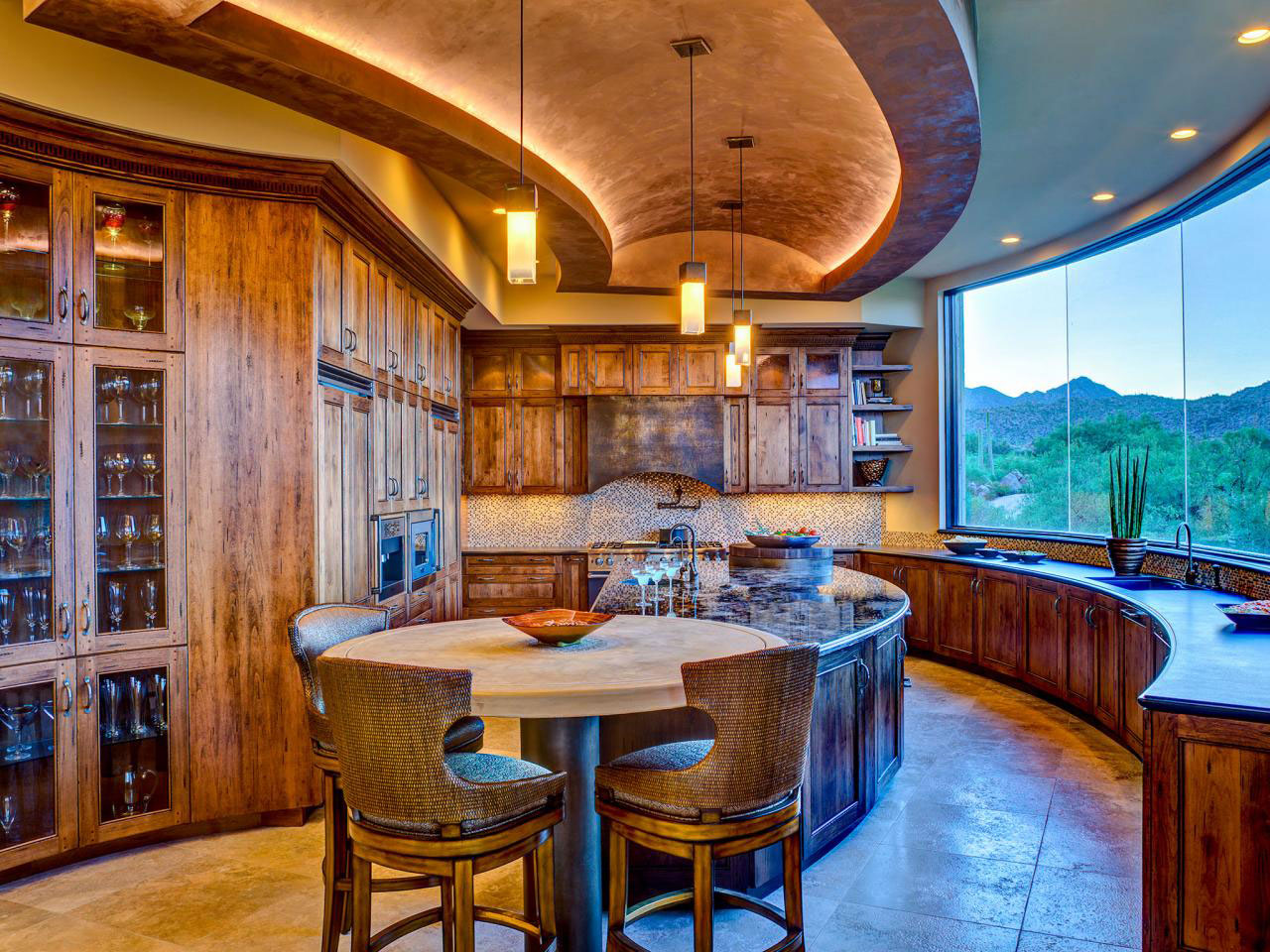
Houzz photos of an Albuquerque kitchen pair a raised island with log beam ceilings.
Beams carry into kitchens, and they are one of the more direct ways to treat a kitchen ceiling in this style.
Toll Brothers builds its Southwestern kitchen examples from patterned tile backsplashes, stone counters, wicker or naturally textured chairs and metal lights. La Fuente, a Mexican decor retailer, boils the advice down further and says to keep it simple.
Bedroom
La Fuente applies the living room principles to the bedroom with fewer items. At the other end of the budget, Houzz shows a master bedroom with a barrel ceiling and a fireplace.
A good bedroom gets one textile layer on the bed, a lamp with an iron or tin base, and a single nicho or shelf for one pot. Skip the second rug pattern. A wall of pottery and a pile of decorative pillows don’t help either.
Bathroom
Houzz lists an Albuquerque powder room with terra-cotta tile, a pedestal sink and blue walls. La Fuente’s guide adds bright towels and a couple of pottery pieces.
Patio
A clay or earthenware fireplace anchors the patio, according to Wayfair’s style guide. Toll Brothers adds woven dining and lounge chairs, and wood decking and other natural surfaces fit in as well. Drought-tolerant beds work too, as in a Phoenix side-yard path photographed on Houzz.
Courtyards and enclosed patios are standard in Pueblo-style plans, so the outdoor room is part of the floor plan, not an add-on.
Southwestern, Santa Fe, Pueblo Revival and modern Southwestern compared
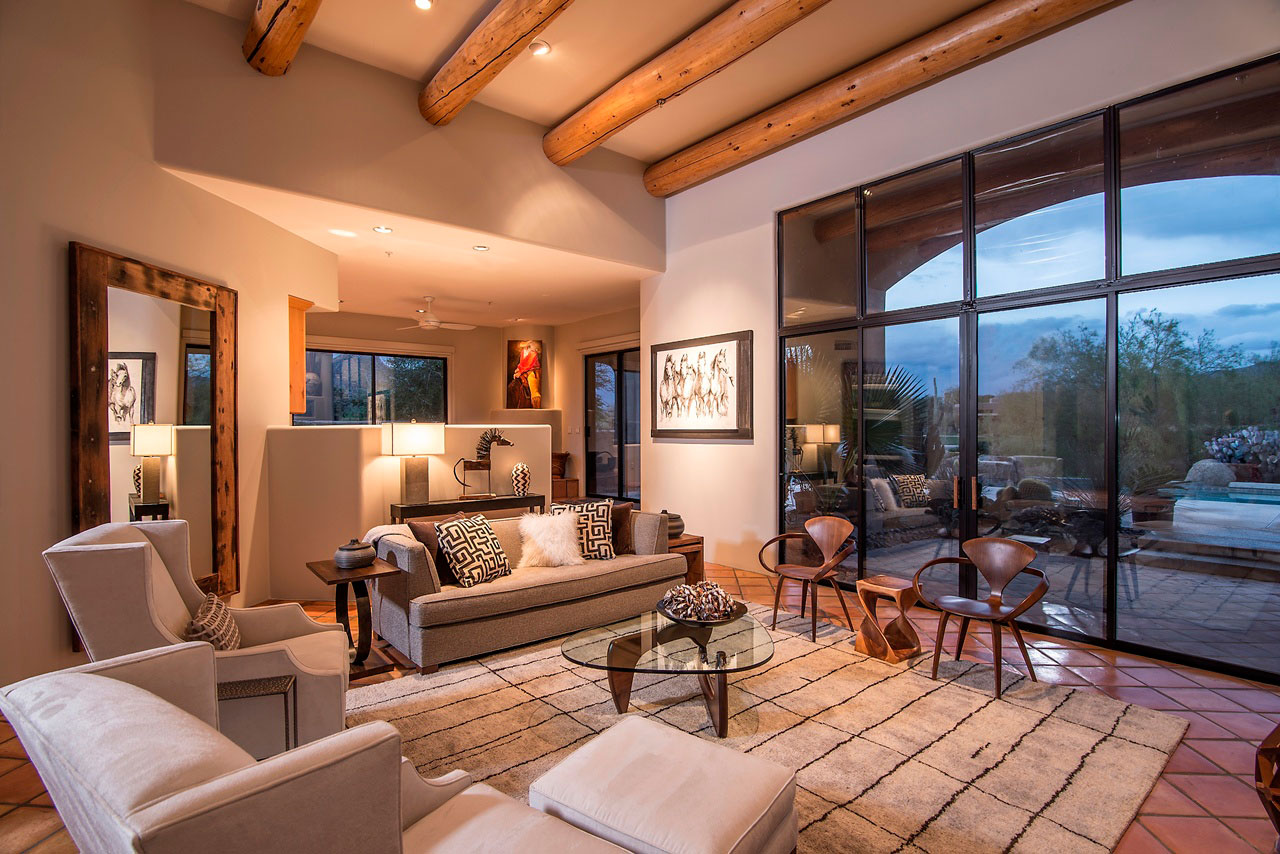
Southwestern is the umbrella term. Santa Fe style is the New Mexico version of it, and Pueblo Revival and Territorial Revival are the two architectural strands inside Santa Fe style.
The City of Santa Fe’s own planning document names Pueblo-Spanish Revival, Territorial Revival and Santa Fe vernacular as the local types.
| Variant | Defining features | Best fit |
|---|---|---|
| Pueblo Revival | Flat roofs, vigas, rounded massing, earth tones | Thick-walled adobe or stucco homes |
| Territorial Revival | Symmetry, smooth stucco, brick coping, neoclassical trim | Cleaner lines, painted accents |
| Spanish Colonial | Carved pine furniture, ironwork, tinwork | Furniture-led rooms |
| Modern Southwestern | Adobe-derived forms, simplified details, open light | Newer or renovated homes |
Architectural historian Rachel Preston Prinz told Cultured in 2021 that Territorial style stresses symmetry and simplicity, while Spanish-Pueblo Revival leans on setbacks, asymmetry and heavy wooden ornament.
She also objects that Santa Fe style gets conflated with Spanish-Pueblo Revival alone. The EV Studio guide adds a difference in color, since Pueblo homes hold to earth tones and Territorial ones can take a painted accent such as a blue front door.
Santa Fe’s 1957 historic ordinance limited new construction in the historic districts to those two revival styles (University of Vermont, historic preservation journal).
Modern Southwestern sits outside that list. The same city document records a Regional Modernism that drops projecting vigas, parapet coping and window surrounds.
Georgia O’Keeffe’s Abiquiu house is the best-known modern version. The Georgia O’Keeffe Museum notes that she kept the adobe structure but added abundant natural light, updated amenities and mid-century modern furniture.
Match the variant to the house’s lines. Thick, rounded walls suit Pueblo, and a house with straight parapets and symmetrical windows suits Territorial. A plain contemporary box can take the modern version.
How to build the look step by step
Start with the fixed surfaces and finish with the movable ones, so walls come first, then the floor, large furniture, lighting and accents.
Measure before buying anything. A room paint calculator turns the wall dimensions into a paint quantity.
- Set the wall tone. Plaster or plaster-toned paint goes on first, because every later piece is judged against it.
- Lay the floor in terra-cotta tile, flagstone or wide-board wood.
- Place the large pieces. Seating first, then a chest or cabinet.
- Add the rug and textiles.
- Hang the lighting, iron or tin, sized to the room.
- Finish with pottery, baskets and plants. Stop when each surface holds one object, not three.
Floor tile is where guessing gets expensive. Size it with a tile calculator, and order 2 to 4 sample pieces first to see the variation, as Clay Imports advises.
Renters can reverse the sequence. Cyrus Rugs calls a rug the easiest way into the style, and textiles are the one layer that moves with you.
When Southwestern style stops working
Most failures come down to restraint, and to being honest about what you’re buying. Water is the other one.
Too many themed objects
The best-known Southwestern interior is sparse. Domino’s tour of Georgia O’Keeffe’s Abiquiu home describes the same rigorous simplicity found in her paintings.
Give each room one focal point, such as the kiva, the beams or a single large rug, and let everything else recede.
Pieces sold as Native that aren’t
The Indian Arts and Crafts Act of 1990 is a truth-in-advertising law with criminal and civil penalties for marketing products as Indian made when they are not, according to the Interior Department’s Indian Arts and Crafts Board.
An “Indian style” tag usually means a non-Native maker, per an American Friends Service Committee brochure. Ask for the maker’s name and tribal affiliation before buying pottery, rugs or baskets.
Water damage
The New Mexico Architecture Guide describes canales as drain troughs that carry water off flat roofs and away from the walls and foundation. EV Studio adds that brick coping on parapet tops protects against water damage.
O’Keeffe bought her Abiquiu house in 1945 after the roof had collapsed in many spots and weather had damaged the adobe walls (Domino).
Southwestern Interior Design FAQ
Is Southwestern style still current?
Yes, in an updated form. The Associated Press reported a revival of Southwestern decorating in 2019, and designer Joseph Pubillones wrote in 2021 that Santa Fe style interiors are returning, blended with mid-century and contemporary seating.
How does Southwestern style differ from Mexican style?
Mexican style feeds into Southwestern style but isn’t a synonym for it. Wayfair’s guide names Spanish, Mexican and Native American inputs, so Pueblo adobe forms and woven rugs sit on top of the Mexican tile and pottery.
Do you need an adobe house for Southwestern style?
No. Pueblo-style homes today are typically concrete block or wood frame covered in stucco, according to EV Studio.
Coaster Furniture adds that white walls paired with dark wood furniture bring the look into a home that is not Spanish-style.
What is Southwestern farmhouse style?
It’s a hybrid. The base is farmhouse, meaning white walls and plain wood, finished with Southwestern accents such as terracotta, woven rugs and pottery.
The wood stays warm and the palette stays light, so the desert pieces read as accents, not as the theme.
Can Southwestern style work in a small room?
Yes, if the room gets one or two strong elements instead of all of them. Toll Brothers’ examples include a bright, airy kitchen and a light, airy home office, both built on natural textures in chairs and fixtures.
How can you decorate Southwestern style on a budget?
Start with the layer that moves. Paint, pillows, throw blankets and clay planters holding cacti or succulents all count, and Wayfair’s guide recommends the last three.
Save beams, plaster and handmade tile for a renovation budget.
Mixing Southwestern Pieces With the Furniture You Own
Southwestern interior design blends into an existing room when one handmade anchor sits among furniture you already own. Designer Linda Robinson pairs Southwestern pieces with European antiques and Persian rugs (Associated Press, 2019).
Keep the large furniture, repaint the walls in a desert tone, and buy handmade pieces last. The order matters, because paint reverses in a weekend and handmade pieces cost more to replace.
The catch is that a blended room reads as Southwestern-inspired, not as a regional interior.
Revival campaigns assembled the style from several cultures to begin with, so a blended room continues that history, and the result is a form of eclectic interior design with a desert accent.

- Kitchen Color Schemes by Cabinet Color: What Pairs Well - October 19, 2026
- Curtain Colors for Every Wall Color: Safe vs Bold Picks - October 18, 2026
- Interior Design Styles: Find Your Primary and Secondary - October 14, 2026