White Cabinets
Ideas for White Kitchen Cabinets With Green Island

White kitchen cabinets with a green island work when the undertone of the white matches the base of the green: warm whites beside sage and forest greens, crisp whites beside deeper, earthier ones.
The island carries the only strong color in the room, so it anchors the layout while the perimeter stays neutral.
Islands are also a main renovation target. Houzz’s 2026 U.S. Kitchen Trends Study found that 58% of renovating homeowners added or updated one.
For the perimeter cabinets and countertops around the island, see our kitchen color schemes guide.
Does a green island work with white cabinets?
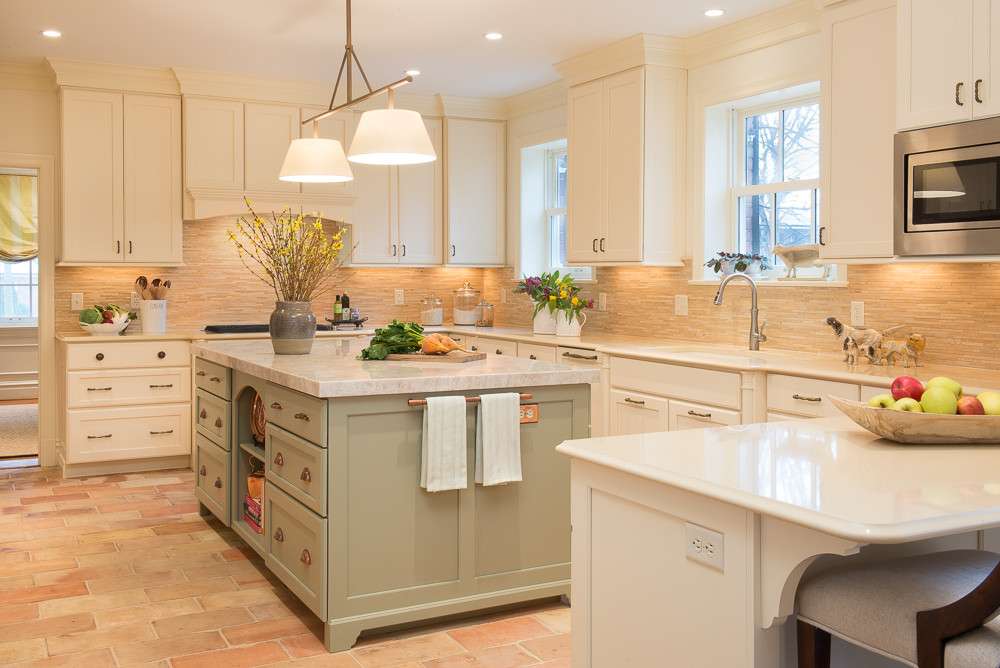
Yes. White perimeter cabinets keep the room bright and neutral, and the island carries the only strong color.
The island sits in the middle of the room, so it becomes the natural focal point without any change to the layout.
Green is also gaining ground overall. Houzz’s 2026 U.S. Kitchen Trends Study (1,780 respondents) found green cabinets in 6% of renovated kitchens, ahead of gray at 5%.
Where it fits:
- Farmhouse, traditional and transitional kitchens
- Modern kitchens with Shaker or flat-panel doors
- Small kitchens, as long as the green is soft (sage, moss)
- Large or vaulted kitchens, where deeper greens hold their own
Painting only the island is the lower-risk way into green, since it is the easiest piece to repaint later. Wall color is a separate decision, and the usual kitchen color schemes built around white cabinets still apply around it.
Which green shade works best on the island?

Sage and gray-green suit most kitchens. Deep forest and emerald work where the room gets strong daylight.
| Green family | Look | Example paint |
|---|---|---|
| Sage | Soft, muted, calm | October Mist 1495 (Benjamin Moore) |
| Gray-green | Smoky, reads near-neutral | Evergreen Fog SW 9130, Pewter Green SW 6208 (Sherwin-Williams) |
| Olive | Earthy, warm | Ripe Olive SW 6209 (Sherwin-Williams) |
| Forest | Deep, traditional, high contrast | Regent Green 2136-20 (Benjamin Moore) |
| Emerald | Saturated, blue-based, crisp | Sample several, no single code leads |
Light and mid greens: sage and gray-green read almost like neutrals, so they sit calmly beside white. October Mist 1495 has an LRV of 46.54 according to Benjamin Moore, which is light enough to stay soft in a bright kitchen. For the rest of the room, see what pairs well with sage green.
Deep greens: going with a dark green kitchen island gives the sharpest contrast against white cabinets. In a dim room the same paint can look close to black, which is why deep greens belong on the island and not on every cabinet.
One common miss is a sage with too much yellow in its base. It drifts toward avocado, a risk Facade Colorizer’s cabinet guide flags too, while a gray-balanced green stays put.
Which white cabinet color goes with each green?
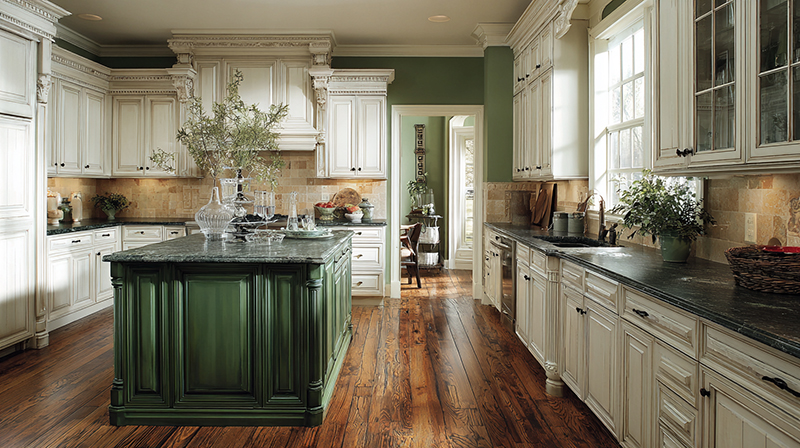
Warm whites such as White Dove and Simply White are the usual partners for sage and forest greens. Crisp whites like Pure White suit earthier greens that need a clean edge.
| Green | Character | White it is paired with |
|---|---|---|
| October Mist 1495 | Light sage | Simply White or Cloud White |
| Peale Green | Warm forest, slight yellow | White Dove or Cotton Balls |
| Regent Green 2136-20 | Deep green | White Dove OC-17 |
| Retreat | Earthy, muted | Pure White SW 7005 or Chantilly Lace |
The first three pairings come from Benjamin Moore’s own kitchen guidance and the Suite Minded paint guide. The Retreat pairing is Suite Minded’s pick for a bright white without many undertones.
Alabaster SW 7008 is a middle option. Sherwin-Williams describes it as a balanced white and lists it among its top ten trending colors, and it is worth checking against the colors that work alongside Alabaster before you commit.
Warm whites: soften the island and make a yellow-leaning green feel intentional.
Crisp whites: sharpen the contrast, which suits deeper or grayer greens.
Hold the white chip and the green chip next to each other on the actual cabinet wall. Undertones show up fastest side by side.
What countertop pairs with a green island?

White quartz is the default. A butcher block island top is the most common contrast when the perimeter stays white.
Same top on both zones

One white surface across the perimeter and the island ties the two cabinet colors together. It also lets the green do all the work, which is the idea behind pairing green cabinetry with white countertops.
Veined marble such as Carrara adds movement. Cambria shows the quartz version: an emerald island with white perimeter cabinets and Brittanicca Warm quartz, a marble alternative, finished with gold hardware.
A different top on the island
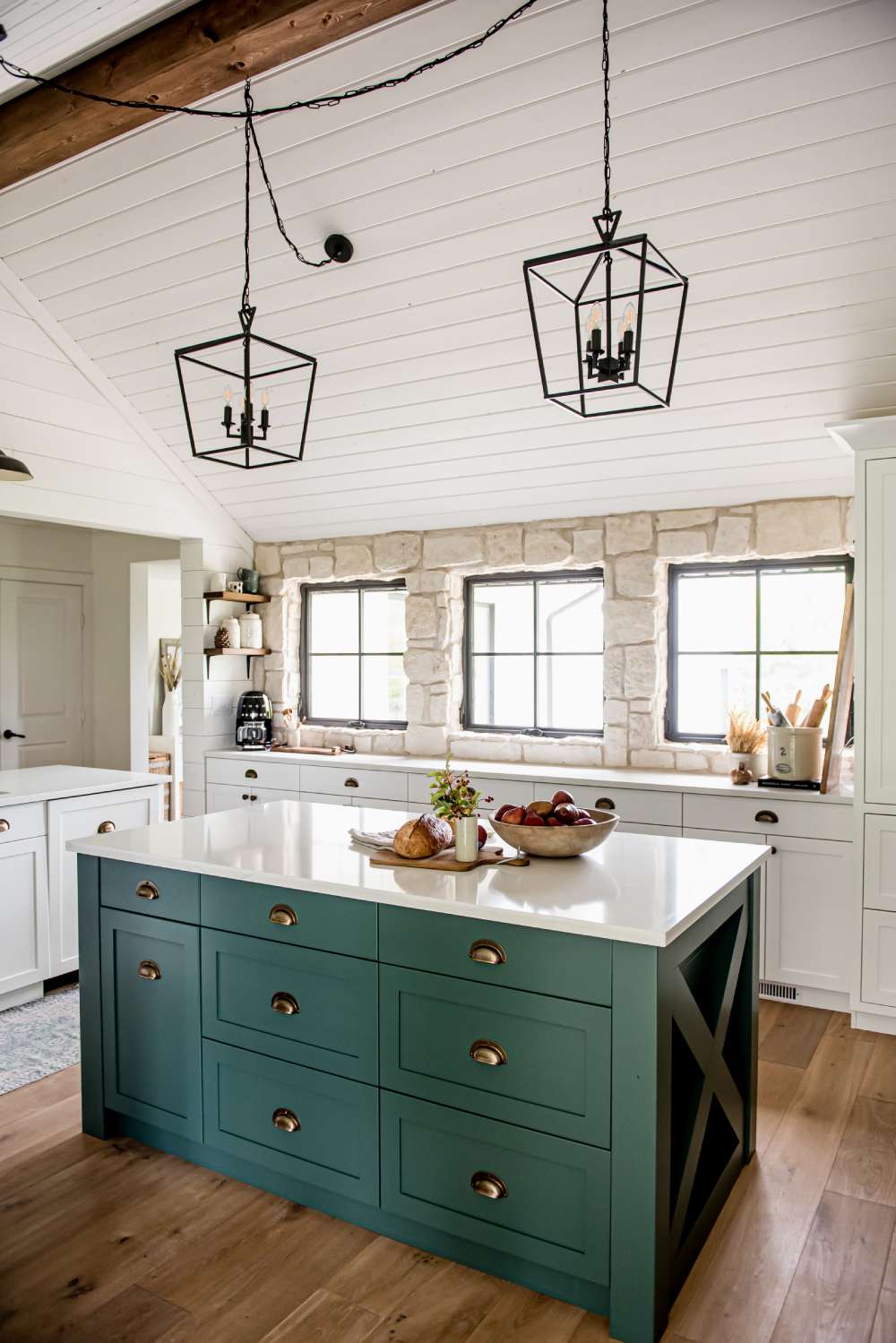
Among homeowners who use a different material on the island, butcher block or wood slab is the top choice at 44%, up 13 points in a year (Houzz, 2026 U.S. Kitchen Trends Study).
Wood warms a cool green and gives a deep green some texture. The same idea appears in green cabinetry paired with butcher block tops.
Exception: a very light green can look washed out beside a white top. A darker countertop adds the contrast it is missing.
Which hardware finish suits a green island?
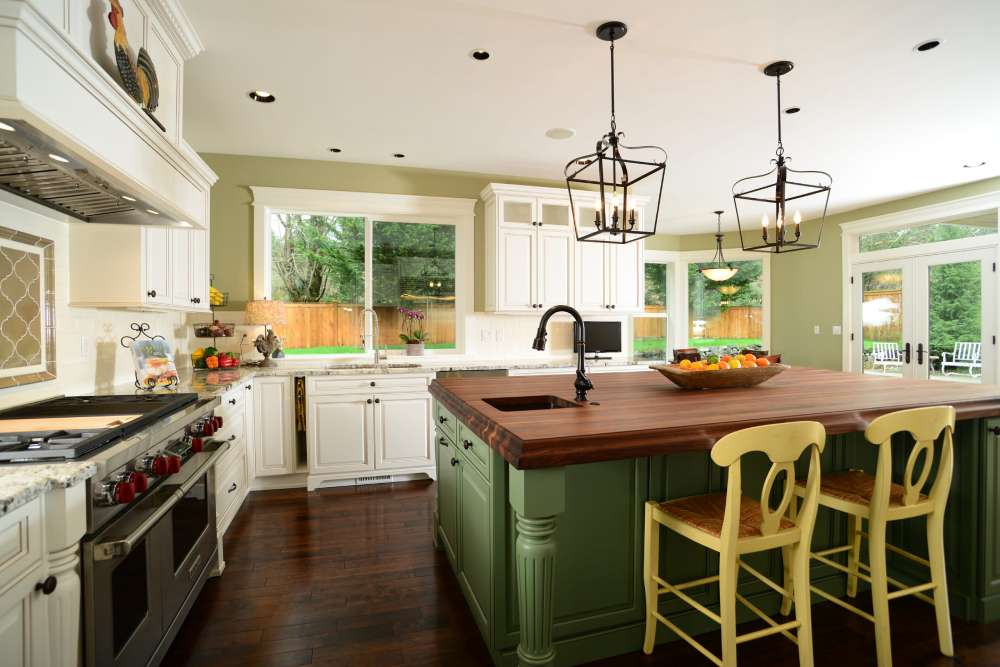
Brushed nickel leads at 28% of renovated kitchens, with black at 18% (Houzz, 2026). Green islands lean toward brass and black, though.
Brass and gold: the go-to pairing for green, and the easiest way to warm a sage or olive island.
Unlacquered brass: a living finish that changes tone with use, so it suits traditional and farmhouse kitchens.
Matte black: adds contrast against white perimeter cabinets. It reads sharper on a deep green, as in green cabinetry with black hardware.
Nickel and chrome: clean and contemporary, and best on blue-based greens such as emerald.
Pick one finish and repeat it on both cabinet colors. Mixed metals on a two-tone kitchen compete with the island, which is already the accent. Warm metals in particular follow the logic of gold hardware on green cabinets.
What backsplash and flooring go with white cabinets and a green island?
White tile and warm wood floors are the safe pair. A green backsplash next to a green island splits the focus, so keep the tile quiet.
Backsplash
White is still the top backsplash color at 31% of renovated kitchens, though it is down 4 points in a year (Houzz, 2026 U.S. Kitchen Trends Study).
White subway tile: the neutral default. It frames the island without competing with it.
Zellige tile: a handmade, uneven surface that adds texture behind a plain white perimeter.
Marble or full slab: keeps the wall calm so the island stays the only colored element. For the pairing logic, see this guide to backsplashes that suit marble countertops.
A Philadelphia kitchen by Revival shows the idea: custom white oak cabinetry, a sage green island, and marble on both the countertops and the backsplash (Houzz).
Flooring
Wood is the most popular floor color in renovated kitchens at 49% (Houzz, 2026). It works with every green in this article.
- Light or white oak keeps sage and olive airy
- Dark wood gives a pale green more depth
- A wood tone that repeats a butcher block island top ties the two zones together
Does door style and sheen change how the green looks?
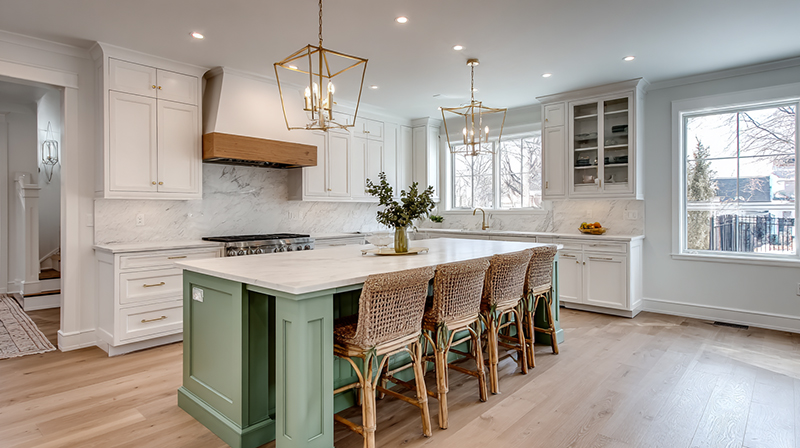
Yes, both do. Door profile sets the style, and sheen decides how deep the green reads.
Shaker: keeps the island and the perimeter speaking the same language. Decor Cabinets notes that a Shaker profile on a green island fits a modern transitional kitchen easily.
Flat-panel: suits modern kitchens, especially handle-free ones. Domino’s roundup of green cabinet colors points out that a classic hunter green can feel fresh on hardware-less doors.
Use the same door profile on both zones unless the kitchen is deliberately eclectic.
Benjamin Moore’s technical data sheet lists its Advance satin at 25 to 35 gloss units at 60 degrees, a finish that stands up to repeated washing. That is the practical pick for an island that gets wiped every day.
Matte reads softer and flattens a deep green into something closer to velvet. The trade-off is more effort to keep it clean.
How does natural light change the green?
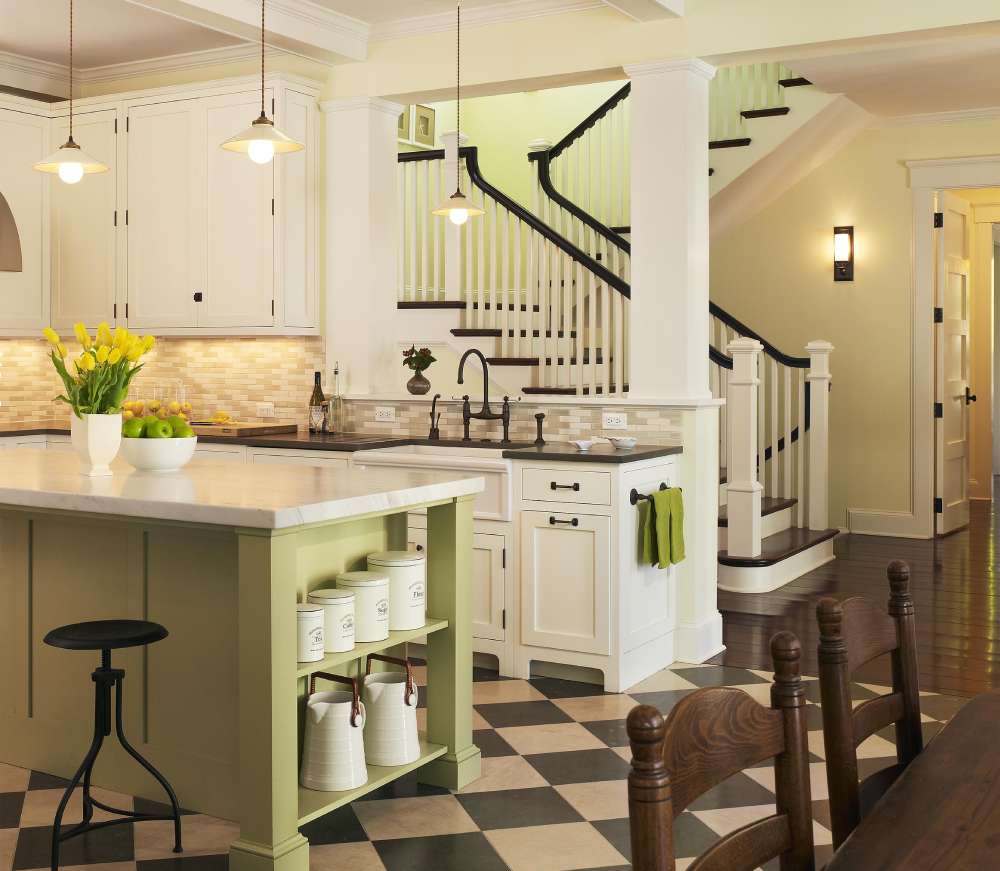
The window direction decides it. The same paint shifts between cool and warm depending on where the room faces.
| Exposure | Light | Effect on the green |
|---|---|---|
| North | Cool, bluish, all day | Grays the green out, deep shades read darker |
| South | Warm, orange-yellow, all day | Warms the green and lifts mid-tones |
| Low light, any direction | Dim, more shadow | Deep greens go flat |
Sherwin-Williams lists north light as cool and bluish and south light as warm and orange-yellow. Facade Colorizer’s orientation guide adds that north light pulls colors grayer and slightly darker.
Peale Green is a good example. Suite Minded reports that it reads as a deeper forest green in dim rooms.
Artificial light matters as much as daylight. Sherwin-Williams says any light source, from daylight to candlelight, changes how a color appears, so the bulbs in the island pendant lights are part of the test.
The role light plays in a room is the reason to look at your sample at 9 a.m. and again after dark.
When does a green island not work?
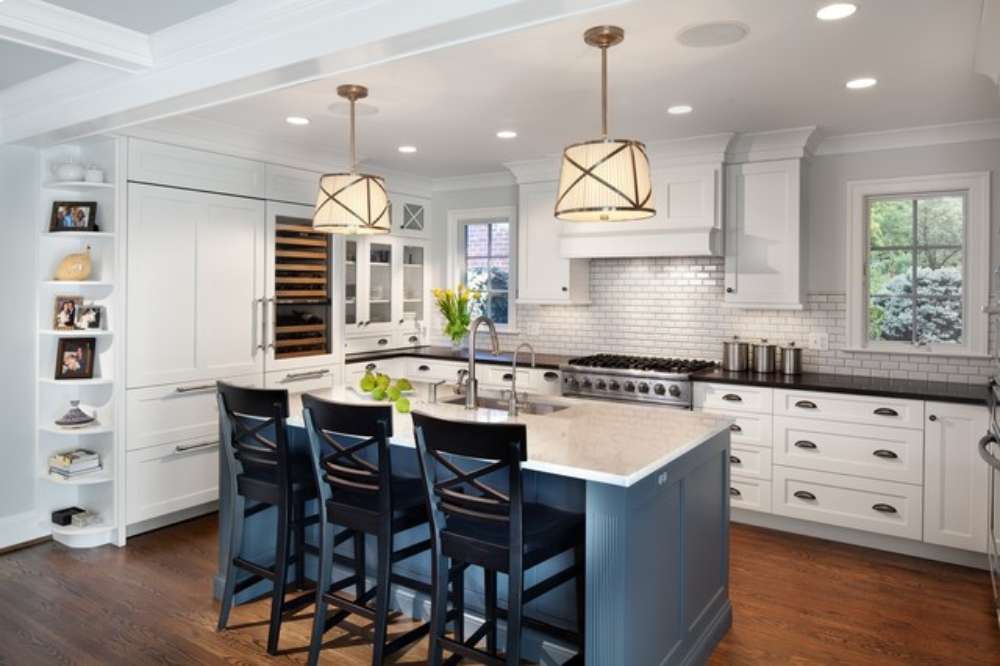
It fails in three cases: a deep green in a low-light kitchen, a large dark island in a very small room, and a crisp white beside a yellow-heavy green.
Low-light kitchen with a deep green: Sherwin-Williams’ color guidance says dark shades tend to have lower LRV and may not work where there is little natural light. Pick a mid-tone green or add light.
Small kitchen with a heavy island: soft sage or moss keeps it open, while a big dark island eats floor space visually. For tight rooms, the best colors for small rooms lean light.
Yellow-heavy sage against stark white: the green drifts toward avocado and the white looks cold. Move to a gray-balanced green or a warmer white.
Sources disagree on dim rooms. The Sherwin-Williams guidance above warns against dark shades, while a designer quoted in the company’s Color Conversation series says light colors can look sad and gray in low light and recommends a more saturated color instead.
Both can be right. A mid-depth, saturated green is the compromise, and a sample on the actual island door settles it.
How to paint a kitchen island green
Sample first, prime for adhesion, apply two thin coats, and let the paint cure before heavy use.
- Sample the color. Paint boards and tape them beside the white cabinets and the countertop.
- Clean and remove hardware. Degrease every surface you plan to paint.
- Test the primer. On previously painted or laminate surfaces, Sherwin-Williams recommends Extreme Bond Primer, and sanding may be unnecessary if a test patch bonds well.
- Prime and sand again. Let the primer dry at least 24 hours, then sand with very fine grit and wipe with a damp cloth (Sherwin-Williams).
- Apply two thin coats. Benjamin Moore Advance needs 16 hours before recoating, and Sherwin-Williams recommends Emerald Urethane Trim Enamel over its primer.
- Let it cure. Advance can take up to 30 days to reach full hardness, per Benjamin Moore, so go easy on the island until then.
A paint calculator gives the quantity for the island doors, panels and sides before you buy.
If painting is not an option, there are ways to cover cabinets without painting them. Put the new hardware on last, once the finish is dry.
FAQ About White Kitchen Cabinets With a Green Island
Should the green stay on the island or extend to the lower cabinets?
Keep it on the island if the perimeter is white. Deep greens are lower risk on an island or lower cabinets only, with white or warm-white uppers above, according to Facade Colorizer.
Carrying green to the lowers turns the room into a different two-tone kitchen.
What wall color goes with white cabinets and a green island?
A warm white or soft greige keeps the focus on the island. Greiges, warm taupes and earthy greens are the usual choices around white cabinets, per Jenna Kate at Home.
Skip a second green on the walls, since it competes with the island.
Which pendant lights suit a green island?
Brass and black pendants are the common picks, and they should repeat your hardware finish. Woven and vintage-style shades also appear in green island kitchens.
Test the bulb color temperature too, because Sherwin-Williams notes that any light source changes how a paint color reads.
Is painting an island cheaper than replacing it?
Painting costs less than replacing, and the island is the easiest piece to redo. Among homeowners who choose a partial cabinet upgrade, 50% refinish cabinet exteriors, the most common strategy (Houzz, 2026).
Price depends on the paint system and whether you hire a pro.
Will a green island look dated?
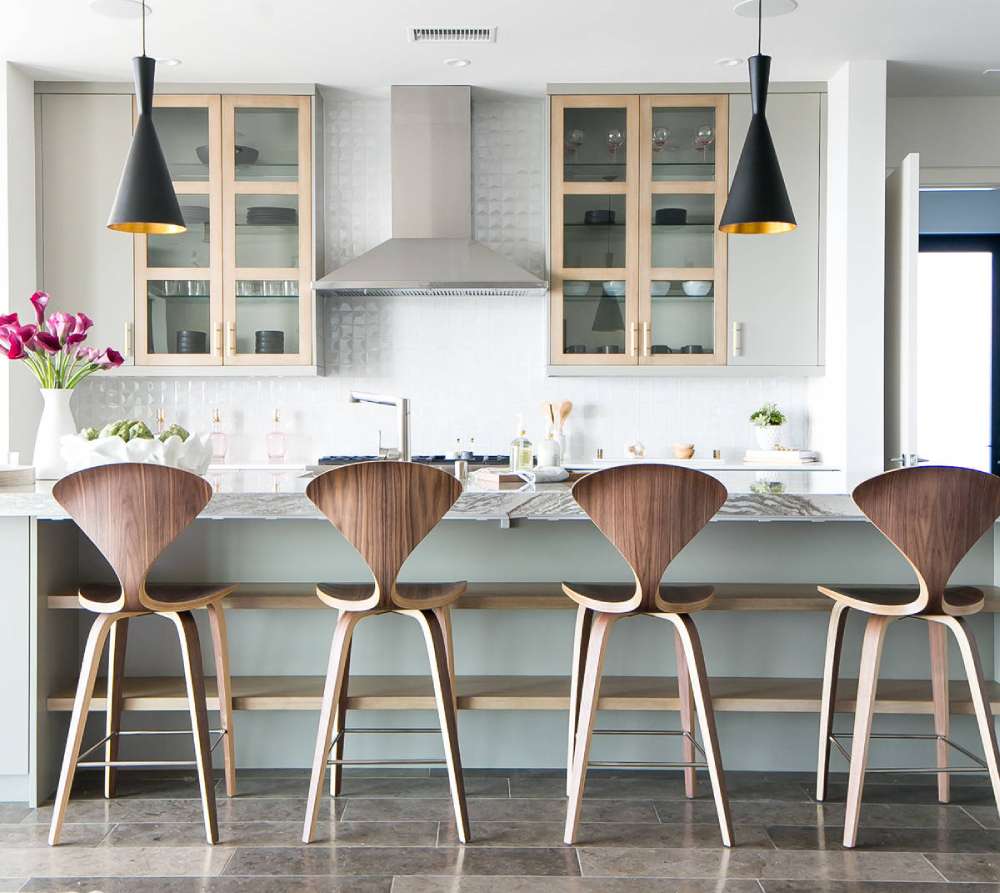
Muted, gray-balanced greens age well. Captivating Cabinets lists muted green-grays among the most timeless cabinet colors.
If you want a bolder shade, the island is the right place for it, since it is easier to change than a full set of cabinets.
Do the appliances and bar stools need to match the green?
No. Stainless steel is the dominant appliance finish at 72% of renovated kitchens (Houzz, 2026), and it sits fine beside a green island.
Matching is optional. One homeowner-designer’s remodel in Canadian Log Homes used deep olive appliances and coordinating counter stools to repeat the green, but wood or cream stools work just as well.
Which Decision Comes First With a Green Island?
In white kitchen cabinets with a green island, the green is chosen first. The white, the countertop and the hardware are then picked to suit it.
- Green, sampled in the room
- White, matched to its undertone
- Countertop and hardware, last
The order reflects cost and risk. Paint is the easiest piece to correct, but the green sets the undertone everything else must match.
The sequence reverses when white cabinets are already installed. The green then has to adapt to a \*\fixed white\\*, and the trade-off is a narrower choice of shades.
As of October 2026, the next Houzz kitchen study will show whether green keeps its lead over gray.
Styling comes after the finish cures, and a guide on how to decorate a large kitchen island covers that step.
More Kitchen Color Guides
- White cabinets and a blue island
- White cabinets and a black island
- Green cabinets with black countertops
- Green cabinets with grey countertops
- All kitchen color schemes by cabinet color

- Shoji White vs Alabaster: Which Soft White Wins? - October 25, 2026
- Color Combinations for 32 Colors and 10 Wood Tones - October 22, 2026
- Kitchen Color Schemes by Cabinet Color: What Pairs Well - October 19, 2026


