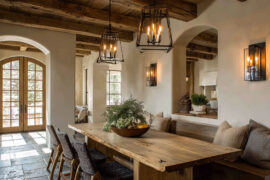
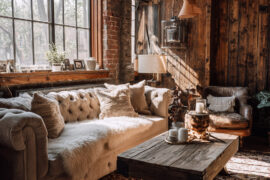
Warm, grounded, and never overdone. That is what modern rustic interior design gets right where so many other styles fall short.
It combines raw natural materials, reclaimed wood, honed stone, and organic textures with clean-lined contemporary forms. The result is a space that feels intentional rather than themed.
But getting the balance right is tricky. Most spaces drift too far toward farmhouse nostalgia or cold minimalism, losing the warmth that makes this style work in the first place.
This guide covers everything: the core material palette, the right color choices, furniture silhouettes, lighting strategy, room-by-room application, and the mistakes that make a modern rustic space look cheap instead of considered.
What Is Modern Rustic Interior Design?

Modern rustic interior design is a style that merges raw, natural materials with clean-lined contemporary forms. It keeps the warmth and organic character of rustic design while stripping away the clutter, the ornate details, and the nostalgic kitsch that make traditional rustic spaces feel heavy.
The result is a space that feels grounded and warm, but never dated.
This style is not farmhouse. It is not industrial. It sits between them, borrowing restraint from modern design and material honesty from its rustic roots. The contrast is the point: a live-edge walnut table next to a flat-front cabinet in matte charcoal. A stone fireplace wall opposite a concrete floor. Imperfect materials in a perfectly controlled layout.
Understanding how design principles work together matters here. Contrast in interior design is what keeps modern rustic from reading as either too cold or too rough. Get the balance right and the space feels intentional. Get it wrong and it just looks unfinished.
Where Did This Style Come From?

Modern rustic grew out of Scandinavian and Alpine design traditions, both of which have long valued natural materials alongside functional simplicity.
It gained real mainstream traction after 2010, partly as a reaction to the cold, all-white minimalism that had dominated interiors through the 2000s. People wanted warmth back. But they did not want the full cabin aesthetic either. The design world landed somewhere in the middle.
Key influences:
- Scandinavian interior design, with its emphasis on natural wood, muted palettes, and functional restraint
- Alpine lodge interiors from Switzerland and Austria, where exposed timber and stone have been standard for centuries
- The wabi-sabi philosophy from Japan, which finds beauty in imperfection and natural aging
- American barn conversion design, which made reclaimed wood a mainstream material in residential interiors
How Is Modern Rustic Different from Other Rustic Styles?
The word “rustic” covers a wide range of looks. Modern rustic is a specific point on that range.
| Style | Defining Quality | What It Avoids |
|---|---|---|
| Modern rustic | Raw materials + clean lines, controlled contrast | Decorative clutter, turned legs, painted distressed finishes |
| Farmhouse | Nostalgic, soft, and decorative | Bare concrete, blackened steel, stark material contrasts |
| Rustic industrial | Raw materials + urban, mechanical elements | Warmth, soft textiles, organic forms |
| Rustic cabin | Full immersion in natural materials, no modern edit | Minimalist restraint, contemporary furniture lines |
Modern rustic is the version of this aesthetic that works in a city apartment as well as a mountain home. That flexibility is a big part of why it has stayed popular.
What Are the Core Materials in Modern Rustic Design?

The material palette is the style. More than color, more than furniture form, the specific combination of raw and refined materials is what makes a space read as modern rustic rather than something else entirely.
The reclaimed lumber market was valued at $57.28 billion in 2024 (Precedence Research), a figure that reflects how mainstream the appetite for salvaged, character-rich materials has become across both residential and commercial design.
Wood: Reclaimed vs. New-Cut with Distressed Finish
Reclaimed wood is the preferred material. It carries grain variation, nail holes, weathering, and color depth that new wood simply does not have. Pioneer Millworks and TerraMai are two of the most recognized U.S. suppliers of wide-plank reclaimed oak and pine for flooring and wall applications.
The residential segment held 50.7% of global reclaimed lumber market share in 2024 (Market Data Forecast), driven largely by homeowners using it for flooring, ceiling beams, and accent walls.
New-cut wood with a distressed or wire-brushed finish is a workable alternative when reclaimed stock is unavailable or cost-prohibitive. The key is the finish: matte, open-grain, and tactile. Lacquered or high-gloss wood kills the effect immediately.
Stone and Concrete: Where Each Belongs
Natural stone and concrete serve different purposes in a modern rustic space. They are not interchangeable.
- Honed granite and leathered quartzite: countertops, bathroom vanities, fireplace surrounds. The leathered finish adds tactile depth and hides fingerprints better than polished surfaces
- Stacked slate and limestone: feature walls, fireplace cladding, shower surrounds. Best used in a single plane rather than across multiple surfaces
- Concrete: floors, kitchen islands, and bathroom surfaces where a cool, neutral anchor is needed to offset warm wood tones
Industry data shows 65% of retailers reported increased consumer demand for natural stone looks in 2024 (Future Market Insights). That preference for stone-like surfaces extends well beyond the kitchen.
Metal: Why Finish Matters More Than the Metal Itself
Blackened steel and brushed iron are the correct metals for this style. Matte black hardware on cabinet doors, steel-framed windows, and iron light fixtures all reinforce the modern edge without adding shine or glamour.
Polished chrome and brushed gold are both wrong here. They shift the space toward either clinical modern or transitional glam, neither of which belongs in a modern rustic interior.
One rule: keep all metal finishes consistent across a room. Mixing matte black with aged brass reads as indecision, not eclecticism.
Textiles: Natural Fiber Only
Linen, wool, cowhide, and jute are the textile materials for this style. Each brings texture without pattern, which is important. Modern rustic spaces rely on material texture rather than decorative print to add visual interest.
Synthetic fabrics in solid colors can approximate the look from a distance, but they lose the tactile quality that makes a space actually feel warm rather than just look warm.
What Is the Modern Rustic Color Palette?

The palette is warm, muted, and anchored in earth. No cool-toned grays. No stark whites. Both push the space toward minimalism or Scandinavian rather than modern rustic.
Understanding how color interacts with light and material is a core part of getting this right. How you apply color in interior design affects not just the walls but how the wood, stone, and textile materials read under different light conditions.
The Base Layer: Warm Neutrals
The wall color is the neutral foundation everything else sits against. These three are reliable anchors for modern rustic spaces:
- Benjamin Moore Revere Pewter (HC-172): a warm greige that shifts between gray and beige depending on light. Works particularly well in rooms with exposed wood beams
- Sherwin-Williams Accessible Beige (SW 7036): slightly warmer and more beige-forward, suits south-facing rooms or spaces with a lot of warm-toned wood
- Sherwin-Williams Urbane Bronze (SW 7048): a deeper, moody earthy brown-green for accent walls or rooms where dark drama is the goal
Accent Colors and What to Do with Them
Terracotta, ochre, and moss green work as accent tones. Not dominant colors. One accent color per room, introduced through textiles, ceramics, or a single piece of upholstered furniture.
Black works as a modern anchor throughout the space. It appears on window frames, cabinet hardware, light fixtures, and occasionally on a single piece of furniture. It is not a wall color in this context.
Natural light changes these colors significantly. A warm beige wall in a north-facing room with limited sunlight can read flat and gray. In that scenario, shift to a slightly warmer or deeper version of the same hue. The earthy color palette that reads beautifully in a sun-drenched living room needs adjustment when the light conditions change.
What to avoid: cool grays (Repose Gray, Agreeable Gray in cool-light rooms), all-white walls, and pastels. These are not wrong colors generally, but they are wrong for this specific style.
What Furniture Defines a Modern Rustic Space?

Furniture is where the “modern” half of modern rustic does most of its work. The forms are restrained, the lines are clean, and there is no ornamentation. The rustic character comes entirely from the material, not the silhouette.
The global wooden furniture market was valued at $461.84 billion in 2024 (Data Bridge Market Research), with consumers increasingly favoring reclaimed and sustainably sourced pieces that combine unique character with environmental responsibility.
Seating: Silhouette and Upholstery
Low-profile seating with straight or slightly tapered legs. No rolled arms, no button-tufting, no turned legs.
The right combinations:
- Linen or bouclé sofa in warm white, natural, or a single muted tone. Avoid pattern
- Leather armchair in cognac or dark chocolate. Full-grain leather only, not bonded or corrected grain
- Occasional chairs in wool or cowhide for textural contrast
Legs should be tapered wood in walnut or oak, or blackened steel. Avoid chrome, polished wood with a lacquer finish, or ornate carved legs entirely.
Tables: Live-Edge, Solid Wood, and When to Use Stone Tops
The live-edge dining table is the statement piece of this style. A single slab of walnut, oak, or maple with the natural edge preserved, supported by either trestle legs in solid wood or a blackened steel base.
Live-edge slabs from suppliers like Elko Hardwoods, Grothouse, or Urban Hardwoods typically range from $800 to $4,000 depending on species, slab size, and finish. That is a wide range, but it reflects the material variation in the market.
Stone-top coffee tables and side tables work well as a secondary material in the same room. Honed marble or concrete over a steel or solid wood base. They introduce a cooler, harder surface that contrasts with the softness of upholstered seating.
Storage: Open Shelving vs. Closed Cabinetry
Open shelving in solid wood or reclaimed pine suits living rooms and kitchens. It shows the material and adds a layer of organic texture to the wall. Rustic shelving done well has visible wood grain, simple metal brackets in black or iron, and enough spacing between items to avoid looking cluttered.
Closed cabinetry in kitchens and storage areas should use flat-front doors. No shaker profile here. The shaker door belongs to farmhouse and transitional styles. Flat-front in a matte painted finish or natural wood veneer keeps the modern edge intact.
Mixing both in the same room works. Upper open shelves in a kitchen with lower closed cabinetry is a common and effective combination.
How Does Lighting Work in Modern Rustic Interiors?

Lighting does two jobs in this style. It provides functional illumination and it reinforces the material character of the space. Every fixture is a visible design element, not just a light source.
Getting light in interior design right in a modern rustic space means layering three types: ambient, task, and accent. A single overhead fixture is never enough. Spaces that rely on one light source always feel flat, regardless of how good the other design decisions are.
Pendant Lighting: The Primary Statement
Woven rattan or jute pendants over dining tables and kitchen islands bring organic texture overhead. They add warmth without being too decorative.
Rattan pendant in a neutral natural tone: works in dining rooms and casual kitchens
Blackened metal pendant with Edison-style bulb: better in kitchens and industrial-leaning spaces. The Edison bulb specifically adds a warm, low-color-temperature glow that works with the wood tones in the room.
Linear suspension fixtures in matte black or aged iron suit longer dining tables and kitchen islands where a single round pendant would be out of scale. Brands like Arteriors, Visual Comfort, and Rejuvenation consistently produce the right fixtures for this aesthetic.
Ambient, Task, and Accent: The Three-Layer Approach
Every room needs all three. This is not optional in a well-executed modern rustic interior.
| Layer | Purpose | Best Fixture for This Style |
|---|---|---|
| Ambient | Overall room illumination | Recessed lighting in warm white (2700K-3000K), or a central pendant |
| Task | Focused light for work surfaces | Under-cabinet LED strips in kitchens, reading sconces in bedrooms |
| Accent | Highlight texture and architectural elements | Directional spots on stone walls, picture lights on artwork |
Warm white bulbs at 2700K are the correct color temperature for this style. Cool white (4000K and above) kills the warmth of wood and makes natural stone look cold and flat.
Sconces and Floor Lamps
Wall sconces with metal shades in matte black or oil-rubbed bronze work in bedrooms, hallways, and beside fireplaces. They add light at eye level, which is often missing in rooms that rely only on overhead fixtures.
Floor lamps with natural linen shades on simple wood or metal bases fill corners and add another layer of ambient light without requiring any electrical work. A good arc floor lamp over a reading chair is one of the most practical lighting additions in a living room.
What Are the Modern Rustic Design Rules for Open-Plan Spaces?

Open-plan layouts are where modern rustic either works very well or falls completely apart. The challenge is that without walls to separate zones, the space needs to achieve definition through material and furniture placement instead.
Good space planning is the foundation here. Getting the zones right before selecting materials or furniture prevents the most common open-plan mistakes: misaligned furniture groupings, competing focal points, and flooring transitions that fragment the space.
Zoning with Materials, Not Walls
The stone or brick fireplace wall defines the living zone without requiring a partition. It serves as the focal point of the seating area and anchors the space visually from multiple positions in the room.
Consistent flooring across the entire open plan is non-negotiable. Wide-plank hardwood or polished concrete running uninterrupted from the kitchen through to the living area reads as one cohesive space. Transitions between different flooring materials chop up the plan and make it look smaller and more fragmented.
Area rugs define zones within that consistent floor. A large jute or wool rug under the seating group separates the living area from the dining area without any physical division.
Kitchen Integration: Cabinet and Island Strategy
The kitchen is the biggest visual element in most open plans. Getting the cabinet style and island position right determines whether the kitchen feels integrated or isolated.
- Flat-front cabinetry in a matte painted finish or natural wood veneer. No shaker doors
- The island functions as the transition piece between cooking and living zones. Its countertop material, finish, and leg style should reference both zones
- Open shelving on one section of the kitchen wall softens the line between kitchen and living area, especially when the shelves hold ceramics and plants rather than utilitarian items
- Hardware consistency: matte black hardware on kitchen cabinets should match or directly reference the metal finishes elsewhere in the open plan
American homeowners spent a median of $20,000 on renovations in 2024 (U.S. Houzz & Home Study, 2025), with small kitchen remodels rising to a median of $35,000. These figures reflect how much investment open-plan kitchen renovations actually require when done properly.
Ceiling Beams as a Unifying Element
Exposed ceiling beams work across an open plan in a way that almost nothing else does. They run the full length of the space, visually connecting the kitchen, dining, and living zones without creating any separation.
Real structural beams are ideal where they exist. Decorative box beams in solid wood are a practical alternative and are indistinguishable from the floor when properly installed and finished in a wire-brushed or lightly oiled matte finish.
Beam spacing matters. Three to five beams across a standard open plan is typically enough. Too many creates a busy, cabin-like ceiling. Too few and the effect reads as an afterthought.
How Is Modern Rustic Design Applied in Each Room?

The principles stay consistent across rooms, but the application shifts based on the function of the space. A bedroom prioritizes texture and calm. A kitchen prioritizes material durability alongside warmth. A bathroom calls for the most restraint of all.
The global interior design market was valued at $145.3 billion in 2024 and is growing at a CAGR of 5.45% through 2032 (Credence Research), with residential remodeling identified as the fastest-growing segment. Most of that activity is focused on kitchens and bathrooms specifically.
Living Room: Anchoring the Space with a Focal Material

The rustic living room needs one dominant material to anchor the space. Usually that is the fireplace wall.
Stacked stone, brick, or board-formed concrete on the fireplace surround draws the eye and establishes the material character for the rest of the room. Everything else, the sofa, the rug, the coffee table, responds to that anchor.
A low sectional or a sofa-plus-armchair grouping in neutral linen faces the fireplace. A live-edge coffee table or a concrete-top table on a steel base sits at the center. A layered rug situation, jute underneath with a wool or cowhide layer on top, adds warmth and texture underfoot.
Plants belong here. A large-format fiddle leaf fig or olive tree in a hand-thrown ceramic planter adds the biophilic design element that softens the harder materials without cluttering the space.
Bedroom: Texture Over Pattern

The modern rustic bedroom relies on texture to create warmth. Pattern, especially decorative print, fights against the stripped-back quality of the style.
| Element | Material Choice | What to Avoid |
|---|---|---|
| Headboard | Solid wood slab, reclaimed oak, or upholstered linen | Tufted, nailhead trim, ornate carved frames |
| Bedding | Washed linen in natural, white, or warm oatmeal | Patterned duvet covers, high-gloss fabrics |
| Flooring | Wide-plank wood, concrete, or stone tile | Wall-to-wall carpet, patterned tile |
| Accent wall | Reclaimed wood planks, textured plaster, or limewash | Shiplap painted white (farmhouse signal), wallpaper |
Primary bedrooms saw a median renovation spend of $2,750 in 2024 (Houzz), down from $3,500 the year before. For a modern rustic bedroom refresh, that budget is realistic for new flooring, a wood headboard, and updated lighting.
Kitchen: Balancing Function with Raw Materials
The rustic kitchen is the room where material choices interact most directly with daily function. Every surface needs to perform as well as it looks.
Countertops: leathered quartzite, honed granite, or butcher block for the island. Concrete is an option but requires sealing and maintenance that not every homeowner wants to commit to.
Cabinet hardware: matte black pulls and cup handles throughout. Consistent finish, no mixing.
Backsplash: handmade ceramic tile in an irregular format, natural stone subway tile in a stacked or offset pattern, or no tile at all with a smooth plaster or limewash wall. The open shelves kitchen format works especially well here, with a few runs of open shelving replacing upper cabinets entirely.
The sink is a detail that gets overlooked. A farmhouse-style apron front sink in fireclay white or a concrete vessel integrates naturally with the raw material palette.
Bathroom: Where Stone Does the Work
The modern rustic bathroom uses stone as its primary surface material. Everything else is secondary.
A walk-in shower with large-format honed stone tile, floor to ceiling on one or two walls, is the defining feature. A freestanding soaking tub in matte white or concrete finish sits against a stone or limewashed plaster wall. The wood vanity, in solid walnut or oak with a vessel sink in hand-thrown ceramic or rough-edged stone, brings the organic warmth back in.
Fixtures in matte black or brushed iron. No chrome, no brushed nickel. Lighting from a wall-mounted sconce on each side of the mirror rather than a bar fixture overhead. The side-mounted sconces provide better light for the face and suit the style far more naturally than a horizontal bar.
Keep accessories minimal. Three well-chosen objects, a ceramic soap dish, a linen hand towel, a small plant, are enough. The stone and wood do all the visual work here.
What Decor and Accessories Belong in Modern Rustic Interiors?

The accessory layer is where modern rustic spaces either pull together or fall apart. Too many pieces and the space tips toward clutter. Too few and it feels bare. The goal is a curated, collected quality, not a showroom.
Designer Keira Schultz of KS Designs noted a clear shift toward more personalized modern rustic spaces in 2024, with ceramics and art playing a larger role in expressing individual character rather than filling space with generic rustic props (Homes & Gardens, 2024).
Plants: Volume Over Variety
One or two large-scale plants in prominent positions do more for a modern rustic interior than a collection of small ones scattered across shelves.
- Fiddle leaf fig or olive tree as a floor plant beside seating or in a corner
- Trailing pothos or monstera on an open shelf or wall-mounted bracket
- Hand-thrown stoneware planters in matte glazes, terracotta, or unglazed clay only
The container matters as much as the plant. Nursery plastic pots inside a woven basket, or a glossy ceramic in an ornate pattern, both undermine the material language of the style.
Ceramics: Handmade Stoneware Only
Hand-thrown stoneware in matte glazes is the correct ceramic for this style. The slight irregularity of a handmade piece, small variations in glaze, asymmetric rims, textured surface, signals authenticity that machine-made ceramics cannot replicate.
West Elm expanded its artisan ceramics partnership program in January 2024 to include craftspeople in Guatemala and Tunisia, reflecting how mainstream the demand for handcrafted, authentic pieces has become (Market Data Forecast, 2024).
Stick to a tight color range within ceramics: warm whites, warm grays, terracotta, and matte black. Mixing too many glazes across a shelf creates visual noise without adding anything.
Textiles: The Layering Formula
Layered rugs, a linen throw, and a sheepskin piece. That is the full textile formula for most rooms.
Rug base layer: flat-woven jute or sisal in a natural tone, large enough to anchor the full furniture grouping
Top layer: a smaller wool or cowhide rug placed at an angle or centered under the coffee table
Textiles on seating: one linen or wool throw per sofa, folded over an armrest or draped casually. Not arranged, just placed.
What to Avoid in the Accessory Layer
Accessory mistakes are the fastest way to push a modern rustic space into farmhouse or generic rustic territory.
| Item | Why It Fails | What Belongs Instead |
|---|---|---|
| Mason jar vases | Farmhouse signal, not modern rustic | Hand-thrown stoneware vase or simple ceramic vessel |
| Decorative signs with text | Breaks the material-led aesthetic | Large-format abstract art or photography print |
| Galvanized metal buckets | Industrial-rustic, not modern rustic | Blackened iron or raw steel objects with clean form |
| Many small ceramics grouped tightly | Visual clutter, no breathing room | Three pieces maximum per shelf with deliberate spacing |
Art deserves a specific note. Large-format black-and-white photography or a single abstract canvas in warm tones works. Decorative prints with farmhouse phrases, botanical illustration grids, or inspirational quotes all belong to a different style entirely.
What Is the Difference Between Modern Rustic and Farmhouse Style?

These two styles share source material but produce fundamentally different results. Confusing them leads to spaces that feel thematic and over-decorated rather than grounded and intentional.
By 2025, 92% of designers surveyed believed modern farmhouse was losing relevance as a distinct style, with trend forecasters predicting a continued shift toward organic modern and nature-led aesthetics that align more closely with modern rustic principles (Stonewood, 2025).
The Core Distinction: Decorative vs. Structural
Farmhouse relies on decorative elements to signal its identity. Modern rustic relies on the materials themselves.
Farmhouse signals: shiplap, shaker cabinet doors, galvanized metal, barn doors, open shelves with Mason jars, and text-based wall art. The style communicates nostalgia and domesticity through props.
Modern rustic signals: reclaimed wood grain, honed stone, blackened steel, and the honest imperfection of handmade objects. Nothing is decorative for its own sake. Every material is structural or functional.
Joanna Gaines of Magnolia popularized the modern farmhouse look through Fixer Upper from 2013 onward, establishing shiplap and apron sinks as defining markers. Modern rustic sidesteps those markers entirely, borrowing the warmth of natural materials without the nostalgic narrative (Homes & Gardens).
Color, Furniture, and Hardware: Where the Gap Widens
| Element | Modern Rustic | Farmhouse |
|---|---|---|
| Wall color | Warm greige, deep earthy neutrals | Bright whites, soft creams |
| Cabinet style | Flat-front, matte finish | Shaker door, often painted white |
| Furniture legs | Tapered wood or blackened steel | Turned wood, sometimes distressed painted |
| Textiles | Linen, wool, cowhide, plain weaves | Buffalo check, ticking stripe, cotton slipcover |
Modern farmhouse remains the number-one residential design style by house plan sales, representing 33% of all house plan sales in 2025 (HomeDesigns AI). Modern rustic does not have that same mass-market footprint, which is partly what keeps it feeling less saturated and more considered.
When the Line Blurs and How to Fix It
Most spaces drift toward farmhouse by accident through small additions that accumulate.
A shaker cabinet door here, a buffalo check throw there, a barn door on the pantry. Individually none of them feel wrong. Together they shift the reading of the space from modern rustic to farmhouse.
The reset test: look at each decorative element and ask whether it communicates natural material or nostalgic narrative. If it communicates narrative (a sign, a vintage-style label, a distressed painted finish), it belongs to farmhouse. If it communicates material (raw wood grain, stone texture, matte metal), it belongs in modern rustic.
What Mistakes Make a Modern Rustic Space Look Cheap or Dated?

Execution failures in this style tend to fall into two categories: material substitutions that lose the tactile quality the style depends on, and balance failures where one direction overwhelms the other.
Understanding unity in interior design is what prevents the most common version of this: a space where every individual element is fine but nothing coheres because the materials, finishes, and forms are not speaking the same language.
Over-Mixing Wood Tones
This is the single most common execution error. Modern rustic spaces typically use 2 to 3 wood tones maximum. Beyond that, the room feels chaotic rather than layered.
A workable combination: dark walnut on the dining table, medium oak on the floor, a lighter pine on open shelves. Each tone is distinct but they sit in the same warm range.
A failing combination: gray-washed oak floors, golden pine cabinets, a dark espresso coffee table, and a reddish-cherry accent chair. Four competing tones with no unifying thread.
Pick the dominant wood tone first, usually the floor, and let every other wood reference it as either slightly lighter or slightly darker within the same warm family.
Cheap Wood-Look LVP Instead of Real Wood
Low-quality luxury vinyl plank flooring with a printed wood-look finish is the fastest way to undermine a modern rustic interior. The uniform repeat pattern of the printed grain, the slight sheen, and the hollow sound underfoot all contradict the material honesty the style depends on.
Real wide-plank engineered hardwood at the $6 to $12 per square foot range is accessible and delivers the grain variation and warmth that printed LVP cannot. Premium reclaimed wood flooring from suppliers like Appalachian Woods or Pioneer Millworks sits higher, but even mid-range engineered hardwood in a wire-brushed or hand-scraped finish is a significant upgrade over printed vinyl.
Wrong Metal Finishes
Polished chrome, brushed nickel, and brushed gold all push the space away from modern rustic and toward different style territories.
- Polished chrome: reads as contemporary or clinical
- Brushed nickel: transitional, not rustic in any direction
- Brushed gold or brass: shifts toward glam or art deco
Matte black and oil-rubbed bronze are the correct finishes. They sit within the same tonal family as charred wood and darkened iron, maintaining visual coherence across lighting, hardware, and fixtures.
Accessory Overload
Too many small objects, especially when they are all similarly scaled, creates visual noise that reads as clutter rather than character. The details in interior design should be felt before they are counted.
The rule that works: never more than three objects grouped together on any surface, and each group needs at least one item that is noticeably taller or larger than the others. Height variation within a grouping creates a visual hierarchy that feels intentional rather than random.
A shelf with seven small ceramics of similar size will always look less considered than a shelf with one tall vase, one mid-size stoneware bowl, and a trailing plant. Same number of categories, completely different visual result.
How Much Does a Modern Rustic Interior Design Project Cost?

Material costs for this style are above average. The entire palette, reclaimed wood, natural stone, handmade ceramics, quality textiles, matte metal fixtures, is premium by definition. Budget versions of these materials consistently undermine the result.
American homeowners spent more than $600 billion on home renovation costs in 2024, a figure 50% higher than pre-pandemic levels, according to the Joint Center for Housing Studies at Harvard University (2025). The median household renovation spend in 2024 was $20,000 (U.S. Houzz & Home Study, 2025).
Material Costs: What to Expect
Reclaimed wood ceiling beams: $15 to $30 per linear foot installed, depending on species and supplier. A standard living room with three to five beams typically runs $1,500 to $4,000 in materials and labor combined.
Live-edge dining table: $800 to $4,000 for a quality slab from a domestic supplier. Custom dining tables from specialist makers start around $1,200 (MMC Wood Creations, 2025).
Natural stone tile for a shower or feature wall: $12 to $45 per square foot for material, plus $10 to $20 per square foot for installation. A full walk-in shower in honed stone typically runs $3,500 to $8,000 total.
Statement pendant lighting: $200 to $800 per fixture from quality suppliers like Arteriors or Visual Comfort. A dining room with one statement pendant and two complementary fixtures typically runs $600 to $2,000 in lighting alone.
Room-by-Room Budget Ranges
| Room | Refresh Budget | Full Renovation |
|---|---|---|
| Living room | $4,000 to $10,000 | $15,000 to $35,000 |
| Primary bedroom | $2,750 to $6,000 | $10,000 to $25,000 |
| Kitchen (small, under 200 sq ft) | $8,000 to $18,000 | $35,000 to $70,000 |
| Primary bathroom | $5,000 to $12,000 | $17,000 to $45,000 |
Room refresh figures reference Houzz 2025 data. Full renovation ranges reflect industry averages from HomeGuide and Angi (2025).
Where to Spend vs. Where to Save
Not every element of a modern rustic interior needs to be premium. The materials that are touched and seen up close need to be real. The materials that are background or structural can be more budget-conscious.
Spend on: flooring, the dining table, stone surfaces, lighting fixtures, and upholstery. These are the elements that carry the material character of the style and cannot be faked convincingly at the budget level.
Save on: wall paint (color matters more than brand here), accessory ceramics (independent studio potters on Etsy often undercut retail by 40% to 60%), and throw textiles. A $30 linen throw from a fast-fashion homeware brand reads identically to a $180 version from a boutique linen brand once it has been washed and used.
The biggest budget mistake in this style is the reverse: spending on expensive accessories while cutting corners on flooring and stone surfaces. The effect is a space where the foundation looks cheap but the accessories look deliberate, which creates a disconnect that no amount of careful styling can fix.
FAQ on Modern Rustic Interior Design
What is modern rustic interior design?
Modern rustic interior design merges raw natural materials like reclaimed wood and honed stone with clean contemporary lines. It keeps the warmth of rustic style while stripping away decorative clutter, producing spaces that feel grounded and intentional rather than themed or nostalgic.
What is the difference between modern rustic and farmhouse style?
Farmhouse relies on decorative elements like shiplap, shaker cabinets, and text signs to communicate its identity. Modern rustic relies on the materials themselves. Raw wood grain, stone texture, and matte metal do the work. Nothing is decorative for its own sake.
What materials define modern rustic design?
The core palette is reclaimed wood, natural stone, concrete, blackened steel, and natural fiber textiles like linen, wool, and jute. Finishes are matte throughout. Polished, lacquered, or high-gloss surfaces in any of these materials break the effect immediately.
What colors work best in a modern rustic interior?
Warm neutrals anchor the palette: Benjamin Moore Revere Pewter, Sherwin-Williams Accessible Beige, and deep earthy tones like Urbane Bronze. Avoid cool grays and stark whites. Terracotta, ochre, and moss green work as accent colors, introduced through textiles and ceramics only.
What furniture suits modern rustic spaces?
Low-profile seating with straight silhouettes, live-edge dining tables, and flat-front storage. Legs should be tapered wood or blackened steel. No turned legs, no tufting, no ornate carving. The rustic character comes entirely from the material, not the furniture form.
How is modern rustic different from industrial style?
Industrial design is urban, mechanical, and cold. It uses exposed pipes, concrete, and raw steel without warmth. Modern rustic introduces that same steel with natural wood, stone, and soft textiles to create balance. Warmth is the goal. Industrial design actively avoids it.
Can modern rustic work in a small apartment?
Yes. The style scales down well. Use wide-plank engineered hardwood, one live-edge piece as a focal point, and matte black hardware throughout. Keep the palette tight and avoid over-accessorizing. Fewer, better materials read stronger in a small space than many competing elements.
What lighting works in modern rustic interiors?
Woven rattan or jute pendants over dining areas, blackened metal fixtures with Edison bulbs, and wall sconces in oil-rubbed bronze or matte black. Always layer ambient, task, and accent lighting. Warm white bulbs at 2700K are the correct color temperature for this style.
What are the most common modern rustic design mistakes?
Over-mixing wood tones, using cheap wood-look LVP instead of real hardwood, adding polished chrome hardware, and over-accessorizing with small objects. Each mistake either loses the tactile quality the style depends on or tips the balance too far toward farmhouse or generic rustic.
How much does a modern rustic interior design project cost?
A living room refresh runs $4,000 to $10,000. A full kitchen renovation ranges from $35,000 to $70,000. Spend on flooring, stone surfaces, and lighting. These carry the material character of the style and cannot be substituted convincingly at the budget level.
Conclusion
This conclusion is for an article presenting modern rustic interior design as a style built on material honesty, not decorative props.
Wide-plank hardwood floors, leathered quartzite countertops, blackened steel fixtures, and layered natural fiber textiles all work together because they belong to the same honest material language.
Get the balance right between organic warmth and contemporary restraint, and the space holds up for years without feeling dated.
Spend on the surfaces that are touched daily. Keep the earthy color palette tight. Let the handcrafted rustic furniture and raw textures carry the room.
That is the full picture. Material-led, controlled, and grounded in the kind of warmth that no amount of decorative styling can fake.

- Paint Colors That Go with Oak Floors - August 22, 2026
- Paint Colors That Go with Gray Floors - August 20, 2026
- What Color Bedding Goes with Dark Wood Furniture - August 18, 2026