Home Decor
Wooden Interior Design Ideas for Any Space
The floor is the hardest layer to reverse, so it gets decided first. Whatever wood goes down there becomes the dominant tone, and every other wood in the room has to sit comfortably next to it.
Wood doesn’t have to be the base, either. Among kitchen renovators who chose an island top in a different color from the cabinets, 39% picked wood, ahead of white at 19% and brown at 9% (Houzz U.S. Kitchen Trends Study, 2026).
How wood ages depends on the species and the finish, and humidity in the room decides the rest. Sort those out before you start comparing colors.
Which wood species and tones suit an interior?

Match the species to the tone you want and the wear the surface will take. Pale rooms do well with ash, hard maple or light oak, and walnut covers the dark end. White oak and teak sit in the middle.
| Species | Tone | Janka (lbf) | Best use |
|---|---|---|---|
| White oak | Light to medium brown, olive cast | 1,350 to 1,360 | Floors, cabinets, paneling |
| Hard maple | Near-white to light reddish brown | 1,450 | Floors, pale schemes |
| White ash | Creamy white, golden undertones | 1,320 | Furniture, paneling, floors |
| Black walnut | Pale brown to dark chocolate | 1,010 | Furniture, cabinetry, veneer |
| Teak | Golden to medium brown | 930 to 1,070 | Furniture, joinery |
Janka figures are side hardness in pounds-force. White oak appears as 1,350 lbf in Advantage Lumber’s species data and 1,360 lbf in most flooring guides, and teak runs from 930 lbf (ForestSource) to 1,070 lbf (Advantage Lumber).
Each species has its own grain, and grain is where a wooden room gets most of its texture. Oak, maple and ash differ a lot there.
Light, medium or dark: which tone to pick

Among homeowners renovating kitchens, 49% chose wood-tone flooring in Houzz’s 2026 U.S. Kitchen Trends Study. Medium tones took 26%, light 21% and dark just 2%.
Dark is the outlier for practical reasons. It shows dust and scratches, and it absorbs light in a small room.
Light wood like ash, maple or pale oak opens up a small room and suits Scandinavian schemes. Medium tones are the safest base because they pair with warm and cool palettes alike.
Dark walnut is a statement material, so I’d keep it to furniture, a feature wall or cabinetry.
Walnut reads dark with a slight purple or reddish cast. Choosing paint to sit beside it gets easier with a guide to the wall colors that suit walnut wood.
Where Janka hardness matters
Janka rating decides floors. On furniture, cabinet doors and wall panels it barely registers.
ForestSource’s Janka guide puts the residential floor at 1,000 lbf, while All American Flooring accepts anything above 950. Black walnut at 1,010 lbf and teak at 930 to 1,070 sit right on that line, so they suit bedrooms and furniture better than a hallway.
For high traffic or pets, go with white oak, hard maple or ash. Walnut and teak are fine where people rarely walk. Pine is soft by design, with southern yellow pine at 690 to 870 lbf depending on the species (Fast Floors) and white pine lower.
A dent in pine reads as rustic character. Hard maple takes far more force to dent.
Wood ideas by surface: floors, walls, ceilings and furniture
Floors are the biggest commitment and furniture the smallest, so start wherever your budget and tolerance for disruption allow.
Floors and patterns

Straight-lay planks suit any style. Herringbone parquet adds rhythm and costs more to lay.
How much more? Hallmark Floors puts standard labor at $3 to $8 per square foot, and herringbone, chevron or diagonal layouts at $8 to $12 or more.
Wider boards show more grain and fewer seams, while narrow boards read traditional.
Thickness matters if you plan to refinish. Most solid planks are 3/4 inch thick, and thin 5/16 inch products leave little room for it.
Herringbone also wastes more boards at the cuts. Work out quantities with a calculator for flooring before you order.
Walls: slat, shiplap and paneling

Shiplap uses horizontal boards with overlapping rabbeted edges and shows up a lot in farmhouse and coastal rooms. Tongue and groove boards interlock, which hides gaps as the wood moves. Slat panels are vertical strips over a backing, and they soak up sound as a bonus. Wainscoting covers the lower wall with panels in a traditional profile.
Barron Designs lists wainscoting among the revivals of 2026, alongside slat wood accent walls in teak.
Pick one wall. A room wrapped in paneling on all four sides turns into a cabin.
Ceilings and beams
Barron Designs calls ceilings a major focal point of 2026 interiors, with wood leading the way.
An exposed beam grid gives a country look, according to Housing.com. Beams can be structural timber or hollow boxes fixed to the ceiling, and a guide to rustic wooden beams covers how each type is made and placed.
A full wood ceiling lowers a low room visually. Pale species such as light oak keep it open, as in Housing.com’s light oak ceiling example.
Furniture and built-ins
Alvar Aalto patented his bent-wood method in 1933 and used it for Stool 60, which Artek, the company he co-founded, still makes in birch.
Furniture is the lightest way to add wood. Woodwatch points to a single raw, minimally modified piece as the current trend.
Hans Wegner, the Danish designer of wooden chairs, is common in Japandi dining rooms. Aalto is the name for bent birch and laminated legs, George Nakashima for live-edge slab tables, and Charles and Ray Eames for molded plywood chairs.
Built-in shelving and storage dividers add wood and function in one move. Asian Paints recommends open bookcases for storage that keeps a room feeling roomy.
Room-by-room wooden interior design ideas
Living rooms and bedrooms can take plenty of wood. Kitchens do better with it in the cabinets or on an island, and bathrooms only get a little, in forms that tolerate moisture.
Living room
An accent wall in slats or paneling does a lot of the work. A solid coffee table makes a good centerpiece, and built-in shelving around the TV adds more wood without crowding the room. Exposed ceiling beams finish it off.
Costway pairs wood with upholstered furniture, so soft fabric offsets the hardness. A rug between two wood tones does the same job underfoot.
Kitchen and dining area
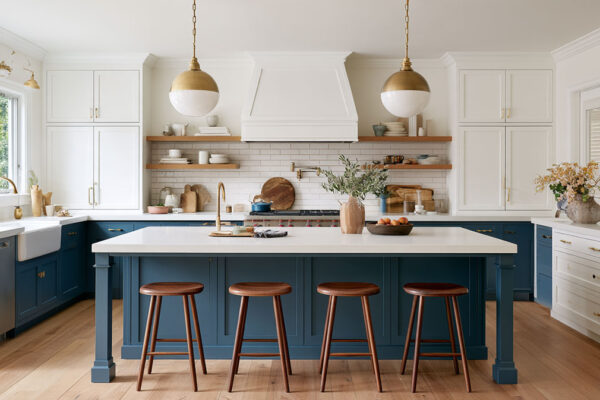
Wood is now the most popular cabinet color in renovated kitchens at 29%, edging past white at 28%, according to Houzz’s 2026 U.S. Kitchen Trends Study. Medium wood leads at 15%, then light at 11% and dark at 3%.
Medium wins because it hides wear and pairs with most countertops. A full wall of wood cabinets can overwhelm, so many kitchens keep wood to the base cabinets or the island (Woodworking Network).
Wall and counter colors come next, and there are worked examples in kitchen color schemes built around wood cabinets.
In the dining area, a solid wood table does the anchoring.
Bedroom
The bed is the anchor.
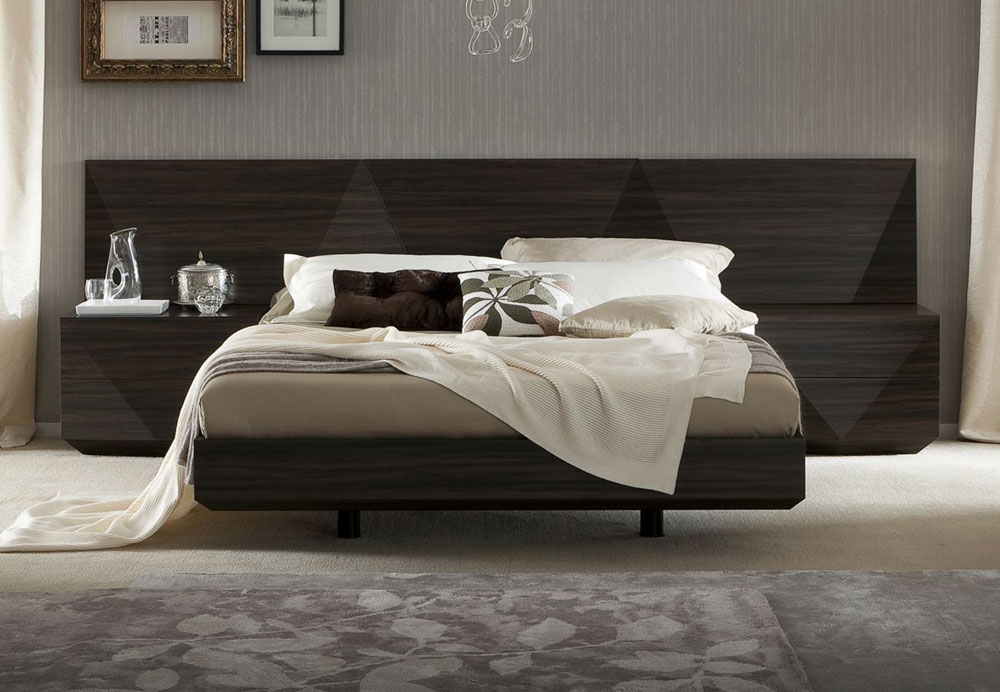
A wood headboard wall or bed frame sets the tone, and calm, even grain suits sleeping better than busy figure. Costway notes that wood furniture warms a bedroom without much decoration.
Keep the bedside tables and wardrobe in the same species so the room stays quiet.
Bathroom
The USDA Wood Handbook recommends 30% to 50% relative humidity in buildings, a range that holds wood at 6% to 9% moisture content.
A bathroom after a hot shower spikes well above that, and wood takes up the moisture and swells. Wood is not waterproof.
A sealed vanity, a mirror frame or shelves are the safe places for it. Teak is the best species here, since Advantage Lumber’s species data rates it among the most decay-resistant woods thanks to its natural oils.
Japanese-style bathrooms center on a hinoki soaking tub, and the details are in this guide to Japanese-style bathroom ideas.
Which interior styles pair best with wood?
Scandinavian, Japandi, rustic, mid-century modern and wabi-sabi all lean on wood, each with its own species and palette. Pick the style first and the species follows.
- Pale oak, ash or pine against white and soft neutrals gives the Scandinavian look.
- Japandi pairs walnut with ash or pale oak, muted clay and mushroom tones, and low furniture.
- Rustic means reclaimed beams, rough grain and visible knots.
- Mid-century modern leans on teak and walnut furniture on slim legs.
- Wabi-sabi wants matte wood that shows its grain, knots and wear.
Pale wood is how the Scandinavian look copes with low daylight. The full logic sits in this overview of Scandinavian interior design.
Japandi blends Scandinavian function with Japanese restraint. Its wood palette is capped at two complementary species, and the Japanese-Scandinavian hybrid shows how that plays out room by room.
Mid-century pieces carry their own warmth, so keep the walls plain around them. Wabi-sabi treats knots and checks as features, not defects.
Materials and colors that sit next to wood
White keeps wood clean and light. Black accents, such as a black-stained coffee table on a white pine floor (Home Network), add graphic depth.
Stone fireplaces and plants push a room toward the natural look, and Asian Paints ties wood and biophilic design together.
Soft textiles balance the hardness, per Wayfair. Metal pieces give relief when a room carries too much wood (Osmoz).
How to mix wood tones so they look intentional
Start with the biggest piece of wood in the room and work outward from there.
- Find the dominant tone. It is usually the floor or the cabinets, or the largest piece of furniture when the room has no built-in wood (The Brick, Studio McGee).
- Match undertones. Studio McGee groups walnut, white oak, cherry and maple as warm, and charcoal, bark and sand stains as cool.
- Set the count. The Brick suggests one light, one medium and one dark tone, while Osmoz caps a room at two or three finishes.
- Repeat each tone at least twice. Room & Board calls this using each wood twice.
- Spread the tones around the room instead of grouping them.
- Add a buffer, such as a rug, textiles or one painted or metal piece.
Osmoz cites a designer rule of thumb of 60% dominant wood, 30% secondary and 10% accent.
Dark pieces bunched at one end tip the balance of the room, which is why the spreading step matters.
Mix or match: where designers disagree
Studio McGee argues that a single wood tone across a room falls flat and prefers contrast. Room & Board goes the other way and treats a fully matched set as a valid choice with strong visual impact. Japandi guidance caps the mix at two species.
The split follows the style. Layered, eclectic rooms want contrast, and minimal rooms read calmer with one or two tones.
What makes a mix fail
Glossy finishes compete for light, especially near strong windows (Osmoz).
Too many tones in one room is the other classic mistake, according to Costway. Photograph the room in three kinds of light and circle the dominant tone before buying anything else.
Choosing a finish: hardwax oil, lacquer, wax, stain or charred
Hardwax oil suits most interior wood where you want a matte, grain-forward look and spot repairs. Lacquer or polyurethane suits surfaces that need a sealed film or higher sheen, stain only changes color, and shou sugi ban gives a black charred look that still needs an oil seal.
Hardwax oil
Hardwax oil is the default pick for floors, tables and wall panels you want to touch.
It highlights the grain and leaves a matte surface (Electrodry), and it has the lowest VOC content of the common finishes (Paneltown). Spot repairs are easy because you sand and reapply only the worn patch.
On the downside, you get less gloss than polyurethane and lower chemical resistance, plus periodic touch-ups.
Rubio Monocoat reports comparable lab abrasion scores against polyurethane. The company sells hardwax oil, so treat that as a vendor claim.
Lacquer and polyurethane
The film sits on top of the wood, so it resists stains and chemicals better than oil and comes in more sheens, matte lacquer included (Paneltown).
The catch is that a damaged film shows across the whole surface, and repair means recoating the room with the furniture out (Rubio Monocoat, Stone Wood Products).
Pick it for cabinet doors and tabletops that take spills. Skip it for a floor you expect to patch.
Wax and stain
Wax is the old method. Paneltown says it needs far more upkeep than hardwax oil, which is why most modern interiors have moved on.
Stain changes color and nothing else, with no protection (Stone Wood Products).
White oak takes stain well, while maple’s hardness makes it harder to stain, according to Floors To Your Home. Every stained surface still needs a clear coat or oil on top.
Shou sugi ban
CharredWood.com, a lumber supplier in Bend, Oregon, sells charred cedar based on a technique more than three centuries old. The board is scorched under a controlled flame, then brushed to the depth you want (Woodworking Network).
The result is a deep black, textured wall that nothing else produces.
Loose char rubs onto skin and clothes, which is why the supplier stresses an oil finish on anything people touch. Brush hard, seal with oil, and keep the look to one feature wall or a single piece of furniture.
Solid, engineered or reclaimed wood: which format fits?
Solid wood suits floors you will refinish for decades, engineered hardwood suits rooms with humidity swings or a concrete slab underneath, and reclaimed wood suits spaces that want character. A Forest Stewardship Council label tells you where the wood came from, not how it will perform.
Solid wood
Hallmark Floors (2026) says solid hardwood expands and contracts dramatically with humidity shifts, which makes it a risky choice over concrete slabs or below grade.
It fits best in main-floor rooms with stable humidity, where a thick board can be sanded again and again.
Engineered hardwood
The wear layer decides everything. The National Wood Flooring Association says a floor considered for refinishing should have a wear layer of at least 3/32 inch (about 2.5 mm), and its guidance in Hardwood Floors magazine (2022) notes that sawn wear layers reach up to 1/4 inch, the same as most 3/4 inch solid floors.
Thin-veneer boards fail that test. Scraped, wire-brushed and sculpted surfaces are extremely difficult to sand, and often cannot be sanded at all, per the same guidance.
A layered core holds its shape better than a single board, so engineered earns its place over slabs and in rooms with seasonal humidity swings.
Reclaimed wood
Reclaimed wood comes from barns, factories and old floors, so every lot carries its own grain, width and wear.
That variety is the appeal, and this guide to what counts as reclaimed wood covers sourcing and grading. Order extra boards, because uneven stock wastes more at the saw.
What Forest Stewardship Council labels verify
The Forest Stewardship Council (FSC) sets standards for how forests are managed and how forest material is used.
FSC 100% means all material comes from FSC-certified forests. FSC Recycled covers material that is entirely reclaimed or recycled, and FSC Mix blends certified, controlled and recycled sources.
A reclaimed product from a certified company falls under the Recycled label. Only certified companies may place FSC labels, and the licence code on the product can be checked through FSC’s claims check.
The label says nothing about hardness, moisture stability or finish. It complements the format choice instead of replacing it.
How much does a wooden interior cost?
Cost runs from a few dollars per square foot for softwood boards to the mid-$20s for premium hardwood, and published ranges for the same job often disagree by a factor of two. Compare full installed quotes, never material prices alone.
These are US dollars per square foot, installed.
- Solid hardwood comes in at $5 to $10 (Thumbtack, updated July 1, 2026, citing Consumer Reports) or $12 to $20 (HomeGnome, 2026).
- Engineered hardwood runs $4 to $9 (Thumbtack) or $8 to $18 (Factory Flooring Liquidators, 2026).
- Reclaimed wood carries a premium of about $2 to $3 more than new material (InchCalculator, 2026).
- Wood wall paneling averages about $20, from $1 to $40 by style (Angi, 2025 data).
Why published prices disagree
Scope explains most of the gap. Rustic Wood Floor Supply counts materials, labor and basic prep, and lands most homeowners between $10 and $16 inside a $6 to $25 range.
Factory Flooring Liquidators warns that a low per-foot price can leave out removal, subfloor repair and trim. The two engineered ranges above overlap only at $8 to $9, so the quote that lists every line item is the one to trust.
Where to spend and where to save
Spend on the floor. It takes all the traffic and sets the base tone for every other wood in the room.
Save on walls and ceilings with shiplap, slat panels or veneer instead of solid hardwood. Angi puts shiplap materials at $1 to $7 per square foot, against that $20 average across all paneling styles.
Run the whole project through a home renovation cost calculator before you commit to a species, because floor, paneling and furniture add up faster than any single line suggests.
When wood does not work indoors
Wood fails in humid rooms, in strong direct sun, and anywhere the conditions cannot be controlled. In each case the fix is a different material in that spot, not a better wood.
Humidity and moisture
At 70 F, the USDA Wood Handbook (Table 4-2) puts equilibrium moisture content at 6.2% when relative humidity is 30% and 13.1% at 70%.
A swing that size moves boards. Lignomat USA lists expansion, cupping, buckling, gaps and mold growth as the results of uncontrolled humidity.
That rules out shower surrounds and floors beside tubs, rooms with a humidifier running all winter, and kitchens where cooking steam has no extraction.
Sunlight and fading
Sunlight changes wood color, and the sources disagree on which way oak goes.
Bauwerk, a parquet maker, says oak goes a little darker and maple turns golden. Consumer Reports lab testing found oak taking on an amber tone.
Alex Wiedenhoeft of the USDA Forest Products Laboratory writes that oak and hickory can lighten in direct sun. He adds that virtually all wood fades toward silvery gray if left unprotected.
Exposure time and finish differ between those sources, and none of them explains the split. Wiedenhoeft also notes that a finish without UV blockers does not stop the change, and that deep color shifts cannot always be sanded out.
- Choose a finish with UV inhibitors (Floor Coverings International).
- Rotate rugs and furniture so the floor ages evenly.
Filter the light too, with window treatments such as sheers or blinds on the sunniest windows.
What to use instead
| Problem | What wood does | Better material |
|---|---|---|
| Standing water or steam | Swells, cups, grows mold | Porcelain tile |
| Direct sun all day | Shifts color, bleaches | Tile or UV-coated vinyl |
| Concrete slab or below grade | Moves with ground moisture | Engineered hardwood |
If you switch a wet room to tile, a tile calculator sizes the order and the waste.
Wooden interior design ideas FAQ
What counts as wooden interior design?
Timber on floors, walls, ceilings and furniture, used to bring in warmth, grain and natural color. It ranges from a single statement piece to a fully paneled room.
Does wood make a small room look smaller?
Not when the tone is light and the wood stays on one or two surfaces. A pale oak floor or a single slat wall widens a small room.
Dark wood on the floor, walls and ceiling together closes it in.
Can veneer or laminate give the same look as solid wood?
Veneer can, laminate mostly cannot. Veneer is a thin slice of real wood glued to a stable core, so it carries real grain and feel.
Laminate prints a wood image on a synthetic surface and cannot be refinished.
Is dark wood out of style?
No, but it works best as an accent. Walnut keeps dark wood current in Japandi and mid-century rooms, while dark wood across every surface of a room is the risky use.
Does a wood ceiling reduce echo?
Only with an absorbent backing. Slat panels over acoustic felt soak up sound.
A bare plank ceiling is a hard surface and reflects it.
Which wood is best for a staircase?
White oak or hard maple suits the treads, since stairs take concentrated wear. Walnut fits handrails and details that see little impact.
Match the tread wood to the dominant tone of the floor it meets.
Which Wood Change Should Come First?
For wooden interior design ideas, start with whatever sets the dominant tone. In a renovation that is the floor, and otherwise it is the existing floor or cabinets. Furniture is the only layer you can still swap later to fit.
After that comes one feature surface, a slat wall or beams, and then the movable pieces like tables, chairs and shelving.
Per square foot, wall paneling averages about $20 (Angi), double the $10 top of Thumbtack’s installed floor ranges. A feature wall covering under half the floor area therefore costs less in total than a $10-per-foot floor quote, and against a $5 quote it has to stay under a quarter of the floor area.
The trade-off is a room that looks unfinished for a few months while furniture waits for the floor.
Once the floor tone is set, the next decision is wall color, and the paint colors that suit wood floors narrow that choice quickly.

- Kitchen Color Schemes by Cabinet Color: What Pairs Well - October 19, 2026
- Curtain Colors for Every Wall Color: Safe vs Bold Picks - October 18, 2026
- Interior Design Styles: Find Your Primary and Secondary - October 14, 2026