

Your home should feel like yours. Not a catalog page, not a staged showroom.
Boho style home decor does exactly that: it layers natural materials, global textiles, earthy tones, and handmade objects into spaces that feel collected rather than coordinated.
This guide covers everything from the core color palette and material choices to room-by-room application and budget-friendly sourcing.
Whether you are starting from scratch or refining an existing space, you will find practical, specific guidance on building a bohemian interior that actually looks intentional.
What Is Boho Style in Home Decor
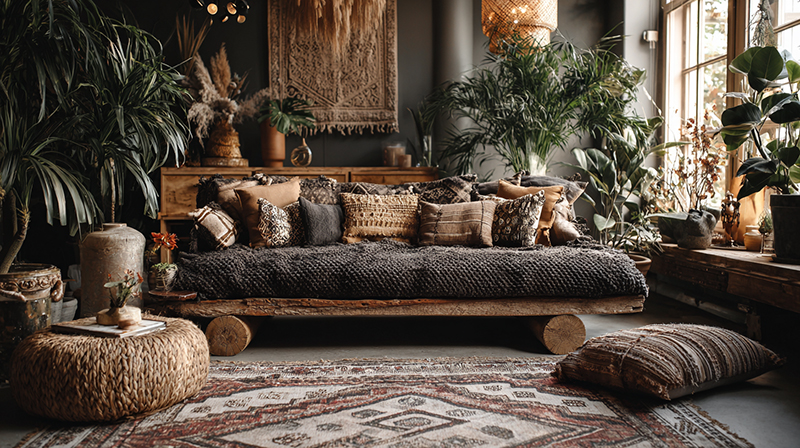
Bohemian interior design is a free-spirited, collected aesthetic that layers global textiles, natural materials, and warm, earthy color against a backdrop of handmade and vintage objects. It draws from 1960s and 1970s counterculture, nomadic traditions, and artist studio culture, prioritizing personal expression over coordinated sets.
The result is a space that feels lived-in and intentional at the same time.
Boho is not the same as maximalism, though they overlap. The key difference is restraint in purpose: every object in a boho interior is there because it means something or adds tactile interest, not just to fill space. And unlike eclectic interior design, which mixes styles with no fixed anchor, boho keeps a consistent warmth through its color palette and material choices.
The global home decor market was valued at USD 960.14 billion in 2024, growing at a projected CAGR of 9.4% through 2030 (Grand View Research). Within that, the home textiles segment is growing fastest, which tracks directly with how boho spaces are built: layered rugs, throw blankets, cushions, and woven wall art are often the first purchases people make when styling this way.
Boho vs. Bohemian vs. Boho-Chic: Is There a Difference?
Bohemian refers to the broader cultural and artistic movement, rooted in unconventional living.
Boho is the shorthand version used in interior design contexts, typically referring to the residential styling interpretation.
Boho-chic signals a polished version of the aesthetic, usually incorporating cleaner lines, a tighter color palette, and fewer objects. It is closer to what most interior designers mean when they reference modern bohemian interior design.
All three share the same foundation: natural materials, warm tones, layered textiles, and a mix of patterns and cultures.
| Term | Tone | Typical Room Density |
|---|---|---|
| Bohemian | Maximalist, expressive | High – many objects, layers |
| Boho | Relaxed, collected | Medium – curated density |
| Boho-chic | Refined, minimal edge | Lower – edited, airy |
The Core Color Palette of Boho Interiors

Boho color starts with a warm neutral base, then layers in deeper saturated tones as accents. The goal is a palette that feels warm without being dark, and colorful without being loud.
Getting this balance right is genuinely where most people struggle.
Base Neutrals
Terracotta, camel, and warm white form the foundation of most boho rooms. These are not cool-toned grays or blue-whites. They read warm under both natural and artificial light, which is what gives boho spaces their characteristic cozy feel.
Sand and rust sit in the same family. Both work well on walls, large upholstered pieces, and linen curtains. Colors that pair well with tan tones include mustard, sage green, and deep teal, all of which appear frequently in boho color schemes.
According to a Global Well-Being Research Consortium study, 63% of consumers in 2023 associated improved mood and relaxation with high-quality natural fiber textiles. Warm neutrals in these materials reinforce exactly that connection.
Accent Colors and How to Use Them
Mustard yellow is probably the most recognizable boho accent. It reads well against terracotta and warm white, and works in cushions, throw blankets, and ceramics without overwhelming a room.
Deep teal provides contrast. It is cool enough to balance the warmth of the base palette, but saturated enough to feel intentional rather than accidental. Understanding what works alongside teal matters here, since pairing it poorly with a boho warm base will make the room feel inconsistent.
Sage green and burnt orange round out the standard boho range. Sage is the calmer choice; burnt orange pushes the palette toward richer, more layered territory. Both work better as secondary accents than as dominant wall colors.
For rooms leaning into jewel tones, deep burgundy or forest green can work. But these tip toward bohemian maximalism territory quickly, so use them sparingly.
| Color | Role in Palette | Best Applied To |
|---|---|---|
| Terracotta / camel | Base neutral | Walls, large upholstery, rugs |
| Mustard yellow | Primary accent | Cushions, throws, ceramics |
| Sage green | Secondary accent | Planters, small textiles, art |
| Deep teal | Contrast accent | Statement pillows, rugs |
| Burnt orange | Warm depth accent | Throws, wall art, accessories |
Earthy color palettes for interior design generally follow the same logic: warm neutrals first, saturated accents second, cool tones used sparingly for contrast. Colors that complement burnt orange include deep teal, warm white, and brown, all of which land squarely in the boho toolkit.
Boho Textiles and How to Layer Them

Textiles are the defining element of boho decor. More than furniture or color, they are what makes a space read as bohemian rather than just eclectic. The layering approach matters more than any individual piece.
Retailers have clearly caught on: the global carpet and rug market was estimated at USD 51.87 billion in 2025 (Statista), and the home textiles segment broadly is forecast to grow at a 9.4% CAGR through 2033 (Market Data Forecast).
Rugs: The Foundation Layer
Start with a large base rug in a neutral tone. Jute, natural-weave cotton, or a flat-woven solid in oatmeal or camel work best here. This becomes the visual anchor.
Layer a smaller patterned rug on top: a kilim, Moroccan-inspired design, or Persian-style piece in deeper tones. The size difference matters. The base should extend well beyond the furniture footprint; the layered piece sits centrally and acts as the visual focus. Placing rugs correctly under sectional sofas and other large furniture changes how the layering reads from across the room.
Mixing textures within the rug layers, such as pairing a flat-woven jute with a higher-pile woven piece, adds visual depth without adding more color.
Cushions, Throws, and Curtains
Cushion mixing is the area where most people either get boho right or get it very wrong. The rules are loose but not nonexistent:
- Mix sizes deliberately. Square, rectangular, and round cushions together look intentional. All the same size looks like a hotel.
- Mix patterns within the same color family. Stripes, florals, and geometric prints can coexist if they share at least one color.
- Fringe, tassels, and embroidery add the tactile element that flat printed covers cannot.
Throw blankets should have texture. Chunky knit, macrame, and loosely woven cotton all work. Avoid synthetic fleece, which reads as too polished for the aesthetic.
Curtains in boho spaces are almost always sheer linen or gauze. Heavy drapes block the light in a way that fights the warm, layered atmosphere. Window treatments in boho rooms let light filter through rather than controlling it with blackout fabric. Floor-to-ceiling natural linen panels are the most common choice.
For sofa cushion combinations, the approach depends heavily on the couch color. Throw pillow ideas for a beige couch generally work across warm neutrals, ethnic prints, and textured solids, which all fit naturally into a boho layering scheme.
Natural Materials That Define the Boho Look

The material palette of boho decor is what connects it to biophilic interior design principles: prioritize materials that come from the earth and read as such. Synthetic substitutes do not achieve the same effect.
Eco-friendly furniture residential use accounted for 54.4% of the global market in 2025 (Grand View Research), driven by consumers choosing natural materials over synthetic alternatives. Boho decor and sustainable sourcing are increasingly the same conversation.
Rattan and Wicker
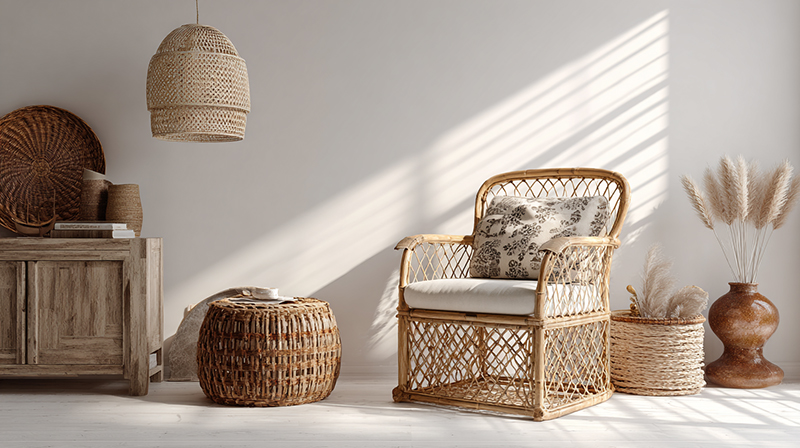
Rattan is one of the most versatile materials in boho styling. It works in chairs, pendant lights, mirrors, baskets, and storage. The global rattan furniture market is experiencing strong growth as consumers shift toward sustainable, handmade options (Qalara, 2025).
What makes rattan specifically useful in boho spaces is its visual lightness. A rattan armchair adds texture and presence without the visual weight of a solid wood or upholstered piece.
Stores like Serena and Lily, Pottery Barn, and World Market all carry rattan collections. Target’s Studio McGee line regularly includes rattan accent pieces at lower price points.
Raw Wood, Jute, and Stone
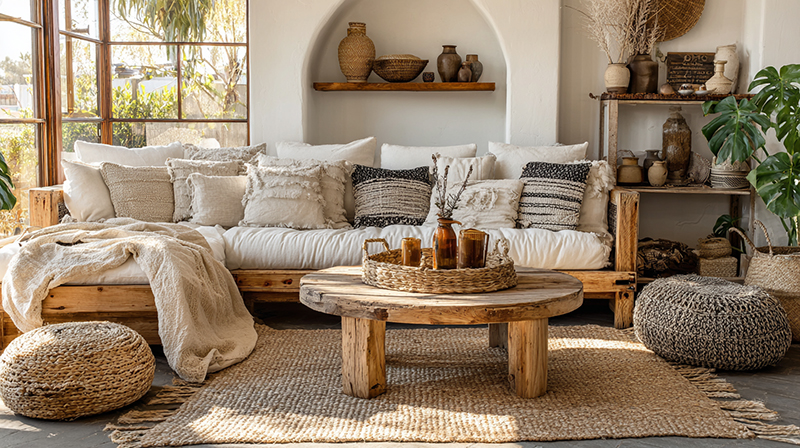
Raw or reclaimed wood shows up in coffee tables, bed frames, shelving, and decorative trays. The grain and imperfections are the point. Sanded-smooth, lacquered finishes work against the handmade quality boho spaces rely on.
Jute works primarily in rugs and woven baskets. It is coarser than cotton and less refined than wool, which makes it ideal as a base texture layer. Seagrass behaves similarly.
Terracotta pots, raw clay vessels, and stone accents complete the material picture. These work as planters, decorative objects, and accent pieces throughout a room. The imperfection of hand-thrown ceramics reads authentically within this aesthetic in a way that mass-produced glazed pottery does not.
Linen and organic cotton handle soft furnishings: curtains, bedding, cushion covers, and upholstery. These materials wrinkle naturally, which adds to the relaxed, lived-in quality of a well-styled boho interior.
Boho Furniture Choices and Room Layout
Furniture selection in boho spaces follows a few clear principles: stay low, avoid matching sets, and mix time periods.
According to Opendoor’s 2024 report, U.S. consumers spend an average of USD 1,598 on home decor purchases annually. Within boho styling, a significant portion of that typically goes toward textiles and statement furniture pieces rather than full matching room sets.
Low-Profile and Floor-Level Seating
Floor cushions, poufs, and low-slung sofas are the most characteristic furniture choices in boho living rooms and bedrooms. They create a casual, ground-level atmosphere that higher furniture does not.
Poufs double as side tables or additional seating. A leather or woven cotton pouf placed near a low sofa is one of the fastest ways to signal the boho aesthetic without purchasing new furniture. Pouf seating ideas for boho rooms tend to work best when paired with layered rugs underneath.
Ottoman seating follows the same logic. Ottoman ideas in boho spaces typically involve fabric-covered or woven pieces, not smooth leather or hard-edged contemporary styles.
Mixing Vintage and Contemporary Pieces
Boho rooms almost never contain furniture from a single source or era. The aesthetic depends on the collected-over-time quality that matching sets cannot replicate.
Antique furniture costs about 80% less than comparable new pieces on average (SwiftBeacon, 2024), which makes thrift stores and antique markets natural entry points for boho styling. A vintage sideboard paired with modern cushions and a contemporary rug reads as intentionally boho in a way that a coordinated room set never will.
Brands like Anthropologie, World Market, and West Elm offer boho-adjacent new furniture. IKEA pieces often work as neutral backdrops, particularly shelving and bed frames, that can be styled with boho textiles and accessories.
Upcycled furniture fits naturally into boho aesthetics. A repainted vintage chair, a refinished side table, or a recovered bench all carry the handmade quality that defines the style. This also connects to the broader sustainable design trend that runs through most boho sourcing decisions.
Layout Principles
Symmetrical furniture arrangements work against the boho aesthetic. The style reads better with conversation-focused, slightly irregular layouts.
A practical approach: anchor the seating around a central rug, position the largest piece (usually a sofa or daybed) off-center if the room allows, and use a mix of low and slightly higher accent pieces to create visual variation. Space planning in interior design for boho rooms focuses on flow and comfort rather than formal balance.
Living room design ideas in the boho direction consistently favor layering over arrangement precision. The room should look like it evolved over time, not like it was delivered and staged in a single day.
Plants and Greenery in Boho Decor

Plants are not optional in boho decor. They are structural to the aesthetic in the same way textiles are: they add organic form, texture, and the sense of a living, breathing space that no object can replicate.
Etsy searches for macrame rose more than 400% in 2024 (RainPOS via Seed Sheets, 2025), partly driven by demand for macrame plant hangers as boho plant display tools. Indoor plant styling and boho decor are tightly linked in how consumers search and shop for both.
Trailing and Hanging Plants
Pothos, string of pearls, and ivy are the workhorses of boho plant styling. They trail naturally, look good in macrame plant hangers, and are forgiving for people who do not have a careful watering habit.
Macrame hangers are the most boho-specific display choice. Hanging two or three at different heights near a window creates a vertical green element that adds depth to an otherwise flat wall. Macrame wall hanging ideas for plants typically work in odd-numbered groupings, positioned at varying heights for visual rhythm.
Floating shelves are the alternative display method. A row of trailing plants at window height, in terracotta or ceramic pots, achieves a similar effect. Rustic shelving ideas in reclaimed wood or raw timber work particularly well as plant display surfaces in boho rooms.
Statement Plants and Dried Botanicals
Monstera, fiddle-leaf fig, and bird of paradise are the three most common statement plants in boho interiors. Each provides a large organic shape that reads as sculptural.
These work best when clustered with smaller plants rather than placed in isolation. A monstera alongside a basket of pothos trailing and a small terracotta succulent grouping creates the layered, abundant quality boho plant styling aims for. Indoor plant ideas for boho rooms almost always involve groupings rather than single specimens.
Pampas grass and dried botanicals add texture without maintenance requirements. Dried pampas grass in a tall terracotta or ceramic vessel is one of the most popular boho decor choices of the last several years, and it reads well alongside both fresh plants and natural material furniture. It has staying power precisely because it sits between decor object and plant, fitting both categories.
Container choices matter as much as plant selection. Terracotta pots, woven baskets as pot covers, and vintage ceramic vessels all reinforce the natural material palette of a boho room. Standard plastic or white ceramic nursery pots undercut the aesthetic immediately, regardless of what is growing in them.
Boho Wall Decor and Art

Walls in boho spaces carry as much visual weight as the floor. Bare walls work against the layered, collected quality the style depends on.
Fabric-based wall hangings (tapestries, macrame, and woven textiles) account for an estimated 18-20% of the wall art market in 2024, with a projected CAGR of 5.5% through 2035, according to Future Market Insights. Growth is concentrated specifically in North America and Europe, where boho and eclectic interior themes are most active.
Gallery Walls the Boho Way
Boho gallery walls are defined by mix over match. The goal is a wall that looks like it accumulated over time, not one that was ordered as a set.
What to mix:
- Frame sizes and finishes: ornate gold, raw wood, thin black metal
- Mediums: prints, original artwork, vintage photos, mirrors, small woven pieces
- Orientations: landscape and portrait together
Avoid uniform grid arrangements. Organic, asymmetric layouts with uneven spacing read as more authentically boho than perfectly spaced rows.
Anthropologie and Urban Outfitters have built entire product lines around fabric-based hangings as gallery wall anchors. Both brands treat macrame as a centerpiece piece, not an add-on.
Macrame, Tapestries, and Woven Textiles
Google Trends data shows searches for “boho macrame wall hanging” surged from a baseline of zero in August 2024 to a peak of 100 by August 2025, with a secondary spike of 94 in December 2024 (Accio, 2025).
Scale matters here. A small macrame piece gets lost on a full wall. One large, well-placed macrame hanging reads as a statement and acts as the visual anchor for everything else around it. Boho wall art ideas that work best in this category consistently use oversized pieces, not clustered small ones.
Tapestries work similarly. A global-inspired textile hung directly on a wall as art, without a frame, reads as far more intentionally boho than a mass-produced canvas print.
Mirrors and Vintage Accents
Vintage mirrors with rattan, ornate metal, or hammered brass frames add reflective depth without adding more visual complexity. They work particularly well alongside gallery walls, where a mirror breaks the all-flat-surface quality of prints and art.
Dream catchers occupy a specific niche within boho wall decor. Dream catcher ideas for wall display work best when grouped in sets of two or three at varying heights, using natural cord and feather materials rather than synthetic versions.
One practical rule: skip mass-produced matching print sets. The matched set look works against the collected quality that makes boho wall arrangements feel personal.
Boho Lighting: Layered and Warm

Lighting is where most boho rooms succeed or fail without the owner realizing why. Cool-white recessed lighting will undercut everything else in a well-styled boho room. The atmosphere depends on warm, layered, low-level light.
The global decorative lighting market was valued at USD 41.60 billion in 2024, growing at a 2.9% CAGR through 2030 (SwiftBeacon). Consumer preference for ambient, mood-focused lighting over functional overhead lighting has accelerated since 2020, with 96% of designers surveyed by aspectLED noting pandemic-driven shifts toward warmer residential lighting choices.
Pendant Lights: The Statement Fixture
Rattan pendant lights are the most characteristic boho lighting choice and have remained consistently popular through 2024 and 2025. Their open-weave construction filters light in a way that creates soft shadow patterns on walls and ceilings, which adds atmosphere at no additional cost.
Best applications by room:
- Dining room: single large pendant or a cluster of three at varying heights over the table
- Kitchen island: two smaller pendants spaced evenly
- Bedroom: one bedside pendant replacing a table lamp, freeing up nightstand space
Pendant lighting in boho spaces almost always uses warm-toned bulbs. Edison-style bulbs in particular pair well with macrame and rattan fixtures, reinforcing the vintage, handmade aesthetic.
Moroccan lantern-style pendants are the other main category. Pierced metal with warm amber or red-toned glass creates a completely different effect from rattan, but both sit within the boho material palette.
Ambient and Accent Layers
String lights do real work in boho spaces. Not as decoration, but as a genuine ambient light source. A strand draped along a shelf, around a canopy bed frame, or above a reading nook adds warmth that no overhead fixture can replicate.
Ambient lighting in boho rooms comes from multiple low sources working together: a floor lamp in one corner, string lights near the ceiling line, table lamps at eye level, and candles adding flicker. No single bright overhead fixture. The approach mirrors what accent lighting achieves in formal design contexts, but applied casually throughout the room.
Candles and lanterns are not optional accents in boho rooms. They are functional light sources. Grouped candles on a tray, lanterns on the floor beside a sofa, or a cluster of pillar candles on a mantle all add to the layered light approach that defines this aesthetic. The flickering quality they introduce is something no electric source replicates.
One practical note: avoid recessed lighting as the primary source in a boho space. It creates flat, directional light that works against the warm, enveloping atmosphere. If a room has recessed fixtures already, supplement heavily with lower-level warm sources and dim the overheads as far as possible.
Floor Lamps and Natural Bases
A floor lamp with a rattan, driftwood, or natural stone base and a linen or jute shade works as both a light source and a decor object. This is where task lighting in boho rooms differs from conventional task lighting: the fixture itself contributes to the aesthetic rather than just serving function.
What to avoid: Polished chrome or brushed nickel finishes, cool white bulbs, and any fixture that reads as contemporary-minimalist. These fight the warm, organic material palette of the room.
How to Decorate Specific Rooms in Boho Style
Boho principles apply across every room, but the execution differs by space. The priorities shift depending on what the room is used for and how much furniture and surface area it contains.
| Room | Primary Focus | Key Boho Elements |
|---|---|---|
| Bedroom | Layered textiles, intimate lighting | Canopy bed, macrame headboard, layered bedding |
| Living room | Seating variety, rug layering | Mixed cushions, gallery wall, plant clusters |
| Bathroom | Natural accessories, plants | Rattan accents, open shelving, dried botanicals |
| Balcony/outdoor | Casual seating, warm light | Floor cushions, string lights, hanging plants |
Boho Bedroom Decor

The bed is the architectural anchor. Everything else builds around it.
Canopy beds and macrame headboards are the most distinctly boho bedroom choices. A canopy bed with sheer linen draping creates an enveloping, low-light quality. A macrame headboard achieves a similar visual effect at lower cost. Canopy bed ideas in boho bedrooms consistently use natural, undyed, or raw linen rather than structured, formal draping.
Bedding layering follows the same textile logic as the living room: a base layer in a warm neutral linen or cotton, then a patterned quilt or duvet in earthy tones, then throw blankets and mixed cushions on top. Bohemian bedroom decor built this way creates the layered, welcoming quality the aesthetic depends on.
Low bed frames, ideally in raw or reclaimed wood, reinforce the ground-level, relaxed atmosphere. Platform beds and floor-level mattress setups both work. High-clearance traditional bed frames do not.
Boho Living Room Decor
Rug layering anchors the seating area. Gallery wall anchors the main wall. Plants fill the corners. That is the structural logic of a boho living room.
Bohemian living room design ideas work best when the seating arrangement is conversation-focused rather than television-focused. Angling a sofa slightly, adding floor cushions and a pouf, and placing seating at multiple heights creates the casual, relaxed grouping that reads as authentically boho. Eclectic living room decor follows a similar approach, though without boho’s specific material and color constraints.
What gets the gallery wall wrong: ordering matching sets, using uniform frames, centering everything perfectly. Get comfortable with asymmetry. Asymmetry in interior design is one of the core visual tools in boho styling, especially on walls.
Boho Bathroom Decor
Bathrooms are where boho styling is most often overlooked and most impactful when done right.
Three changes that convert a standard bathroom to boho:
- Replace chrome or plastic accessories with rattan, bamboo, or terracotta equivalents
- Add one or two plants (pothos, ferns, or air plants all tolerate bathroom humidity)
- Switch to open shelving in raw wood or metal, styled with natural soaps, ceramic vessels, and folded linen towels
Dried pampas grass or eucalyptus in a tall vase adds organic texture without requiring light or watering. It reads as decorative rather than functional, which is exactly the point. The ikat pattern on a bath mat or hand towel pulls in the global textile element that defines boho without requiring a full renovation.
What is an ikat pattern? It is a resist-dyeing technique originating across Central Asia, Southeast Asia, and Latin America that creates blurred, feathered geometric designs. It appears frequently in boho textiles because its handmade quality reads as authentic rather than mass-produced.
Budget-Friendly Ways to Get the Boho Look

Boho is one of the few interior styles that actually rewards a limited budget. The collected, layered aesthetic depends on pieces that look like they came from different places and times. New, matched sets work against it.
Price is the top reason consumers buy home decor online, with 55.45% prioritizing affordability and 54.03% valuing the time savings of online shopping, according to SwiftBeacon’s 2024 analysis. Boho’s reliance on secondhand and handmade pieces puts it directly in line with how most budget-conscious shoppers already approach decor.
Thrifting and Vintage Sourcing
Rattan furniture, kilim rugs, woven baskets, ceramic vessels, and vintage mirrors are the best boho items to source secondhand. All of these improve visually with age and wear, which means thrifted versions often look better in a boho context than brand-new equivalents.
Where to look:
- Facebook Marketplace and eBay for rattan chairs, vintage rugs, and furniture
- Etsy for handmade macrame, ikat textiles, and artisan ceramics
- Thrift stores for ceramic vessels, woven baskets, and vintage frames
- Estate sales for kilim rugs, global textiles, and unique furniture pieces
Antique furniture costs about 80% less than comparable new pieces on average (SwiftBeacon, 2024). In boho styling, that price advantage comes with an aesthetic advantage too: the worn, storied quality of a vintage find reads more authentically than anything purchased new.
DIY Macrame and Handmade Accents
DIY craft kit sales grew 35% in 2024, driven significantly by macrame kits (RainPOS via Seed Sheets, 2025). Macrame wall hangings made from natural cotton cord typically cost USD 15-40 in materials versus USD 80-400 for comparable retail pieces.
Basic macrame knots take an afternoon to learn. A large wall hanging takes a weekend. The result is a piece that is genuinely handmade, which reads very differently on a boho wall than a mass-produced version.
Vintage furniture ideas extend the DIY approach beyond textiles. Repainting a thrifted chair in terracotta or sage green, replacing hardware on an old dresser with rattan or ceramic pulls, and reupholstering a bench seat in a woven linen fabric are all achievable projects that add far more character than buying new.
Where to Prioritize Spending
Not everything needs to be thrifted or DIY. Some items are worth buying new because quality matters for longevity or visual impact.
Spend on: A quality jute or kilim base rug (it anchors the whole room), one statement rattan pendant light, and live plants with proper terracotta or ceramic pots.
Save on: Cushion covers (mix cheap and vintage), wall art (thrift frames and use Etsy prints), baskets and storage (thrift stores are full of them), and candles (any brand works at the right price point).
Retailers like IKEA, Target’s Studio McGee line, and H&M Home all carry boho-adjacent pieces at accessible prices. Apartment decorating ideas in the boho direction frequently use IKEA as a neutral base, layered with thrifted and handmade textiles and accessories. The IKEA pieces provide structure; the layered pieces provide character. That combination works consistently because boho is not about any individual piece. It is about how everything sits together.
Vintage home decor and boho style share enough DNA that sourcing for one naturally feeds the other. Both prioritize collected objects over coordinated sets, handmade quality over mass production, and warm natural materials over synthetic alternatives. A boho space built primarily through thrifting and DIY will often look more authentic than one assembled entirely from retail.
FAQ on Boho Style Home Decor
What is boho style in home decor?
Boho style is a free-spirited, layered aesthetic built on natural materials, global textiles, earthy tones, and handmade objects. It prioritizes personal expression over matching sets, drawing from bohemian culture, nomadic traditions, and artist studio living.
What colors are used in boho home decor?
The base palette runs on warm neutrals: terracotta, camel, sand, and warm white. Accent colors include mustard yellow, sage green, deep teal, and burnt orange. Jewel tones appear occasionally but push the look toward maximalism when overused.
What materials define the boho aesthetic?
Rattan, jute, raw wood, linen, and organic cotton are the core materials. Terracotta, seagrass, and woven cotton appear throughout. Synthetic substitutes do not achieve the same effect. Natural, imperfect, and handmade materials are the point.
How is boho different from eclectic decor?
Both mix styles freely, but boho stays anchored in warmth, natural materials, and a consistent earthy palette. Eclectic interior design has no fixed material or color anchor. Boho feels collected over time; eclectic feels deliberately varied.
What furniture works best in a boho room?
Low-profile pieces work best: floor cushions, poufs, low-slung sofas, and rattan chairs. Mismatched vintage finds outperform matching sets every time. The furniture should look like it came from different places and different eras.
How do you layer rugs in a boho space?
Start with a large neutral base rug in jute or flat-woven cotton. Layer a smaller patterned kilim, Moroccan, or Persian-style rug on top. Placement under furniture matters: the base rug should extend well beyond the seating footprint.
What plants suit a boho interior?
Monstera, pothos, fiddle-leaf fig, and string of pearls are the most common choices. Display trailing plants in macrame hangers, statement plants in terracotta pots, and dried pampas grass as a low-maintenance texture accent throughout the room.
How do you light a boho room correctly?
Layer multiple warm light sources: rattan or Moroccan pendant lights, string lights, floor lamps with natural bases, and candles. Avoid cool-white recessed lighting as the primary source. Warm, low-level, layered light is what creates the boho atmosphere.
Can you achieve boho style on a budget?
Yes. Boho actually rewards budget sourcing. Thrift stores, Facebook Marketplace, and Etsy are the best places to find rattan furniture, vintage rugs, and handmade textiles. DIY macrame wall hangings cost USD 15-40 in materials versus USD 80-400 at retail.
Is boho style still popular in 2025?
Yes. Search interest for boho macrame wall hangings hit a Google Trends peak of 100 in August 2025. The style has shifted toward a more refined, modern boho direction, incorporating cleaner lines and sustainable natural materials alongside the classic layered textile aesthetic.
Conclusion
This conclusion is for an article presenting boho home decor as a style built on intention, not impulse buying.
Rattan furniture, kilim rugs, macrame wall hangings, layered textiles, and indoor plants all contribute to a space that feels genuinely lived-in.
None of it requires a large budget. Thrifting, DIY, and selective sourcing from places like Etsy or World Market get you further than purchasing a matched set ever will.
The earthy color palette, natural materials, and global-inspired accents work together because they share the same warmth and handmade quality.
Start with one layer: a jute rug, a terracotta pot, a macrame hanging. Build from there. Bohemian interior design rewards patience more than spending.

- Paint Colors That Go with Gray Floors - August 20, 2026
- What Color Bedding Goes with Dark Wood Furniture - August 18, 2026
- What Color Walls Go with Oak Floors - August 16, 2026


